January time machine: Historical headlines
From the Time machine special sections series
-
Johanna Eubank
Online producer
- Updated

Past January headlines involved two planes crashing or landing in rivers, two deadly blows to the space program, the news that cigarettes cause cancer and a mass shooting in Tucson.
Introduction
Updated
Today the Arizona Daily Star offers a look back at some front pages that appeared in Januarys throughout the newspaper’s history. Some had big national or international news on the cover. Sometimes the big news was local.
Unfortunately, bad news makes the headlines much more often than good news. Big news in January involved two planes crashing or landing in rivers, Two deadly blows to the space program, the news that cigarettes cause cancer and a mass shooting in Tucson.
A single newspaper page earlier in the 20th century was much wider than they are today. To be able to print the entire page, we have been forced to shrink them so that they are too small for many to read. The center of this section shows a page that is much closer to the original size. On other pages where the reproduction is smaller, we've reprinted at least part of the stories we've highlighted.
See more at newspapers.com
If you want to be able to read the entire pages here, consider subscribing to newspapers.com where you can then download PDFs of pages that you can enlarge or clip stories of interest.
The Star began publishing in 1877. Most of the Star’s editions are available beginning in 1879 on Newspapers.com. Go to tucson.com/archives to learn about subscribing to the collection of more than 2 million pages.
Time machine newsletter
The Star has a throwback email newsletter, where we send snapshots of Tucson history to your inbox every Thursday. Sign up at tucson.com/timemachine
Jan. 23, 1901: Queen Victoria has died
Updated
Download a PDF that you can enlarge for easier reading
EDWARD VII
Now Reigns Over England ─ The Queen Passes Peacefully Away.
Cowes, Isle of Wight, Jan. 23. ─ Queen Victoria is dead and Edward VII reigns. The greatest event in the memory of this generation, the most stupendous change in existing conditions that could possibly be imagined has taken place quietly, almost gently, upon the anniversary of the Queen's father, the Duke of Kent. The end of this career never equaled by any woman in the world's history came in a simply furnished room in Osborne House. This most respected of women lying now dead lies in a great four-posted bed and made a shrunken atom, whose aged face and figure were a cruel mockery of the fair girl who in 1837 began to rule over England. Around her were gathered almost every descendent of her line. Well within view of her dying eyes there hung a portrait of the Prince Consort. It was he who designed the room and every part of the castle. In scarcely audible words the white-haired Bishop of Winchester prayed beside her as he had often prayed with his sovereign for he was Chaplain at Windsor. With bowed heads the imperious ruler of the German Empire and the man who is now King of England, the woman who has succeeded to the title of "Queen," the Prince and Princess and those of less than royal designation, listened to the Bishop's ceaseless prayer.
Six o'clock passed and the bishop continued his intercession. One of the younger children asked a question in a shrill, child-like treble and was immediately silenced. The women of this royal family sobbed faintly and the men shuffled uneasily.
At exactly half-past six, Sir James Reid held up his hand and the people then knew that England had lost her Queen. The Bishop pronounced the benediction.
The Queen passed away quite peacefully. She suffered no pain. Those who were now mourning went to their rooms. A few minutes later the inevitable element of materialism stepped into this pathetic chapter of international history, for the Court dames went busily to work ordering their mourning from London. The wheels of the world were jarred when the announcement came, but in this palace at Osborne everything pursued the usual course. Down in the kitchen they were cooking a large dinner for an assemblage the like of which has seldom been known in England, and dinner preparations proceeded just as if nothing had happened.
The body of the Queen was embalmed and will probably be taken to Windsor on Saturday. The coffin arrived last evening from London. The Prince of Wales was very much affected when the doctors at last informed him that his mother had breathed her last. Emperor William himself was deeply affected, but did his best to minister comfort to his sorrow-stricken uncle, whose new dignity he was the first to acknowledge. From all parts of the world there are still pouring into Cowes messages of condolence. They come from crowned heads, millionaires, tradesmen and paupers and are variously addressed to the Prince of Wales and King of England.
Emperor William's arrangements are not settled. His coach will arrive here today (Wednesday), but it is believed that he will not depart until after the funeral.
Note: Emperor William is also known as Kaiser Wilhelm II. He was the son of Frederick III of Germany and Victoria, the eldest child of Queen Victoria of England. His 42nd birthday was a few days after Queen Victoria's death.
Jan. 7, 1919: Theodore Roosevelt has died
Updated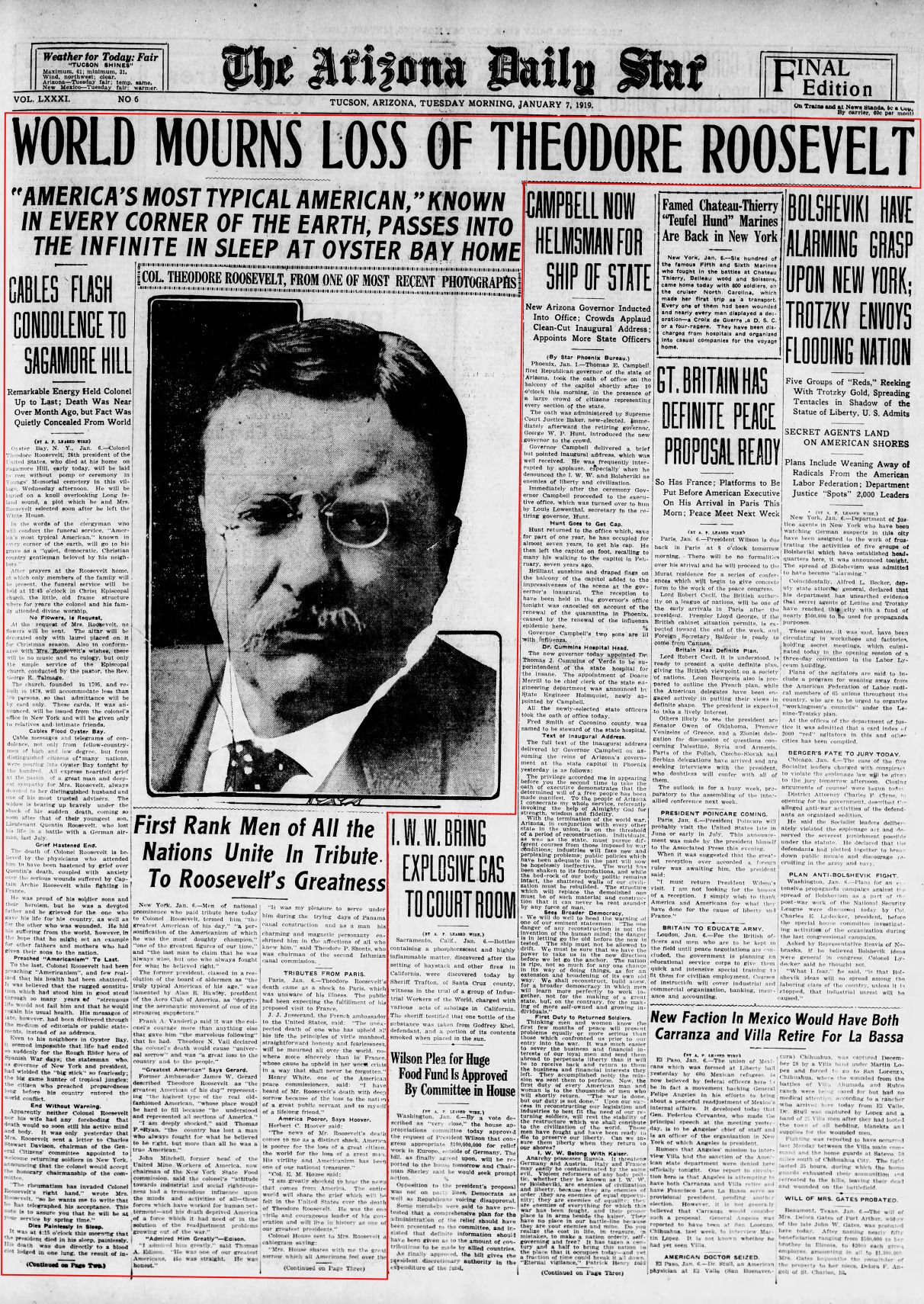
Download a PDF that you can enlarge for easier reading
WORLD MOURNS LOSS OF THEODORE ROOSEVELT
"AMERICA'S MOST TYPICAL AMERICAN," KNOWN IN EVERY CORNER OF THE EARTH, PASSES INTO THE INFINITE IN SLEEP AT OYSTER BAY HOME
CABLES FLASH CONDOLENCE TO SAGAMORE HILL
Remarkable Energy Held Colonel Up to Last; Death Was Near Over Month Ago, but Fact Was Quietly Concealed From World
(By A. P. leased wire)
Oyster Bay, N. Y., Jan. 6. ─ Colonel Theodore Roosevelt, 26th president of the United States, who died at his home on Sagamore Hill, early today, will be laid to rest without pomp or ceremony in Youngs' Memorial cemetery in this village, Wednesday afternoon. He will be buried on a knoll overlooking Long Island sound, a plot which he and Mrs. Roosevelt selected soon after he left the White House.
In the words of the clergyman who will conduct the funeral service, "America's most typical American," known in every corner of the earth, will go to his grave as a "quiet, democratic, Christian country gentleman beloved by his neighbors."
After prayers at the Roosevelt home, at which only members of the family will be present, the funeral service will be held at 12:45 o'clock in Christ Episcopal church, the little, old frame structure where for years the colonel and his family attended divine worship.
No Flowers, Is Request.
At the request of Mrs. Roosevelt, no flowers will be sent. The altar will be decorated only with laurel placed on it for Christmas season. Also in conformance with Mrs. Roosevelt's wishes, there will be no music and no eulogy, but only the simple service of the Episcopal church, conducted by the pastor, the Rev. George E. Talmage.
The church, founded in 1705, and rebuilt in 1878, will accommodate less than 500 persons, so that admittance will be by card only. These cards, it was announced, will be issued from the colonel's office in New York and will be given only to relatives and intimate friends.
Cables Flood Oyster Bay.
Cable messages and telegrams of condolence, not only from fellow-countrymen of high and low degree, but from distinguished citizens of many nations, were pouring into Oyster Bay tonight by the hundred. All express heartfelt grief at the passing of a great man and deepest sympathy for Mrs. Roosevelt, always devoted to her distinguished husband and one of his most trusted advisers. The widow is bearing up bravely under the shock of his sudden death, coming so soon after that of their youngest son, Lieutenant Quentin Roosevelt, who lost his life in a battle with a German airman, last July.
Grief Hastened End.
The death of Colonel Roosevelt is believed by the physicians who attended him to have been hastened by grief over Quentin's death, couple with anxiety over the serious wounds suffered by Captain Archie Roosevelt while fighting in France.
He was proud of his soldier sons and their heroism, but he was a devoted father and he grieved for the one who gave his life for his country, as well as for the other who was wounded. He hid his suffering from the world, however, in the hope that he might set an example for other fathers and mothers who had given their sons to the nation.
Preached "Americanism" To Last.
To the last, Colonel Roosevelt had been preaching "Americanism," and few realized that his health had been shattered. It was believed that the rigged constitution which had stood him in good stead through so many years of "strenuous life" would not fail him and that he would regain his usual health. His messages of late, however, had been delivered through the medium of editorials or public statements, instead of as addresses.
Even to his neighbors in Oyster Bay, it seemed impossible that life had ended so suddenly for the Rough Rider hero of Spanish War days; the statesman who, as governor of New York and president, had wielded the "big stick" so fearlessly; the big game hunter of tropical jungles; the citizen who preached preparedness long before his country entered the world conflict.
End Without Warning.
Apparently neither Colonel Roosevelt nor his wife had any foreboding that death would so soon still his active mind and body. It was only yesterday that Mrs. Roosevelt sent a letter to Charles Stewart Davison, chairman of the General Citizens' committee appointed to welcome returning soldiers in New York, announcing that the colonel would accept the honorary chairmanship of the committee.
"The rheumatism has invaded Colonel Roosevelt's right hand," wrote Mrs. Roosevelt, "so he wants me to write that he has telegraphed his acceptance. This note is to assure you that he will be at your service by spring time."
Jan. 17, 1919: Prohibition amendment ratified
Updated
Download a PDF that you can enlarge for easier reading
U. S. VOTED DRY WITH A MARGIN OF TWO STATES
Nebraska Wins Honor of Making Deciding Ratification; Nation Is First Great Power in the World to Vote in Prohibition
(By A.P. leased wire.)
Santa Fe, N. M., Jan. 16. ─ The prohibition amendment to the federal constitution was ratified by the house of the New Mexico legislature today, but action in the senate was deferred while the measure was referred to committee and both houses adjourned until Monday
Washington, Jan. 16. ─ Ratification today of the federal constitutional prohibition amendment made the United States the first great power to take legislative action to stop permanently the liquor traffic.
Nebraska's vote gave the necessary affirmative three-fourths majority of the states to make effective the amendment submitted by congress in December, 1917. It was followed by similar action in the legislatures of Missouri and Wyoming making 38 states in all which have approved a "dry" America.
Affirmative action by some of the ten state legislatures yet to act is predicted by prohibition advocates.
Huge Stocks to Dispose of.
Under the terms of the amendment, sale and importation of intoxicating liquors must cease one year after ratification, but prohibition will be a fact in every state much earlier because of the war measure forbidding manufacture and sale of alcoholic beverages after June 30 until the demobilization of the military forces is completed. Under the war-time measure, exportation of liquor is permitted, but the great stocks now held in bonded warehouses will have to be disposed of before the federal amendment becomes effective.
Discussion as to whether the new amendment becomes a part of the constitution now that 36 states have ratified it or whether it becomes a part of the basic law only when each state has certified its action to the secretary of state, led today to a search for precedent, which showed that the only two amendments ratified in the last half century providing for income taxes and direct election of senators were considered effective immediately the thirty-sixth state had taken affirmative action.
Senator Sheppard, author of the prohibition amendment, held that national prohibition becomes a permanent fact January 16, 1920.
Only Fourteen States Certified.
Only fourteen of the states have certified their action to the state department. The cote of the Mississippi legislature, the first to act, has not been received at the state department The Mississippi secretary of state said today at Jackson that the certificate had been mailed to Washington immediately after the legislature acted and that a duplicate would be sent if the original had been lost. Proclamation of the ratification of a new amendment is made, but this was said to be a formality and not a requisite part of changing the constitution.
Raises New Federal Problems.
New problems of government are raised by the prospective stoppage of the manufacture and sale of malt liquors, as hundreds of millions of dollars derived from internal revenue will have to be obtained from other sources. Laws for enforcement of the amendment also will have to be passed by congress.
Only a minimum of unemployment is expected to result, as the cumulative severity of successive restrictive measures adopted since the war began already has caused many distillers and brewers to seek other uses for their plants. Hundreds of millions of dollars are invested in distilleries and breweries.
More than half the territory of the United States already is dry through state action or local option elections. Until recently the movement of limited quantities of liquor for personal use was permitted, but the supreme court ruled several days ago that the Reed "bone dry" amendment made such traffic illegal.
West Led In Prohibition.
Western and southern states took the lead in prohibition. In the west only California, Nevada and Wyoming still license the sale of intoxicants and in the south only Louisiana. The remaining wet states form a belt through the Mississippi and Ohio river valleys to New England, these states including Missouri, Illinois, Wisconsin, Kentucky, Ohio, Pennsylvania, Maryland, Delaware, New Jersey, New York, Rhode Island, Connecticut, Massachusetts, Vermont and New Hampshire.
Jan. 14, 1929: Wyatt Earp has died
Updated
Download a PDF that you can enlarge for easier reading
DEATH REACHES LAST OF EARPS IN COAST HOME
Famous Gun Toting Officer Of Tombstone Dies With Boots Off
BRAVERY IS PRAISED
Breakenridge Tells of Old Days When He Knew Famous Family
LOS ANGELES, Jan. 12. ─ (AP) ─ Wyatt Earp, gun-toting peace officer of Dodge City, Kansas and Tombstone, Ariz., frontier days, whose colorful career led him through a dozen fatal conflicts with "bad men" of the old west, died here today. He was 78 years old.
Wyatt Earp, and Virgil, Morgan and Jim, three brothers, together with Doc Holliday were principal figures in the stormy days of Cochise county, Arizona, where Tombstone is located. Their conflict with the Clanton gang of cowboys, shortly following which Morgan Earp was killed from ambush, and during which two famous gun-men died, was followed by an investigation. The Earps, led by Wyatt, then a deputy United States marshal, were exonerated on the grounds that they had acted as peace officers.
Wyatt Earp gained renown when he was chosen as referee of the Tom Sharkey-Bob Fitzsimmons fight in San Francisco. Eearp wore a six-shooter in the ring, and no protest was heard after his decision in favor of Sharkey was given.
Famous Friends
Among the friends of Earp were listed such figures as Bat Masterson, Wild Bill Hickock, and other famous figures of the early west. In Alaska during the gold rush Earp met Bill Hart, western motion picture hero, Wilson Misner, playwrite, and the late Tex Rickard, all of whom were close friends.
Wyatt Earp had been ill for some time. He left his bed the day before Rickard died to cisit Misner and to send a telegram to his sick friend in Florida. The exertion caused a relapse.
Earp leaves a widow, and a niece, the daughter of Virgil Earp, who died in Oakland, Cal., several years ago. The funeral will be held Tuesday.
COL. BILLY BREAKENRIDGE RECALLS EARP'S BRAVERY
"Well, well! Wyatt's dead. That's the last of the Earps!" former deputy United States marshal and two-gun man of Tombstone's "Helldorado" days, was thusly epitomized by Colonel William "Billy" Breakenridge, "than whom there is none than whomer" as far as a raconteur of the early days of the mining camp are concerned.
Found in Room
Breakenridge was found in his room at the Old Pueblo club. He was in bed but had not retired. His first impulse upon learning of the death of Earp was to go to Los Angeles for the funeral, he said, but on a moment's consideration decided that the trip would be too much for him at present. He only recently returned from the coast, and his for the past few days been confined somewhat by a cold.
"There were five of the boys," Colonel Breakenridge said, speaking of the Earp family. "They were, Virgil, the city marshal; Wyatt, the deputy city marshal, and also deputy United States marshal; Morgan, the policeman ─ all of whom lived in Tombstone; and there was Warren, who lived over in Willcox. Besides those four there was the half-brother, Jimmie, who died at that time."
The colonel had much praise for Wyatt, and said, "He made a good officer and was noted as a brave man. All the while he was in Tombstone he held office of some kind, either in the United States marshal's office or with the city."
Colonel Breakenridge is the author of a recent book on Tombstone's "true story" ─ "Helldorado." The book is probably the most accurate historically of any published about the mining camp, critics have said. In that book the colonel has much to say of the Earps, and the days when Wyatt Earp was a peace officer are there retold for the benefit of all who care to read.
The colonel closed with the statement that Wyatt Earp was "very loyal and true to his friends. He got into a good deal of trouble because of that loyalty."
Jan. 26, 1934: John Dillinger captured in Tucson
Updated
Download a PDF that you can enlarge for easier reading
DILLINGER GANG CAPTURED HERE
POLICE FORCED TO USE GUNS IN NABBING TWO GANGSTERS OTHERS SUBMIT TO OFFICERS
Triggerman Pulls Gun On Chief In City Lockup
IDENTITY IS SURE
Men Are Wanted In East For Murders, Bank Robberies
By Fred Finney
John Dillinger and three members of the “Dillinger mob” bank robbery artist, jail delivery specialists and machine gun terrorists supreme in the Midwest, were captured here yesterday afternoon and evening by Tucson police.
In a series of breath-taking captures, each of which might have at any moment culminated in a stream of lead and death, which included lightning displays of gangster armament and as sudden squashing of murderous hopes by officers, Dillinger himself, Charley Makley, 50, Russell Clark, 39, and Harry Pierpont, 31, the “trigger-man” of the gang were apprehended, were stripped of a young arsenal apiece, subdued, identified, and locked up in the county jail for safe-keeping.
The jail was under double guard last night.
The four are being held under fugitive warrants and, in addition, charges of assault with deadly weapons were preferred by the county attorney, Clarence Houston, against Clark and Pierpont. All will be arraigned at 9:30 this morning in justice court before Judge C. V. Budlong.
Dillinger, Pierpont, Clark and Makley, sought throughout the country for months, are wanted for the murder of Sheriff Jess Sarber, of Lima, Ohio, following their jailbreak last October 12. At the time of the jailbreak and murder of the Ohio sheriff, Dillinger, Pierpont, Clark, and Makley were being held, charged with the robbery of the Blufton, Ohio, bank of $2800. Sheriff Sarber’s widow has named “Pierpont, Dillinger mob “triggerman,” as the murder. In addition, Ohio, Indiana, Pennsylvania and Wisconsin banks charge the quartet with robberies aggregating more than $154,000 gained from recent sensational bank holdups.
Women Also Held
Three Women companions were also arrested and held as material witnesses. These are Ann Martin, Dillinger’s companion, Mary Kinder, nabbed with Pierpont, and Opal or Bernice Long, arrested with Clark. A fourth woman, said to be the companion of Makley was released when it was learned that she was an entertainer in a local cabaret and had no connection with the gangsters prior to their arrival here a few days ago. The Kinder woman said to be wanted by Chicago City, Ind., in connection with murder charges there.
After three members of his mob had been arrested yesterday afternoon, Dillinger, one of the most sought-for criminals in the United States, walked into the arms of three waiting traffic officers at 927 North Second avenue, totally ignorant of the arrest of his men. The three traffic officers, who throughout the afternoon, had been specializing in the arrest of notorious eastern gangsters, were on watch at the house occupied by Makley and Clark “just in case.”
Sneering at the effrontery of the “small-time cops” who had nabbed them, Dillinger, Pierpont, Clark and Makley were taken to police headquarters, stripped of numerous hand guns, five sub-machine guns, enough ammunition to run three Mexican revolutions, and a half dozen bullet-proof vests of the latest design. Of the four only Makley was unarmed at the time of his arrest.
Photographs and fingerprint identifications were fixed positively by a U.S. department of justice agent and Mark Robbins local identification expert. Search of the four men and three women held disclosed nearly $27,000 in currency, serial numbers of which were noted by C. J. Endres, U.S. operative, sent here from Phoenix on order of J. Edgar Hoover at Washington for further check against currency losses of the mid-western banks.
When booked at the police station, Makley, first in the series of arrests, gave the name of J. C. Davies, and his business as a “garageman.” Clark gave the name of Art Taylor, business tailor. Pierpont, the “trigger-man” gave the name of J.C. Evans, “tourist.”
The identification of Dillinger came as a surprise to the police. The officers had booked him as Frank Sullivan of Green Bay, Wisconsin. Letters and automobile certificate of ownership taken from his pockets were in the name of Frank Sullivan.
Identified
As Frank Sullivan he was taken to the fingerprint room to be searched, photographed and fingerprinted. After being fingerprinted and as the man was dressing, Robins started classifying the prints. This done, he turned to the police files of the Dillinger gang. As he came to the picture of John Dillinger he looked up and compared the picture with the man in the room. “This is Dillinger,” he remarked quietly.
Then to be positive he looked for a scar on the left wrist and another on the upper lip. Both scars were there on the man the police had booked as Frank Sullivan, although Dillinger had the scar on the lip hidden by a mustache. In addition he was wearing glasses.
When Dillinger was finished dressing Officer Evan picked up the glasses and started to hand them to him. “You can have them,” Dillinger said quietly.
“What, you don’t need them?” Eyman said.
Dillinger smiled in answer.
The series of apprehensions dates from the Congress hotel fire of last Monday. Registered in the hotel, Makley and Clark were the first men to obtain aid in having their baggage removed. It came down the aerial ladder truck from the Tenth street side of the hotel. Firemen William Benedict and Robert Freeman affecting the rescue. Makley or Clark presented the firemen with $12 as a token of appreciation, and were remembered for their anxiety.
The next afternoon, while reading a recent issue of a detective magazine. Benedict and Freeman recognized the picture of Clark and Makley, and later checked this with records of wanted men from the sheriff’s office and police station. The police went into action. Checking deliveries of baggage from Congress hotel, police officers located a recently rented house by one Davis, at 927 North Second Avenue.
The First Capture
Four officers went to this house early yesterday afternoon where Clark was arrested, but not without bloodshed. Chet Sherman went to the front door, a paper in his hand simulating a searcher after a strange address. Behind was Dallas Ford. To the rear door went Frank Eyman and Kenneth Mullaney. As Sherman reached the door, he saw Clark leap from divan and come to the door with a woman. Sherman drew his pistol and Clark, accosting him, grabbed the gun. The two men struggled for its possessions, through the living room of the house and in to the bedroom adjacent. Clark, by far the larger and more powerful, pushing Sherman ahead of him and the plucky officer hanging on to the pistol like grim death.
In the meantime the woman had shunted Ford to one side and slammed the door on the officer’s hand, breaking a finger. Reaching the bedroom, still struggling for the gun, Clark forced Sherman down on the bed, at the same time grabbing a pistol from down under a pillow.
That was his last affirmative move for a while as Ford’s pistol landed on his head. Simultaneously Eyman and Mullaney reached the scene. Clark’s struggles were soon halted and, his head a mass of blood, he was carted off to the station. A trail of blood drops from the bed across the living room out the door and down the walk marked his march to the police car.
Dr. George Purcell, county physician, pronounced the lacerations superficial. After arriving at police headquarters, Clark’s head was bound up by Drs. I. H. Howard and Jack Eason.
Makley was arrested peaceably in the Grabe Electric company store entrance and had no firearms on his person at the time. In the North Second avenue address were found two Thompson sub-machine guns, one, of the regulation, 45 calibre and one of the new “tank gun” models, chambered for the superior powerful 351 calibre rifle bullet.
In addition there were two of the latest type steel and velvet bullet-proof vests and many hundred rounds of ammunition. Two handguns were also taken. On a tabourette, near where Clark was sitting when the officers arrived, stood a half-consumed bottle of Schlitz beer bearing the caption on the label “Repeal Special.”
Shortly after the men arrived at the police station, O.E. Glover, Tucson attorney, entered, stating that he had been asked to represent Davies. Last night Glover stated that he believed Pierpont had called him on the telephone relative to Davie’s (Makley’s) case.
Has Inspiration
While police officers were booking and fingerprinting Clark and Makley, Motorcycle Patrolman Earl Nolan had what looked like an inspiration but which was, in reality, but the reaction of a trained officer and observer. It resulted in the appreciation of Pierpont, “trigger-man” of the Dillinger mob.
Nolan remembered talking to a man Wednesday night, a man with a soft voice, a new car bearing Florida license plates (the car of the original pair of gangsters bore Florida plates) and a pile of luggage in the rear of the same type and pattern as that seized in the arrest of Clark and Makley. Nolan also remembered he had seen a Florida licensed car in a South Sixth avenue tourist camp. The car with the Florida license, loaded and packed, was just leaving. The driver politely agreed to come to the station for questioning.
Eyman drove down with him, the other officers following in the police car. The man was tall, slender, soft voiced, very polite. His mild gray-blue eyes peered through glassed. His manner was that of a diffident, retiring scholar. At the station he walked down the corridor and into Chief Wollard’s office. Here he whirled and pulled out a pistol form his waist. Eyman thrust his gun in the man’s ribs and the man’s gun was relinquished. As quick as a flash the man drew another gun from a shoulder holster, but again Eyman was ready – first.
The glasses fell off; the expression changed to one of pure un-adulterated venom. It was Harry Pierpont, the killer, the “trigger man” for the Dillinger mob.
Almost immediately identified by the department of justice operative and Robbins, Pierpont sneered at the “small-town cops,” looked the group over coolly and said, “I’ll remember you – and you – and you. I can get out of any jail. I’ll be back, and I’ll not forget.”
Again a carload of expensive clothing and luggage, as in the instance of the first arrests. Again a deadly little Thompson sub-machine gun and worlds of ammunition. Also several pair of handcuffs and a set of brass “knucks.”
As Pierpont was being booked at the desk, where he was never unshackled, it became certain that he had something in his mouth. The slender “trigger-man” only gave up a small wad of paper when extreme pressure from a set of “come-alongs” on his wrist was applied. Later it was found that he had a crumpled mass of paper in his hand. This was extracted from him clenched fist via the same method. The moistened wad of paper Pierpont released offered no clue as the writings had become too blotched to be legible. The paper in Pierpont hands was an Indiana driver’s certificate made out in the name of John Donavan.
Plenty of Money
On Pierpont’s person officers found $3,116.20. The prior search of Clark and Makley had produced $6,500. The cars were 1934 Studebakers and Buicks and all luggage was of the finest quality, as were the sub-machine guns and ammunition.
Dillinger, he who walked into the waiting arms of three enthusiastic young police officers, had one hand-gun on his person, and $9,174.44. Of this sum $15 was in hoarded gold. Among his effects in the car were found two more sub-machine guns, an additional 500 rounds of ammunition, a young bulldog puppy and a suitcase containing $6,500 in coin and currency, and two shortwave police radio sets.
Like Dillinger, Pierpoint also carried hoarded gold, $22.50 of it. Dillinger was driving a Hudson sedan, Wisconsin license number 27001. The waiting arms which so gladly gathered the gang leader belonged to Milo Walker, James Herron and Kenneth Mullaney, the latter of whom yesterday raised his average to three gangsters, grade AAA, in three times up.
Dillinger was arrested as Frank Sullivan, this being the name he gave. Cooly he stood at the desk, his hands manacled behind him, while his money was counted. Shown a slip with the total, the prisoner nodded his head. He was then taken into the office of Mark Robbins, finger print expert for the police department. Robbins from his files drew the identification data on John Dillinger, brains of the terrorist mob. Fingerprints checked to a “T.” Then Dillinger admitted his identity and even signed his proper name “John Dillinger” to Robbins’ criminal record card.
Dillinger told officers he had rented, yesterday, a house at 1304 East Fifth street. He had also gas and electric receipts. He was captured quite by surprise at the North Second avenue address about 8:30 o'clock last night when he drove up, being ignorant of the arrest of the other members of his gang. Dillinger was walked over to the county jail to join his fellows, manacled and under heavy guard.
A check-up on the recent activities of the Dillinger mob showed that the men were here about three weeks ago, driving other cars with California licenses, left for the coat, and when apprehended here yesterday had other newer cars with Florida licenses. Clark and Makley entered Arizona last January 21, their on the ticket windshield showed.
From unofficial estimates last night a total of approximately $30,000 in rewards, some of the “dead or alive” category stands against Dillinger and his mob from all parts of the country. On this basis a number of Tucson police officers should have a very good fiscal year what with this and that.
Notable in yesterday’s sensational series of captures, was the work of Chief C.A. Wollard’s younger men, notably the traffic squad. Featured with Chief Wollard in yesterday’s wholesale round-up were Officers Dallas Ford, Chet Sherman, Frank Eyman, Kenneth Mullaney, Earl Nolan and Milo Walker. Mark Robbins, finger print expert, make all the true identifications of the various members of the gang.
Identifications were made through bulletins in the possession of the police department and augmented by a confidential bulletin on the gang issued by the American Banker’s association. This was brought to Chief Wollard by a local banker who, after learning who had been arrested, passed through the group of officers, giving each a heartfelt handclasp. The American banking group had posted a $1,000 “dead or alive” reward on each member of the Dillinger mob.
The aggregate rewards for the bank bandits were unofficially totaled last night at $30,000, which, it was said, included a number recently published by various bankers’ associations.
Jan. 12, 1964: Cigarettes cause lung cancer
Updated
Download a PDF that you can enlarge for easier reading
Also Linked To Other Ailments
Cigarettes Called Principal Cause Of Lung Cancer IN Panel's Report
WASHINGTON, Jan. 11 (AP) ─ Heavy cigarette smoking is the principal cause of cancer of the lungs and the larynx and a health hazard to grave as to call for remedial action, a blue-ribbon government science panel concluded Saturday.
The nature of possible action was not spelled out. However, Surgeon General Luther Terry of the U. S. Public Heath Service said his agency will move promptly to recommend specific steps of the kind urged by the science group.
"I would advise anyone to discontinue smoking cigarettes," he told a news conference.
The 10-man special advisory committee on smoking and health took 14 months to evaluate more than 8,000 studies of the effect of smoking on health. It undertook no fresh research but decided available evidence shows that cigarette smoking far outweighs all other causes of lung cancer and cancer of the larynx in men and perhaps in women.
It had no such clear-cut indictment of cigarette smoking in the area of heart and blood vessel disease or lesser ailments sometimes associated with smoking. But the panel took the view that the more you smoke the more you risk early death.
The report, which ran to about 150,000 words and several hundred pages, hit hardest at cigarette smoking as being what it termed a significant cause of lung cancer, chronic bronchitis, and cancer of the larynx, or voice box.
"Male cigarette smokers also have a higher death rate from coronary artery disease than nonsmoking males, but it is not clear that the association has causal significance."
It said the risk of developing lung cancer for pipe smokers and cigar smokers is greater than for nonsmokers "but much less than for cigarette smokers."
But while it found much physical menace in smoking, the committee reported that there are benefits in the area of mental health and ease, saying "the habit originates in a search for contentment."
As regards other diseases, the box score of the report ran this way:
Cancer of the esophagus--there is evidence of an association with smoking, but cause and effect have not been decided on the basis of present evidence.
Cancer of the urinary bladder ─ an association with cigarette smoking but not enough evidence to establish a cause and effect link.
Stomach cancer ─ no relationship established.
Peptic ulcer (including ulcers of the stomach and of the duodenum which links the stomach with the intestines) ─ an association with cigarette smoking but no cause and effect yet established.
Amblyopia, dimness of vision unexplained by any bodily defect ─ an apparent relationship between this ailment and pipe and cigar smoking ─ but no cause and effect link yet made.
Cirrhosis of the liver ─ there is increased mortality from this among smokers, but the evidence is not sufficient to establish the cause and effect link.
Infant birth weight ─ women who smoke cigarettes during pregnancy tend to have babies of lower than usual birth weight.
As to mortality among cigarette smokers, the report declared that one study has shown that the death rate for smokers of cigarettes only is about 70 per cent higher than that for nonsmokers, and it added:
"The death rates increase with the amount smoked."
Jan. 28, 1967: Apollo 1 astronauts die in fire
Updated
Download a PDF that you can enlarge for easier reading
ASTRONAUTS DIE IN FIERY CAPSULE
Three-Man Crew Killed Instantly
CAPE KENNEDY, Fla. (AP) ─ The three Apollo I Astronauts were killed last night by a flash fire that trapped them aboard the huge spacecraft designed to take a man to the moon by 1970.
Locked behind sealed hatches and killed instantly just 218 feet above the ground were:
Air Force Col. Virgil (Gus) Grissom, a space pioneer and the first man to soar twice into the heavens; Air Force Col. Edward H. White II, First American to walk in space, and Navy Lt. Cmdr. Roger B. Chaffee, a rookie eagerly awaiting his first flight.
The three were hooked into a pure oxygen breathing system in their spacesuits and the oxygen fed the fire. Valiant pad workers trying to rescue the trapped men fell back one by one as they fought through dense, acid smoke toward the capsule.
Although the tragedy postponed indefinitely the Apollo's scheduled Feb. 21 blast off, space officials and President Johnson vowed to press ahead with the moon program despite the deaths.
"Three valiant young men have given their lived in the nation's service," Johnson said. "We mourn this great loss and our hearts go out to their families."
James E. Webb, administrator of the National Aeronautics and Space Administration, promised to pursue the program with renewed dedication.
"We in NASA know that their greatest desire was that this nation press forward with manned space flight exploration, despite the outcome of any one flight," Webb said. "With renewed dedication and purpose we intend to do just that."
The astronauts were the first to be killed in space hardware. Ironically they were killed while the spacecraft was still on the launch pad.
Three other astronauts died in airplane crashes in the line of duty, but yesterday's tragedy involved the first "on premises" deaths in America's space program.
NASA official Gordon Harris said the fire broke out at 6:31 P.M. (EST) while the astronauts were involved in a full-scale simulation of the launch that was to take them into the heavens for 14 days of orbiting next month.
The astronauts' bodies were left in the tiny compartment for more than four hours while Space Agency and Air Force investigators probed the cockpit for clues as to what might have set off the fire.
Harris said the astronauts were wearing their spacesuits at the time of the fire and were on a "pure oxygen system." The bodies were taken to a dispensary at the Cape about 1½ miles from the launch site.
Eyewitnesses reported they could see fire around the spacecraft above the unfueled rocket. Harris said the witnesses reported there was "just a flash."
Jan. 23, 1973: Roe v. Wade
Updated
Download a PDF that you can enlarge for easier reading
Editor's note: While the death of Lyndon B. Johnson was surely considered the big news of the day, the Supreme Court's decision on Roe v. Wade is the article we are highlighting because of the long-term significance.
States Overruled On Abortion Laws
By Warren Weaver Jr.
© 1973 New York Times News Service
WASHINGTON ─ The Supreme Court overruled Monday all state laws that prohibit or restrict a woman's right to obtain an abortion during her first three months of pregnancy. The vote was 7 to 2.
In a historic resolution of a fiercely controversial issue, the court drafted an entirely new set of national guidelines that will result in broadly liberalized anti-abortion laws in some 46 states but not legalize the procedure altogether.
Establishing a detailed timetable for the relative legal rights of pregnant women and the states that would control their acts, the majority specified that:
─ For the first three months of pregnancy the decision to have an abortion lies with the woman and her doctor, and the state's interest in her welfare is not "compelling" enough to warrant any interference.
─ For the next three months of pregnancy, a state may "regulate the abortion procedure in ways that are reasonably related to maternal health," such as licensing and regulating the persons and facilities involved.
─ For the last 10 weeks of pregnancy, the period during which the fetus is judged to be capable of surviving if born, any state may, if it wishes, prohibit abortions, except where they may be necessary to preserve the life or health of the mother.
The ruling will not affect existing laws in New York, Alaska, Hawaii and Washington, where abortions are now legally available in the early months of pregnancy.
But elsewhere in the nation, it will require rewriting of statutes. The basic Texas case decided by the court Monday will invalidate strict anti-abortion laws in 31 states; a second decision involving Georgia will require considerable rewriting of more liberal statutes in 15 others.
Associate Judge Harry A. Blackmun wrote the majority opinion in which Chief Justice Warren E. Burger and Associate Justices William O. Douglas, William J. Brennan, Jr., Potter Stewart, Thurgood Marshall and Lewis F. Powell Jr. joined.
Dissenting were Associate Justices Byron R. White and William H. Rehnquist. Calling the decision "an exercise of raw judicial power," White wrote that "the court apparently values the convenience of the pregnant mother more than the continued existence and development of the life or potential life which she carries."
The majority rejected the idea, pressed by opponents of liberalized abortion including the Roman Catholic Church, that a fetus becomes a "person" upon conception and is thus entitled to the due process and equal protecting guarantees of the Constitution.
Blackmun concluded that "the word 'person'," as used in the 14th Amendment, "does not include the unborn," although states may acquire, "at some point in time" of pregnancy an interest in the "potential human life" that the fetus represents, to permit regulation.
It is that interest, the court said, that permits states to prohibit abortion during the last 10 weeks of pregnancy, after the fetus has developed the capacity to survive.
In its decision on the challenge to the Georgia abortion law, the high court majority struck down several requirements that a woman seeking to terminate her pregnancy in that state would have to meet.
Among them were a flat prohibition on abortions for out-of-state residents and requirements that hospitals be accredited by a private agency, that applicants be screened by a hospital committee and that two independent doctors certify the potential danger to the applicant's health.
The Georgia law permitted abortions when a doctor found in "his best clinical judgment" that continued pregnancy would threaten the woman's life or health, that the fetus would be likely to be born defective or the pregnancy was the result of rape.
The Supreme Court majority, with Blackmun writing the opinion again, emphasized that this medical judgment should cover all relevant factors; "physical, emotional, psychological, familial and the woman's age."
In some of the 15 states with laws similar to Georgie's, doctors have tended to take a relatively narrow view of what constituted a woman's health in deciding whether an abortion was legally justified.
The Texas law that the court invalidated entirely was typical of the criminal statutes passed in the last half of the 19th century prohibiting all abortions except those to save a mother's life. The Georgia law, approved in 1972 and altered by the court Monday, was patterned after the model penal code of the American Law Institute.
Jan. 14, 1982: Jetliner crashes into Potomac River
Updated
Download a PDF that you can enlarge for easier reading
737 smashes into D.C. bridge; 81 feared dead in icy Potomac
By Steven Komarow
The Associated Press
WASHINGTON ─ A Florida-bound jetliner roared from a snowy takeoff and crashed into a Potomac River bridge yesterday, smashing automobiles and plunging beneath the icy water. Eighty-one people, including at least six motorists, were believed killed, but the count could not be verified.
The Boeing 737, an Air Florida flight with 77 adults and three infants aboard, was bound from Washington National Airport to Tampa and Ft. Lauderdale, Fla.
The crash of Flight 90 left only five known survivors among those on the plane, according to Mayor Marion S. Barry Jr. It was the first fatal crash of an American commercial airliner in more than two years.
Only nine bodies were recovered as of last night.
"The assumption is that most of the people are down there still in their seatbelts from the takeoff," said police spokesman Gary Hankins.
Air Florida said there were 72 ticketed passengers, three unidentified infants and a crew of five on the jetliner.
Survivors describe moments of terror
By Robert B. Cullen
The Associated Press
WASHINGTON ─ "The plane started to shake and the next thing I knew I was in the water," said Kelly Duncan, a stewardess on Air Florida's Flight 90.
Duncan was rescued from the icy water by a passerby, Lenny Skutnik, 28, of Lorton, Va., an employee of the Congressional Budget Office. He swam 20 feet to reach her. She was taken to a Virginia hospital where she told Dr. Richard Schwartz what she remembered of the seconds before the crash.
Schwartz quoted Duncan, of Miami, as saying she was in a jump seat in the tail section of the plane.
Duncan was listed in serious condition , suffering from hypothermia.
A passenger, instrumented-rated pilot Joe Stiley of Alexandria, Va., said, "I had a pretty good indication things weren't going right when we started down the runway . . . That we did not have takeoff speed. I knew we were out of runway."
Stiley, a businessman who was headed for St. Petersburg, Fla., said he turned to his secretary, Patricia Felch, when the plane lifted off and said, "We're not going to make it." After the plane hit the water ─ about 20 seconds later ─ Stiley and Felch crawled through a hole in the fuselage. He tried to hold on to her and another woman when a line was dropped from a rescue helicopter, but they slipped from his grasp.
The secretary was later pulled to shore by rescuers in the water, and was hospitalized in critical condition. The fate of the other woman was not known.
Motorists on the ramp approaching the bridge jumped from their cars and formed a human chain down the river bank to haul out five or six of the plane passengers who crawled across the ice to safety or were still belted to seats outfitted with flotation cushions, eyewitnesses said. One woman motorist, swept from her vehicle, dangled from the bridge until onlookers pulled her to safety, a police spokesman said.
Jan. 29, 1986: Shuttle Challenger explodes
Updated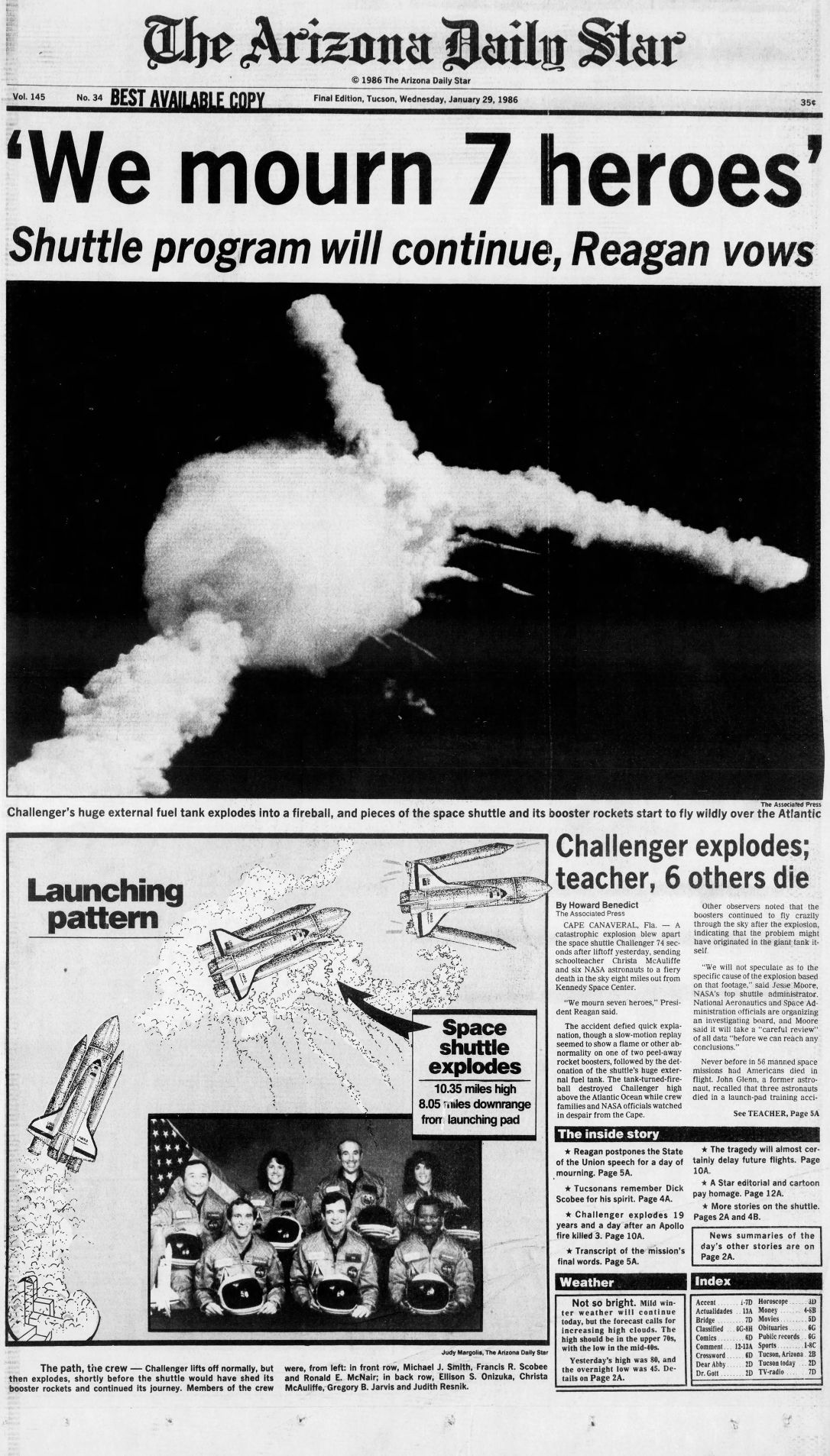
Download a PDF that you can enlarge for easier reading
Challenger explodes; teacher, 6 others die
By Howard Benedict
The Associated Press
CAPE CANAVERAL, Fla. ─ A catastrophic explosion blew apart the space shuttle Challenger 74 seconds after liftoff yesterday, sending schoolteacher Christa McAuliffe and six NASA astronauts to a fiery death in the sky eight miles out from Kennedy Space Center.
"We mourn seven heroes," President Reagan said
The accident defied quick explanation, though a slow-motion replay seemed to show a flame or other abnormality on one of two peel-away rocket boosters, followed by the detonation of the shuttle's huge external fuel tank. The tank-turned-fireball destroyed Challenger high above the Atlantic Ocean while crew families and NASA officials watched in despair from the Cape.
Other observers noted that the boosters continued to fly crazily through the sky after the explosion, indicating that the problem might have originated in the giant tank itself.
"We will not speculate as to the specific cause of the explosion based on that footage," said Jesse Moore, NASA's top shuttle administrator. National Aeronautics and Space Administration officials are organizing an investigating board, and Moore said it will take a "careful review" of all data "before we can reach any conclusions."
Never before in 56 manned space missions had Americans died in flight. John Glenn, a former astronaut, recalled that three astronauts died in a launch-pad training accident 19 years ago and said the history of pioneers is often one "of triumph and tragedy."
The explosion followed an apparently flawless launch, delayed two hours as officials analyzed the danger from icicles that formed in the frosty Florida morning along the shuttle's new launch pad.
"There were no signs of abnormalities on the screens" as flight controllers monitored Challenger's liftoff and ascent, a source said. The source, at the Johnson Space Center in Houston, said the blast occurred "unexpectedly and with absolutely no warning."
"We have a report from the flight dynamics officer that the vehicle has exploded. Flight director confirms that," NASA's Stave Nesbitt said.
NASA said its computers showed that all communications with the shuttle broke off 74 seconds after launch, marking that as the moment of the explosion.
Mission Control said there had been no indication of any problem with the three shuttle engines, its twin solid boosters or any other system. The shuttle just suddenly blew apart 10 miles high and eight miles downrange of Cape Canaveral, Mission Control said. Ninety minutes after the accident, controllers were still at their consoles, solemnly examining flight data.
Jan. 16, 2009: Miracle on the Hudson
Updated
Download a PDF that you can enlarge for easier reading
All 155 survive as airliner plunges into Hudson
By David B. Caruso
And Marcus Franklin
The Associated Press
NEW YORK ─ As the plane descended over New York City, its engines crippled, people ran through the aisle and bowed their heads to pray.
One woman sent a text message to her husband: "My plane is crashing." Passengers were instructed to brace for impact.
Then the pilot of US Airways Flight 1549 brought it down safely ─ floated it, one man said ─ into the frigid Hudson River. One survivor said the impact felt like little more than a rear-end car collision.
All 155 people on board survived, plucked to safety by a small fleet of Coast Guard vessels and commuter ferries that converged on the crash site within minutes. A paramedic said a woman had two broken legs, but there were no other major injuries.
"We had a miracle on 34th Street," Gov. David Paterson said. "I believe now we have had a miracle on the Hudson."
The plane, which had left LaGuardia Airport for Charlotte, N.C., on a flight that ultimately lasted only five minutes, was disabled when it collided with a flock of birds.
The pilot reported the strike and told air traffic controllers he needed to return to La Guardia, said Doug Church, a spokesman for the National Air Traffic Controllers Association. The controller told the pilot to divert to an airport in nearby Teterboro, N.J.
Instead, for reasons not immediately clear, the pilot, identified as Chesley B. "Sully" Sullenberger III of Danville, Calif., chose to guide it into the Hudson, where the water temperature was 36 degrees.
Sullenberger "was phenomenal," passenger Joe Hart said. "He landed it ─ I tell you what, the impact wasn't a whole lot more than a rear-end (collision). It threw you into the seat ahead of you.
"Both engines cut out and he actually floated it into the river," he said.
In a city still wounded from the aerial attack on the World Trade Center, authorities were quick to assure the public that terrorism wasn't involved.
The plane was submerged up to its windows in the river by the time rescuers arrived, including Coast Guard vessels and commuter ferries that happened to be nearby. Some passengers waded in water up to their knees, standing on the wing of the plane and waiting for help.
…
The crash took place almost exactly 27 years after an Air Florida plane bound for Tampa crashed into the Potomac River just after takeoff from Washington National Airport, killing 78 people. Five people on that flight survived.
Jan. 9, 2011: Rep. Giffords shot; six killed
Updated
Download a PDF that you can enlarge for easier reading
Rep. Giffords shot, critical
Judge Roll, girl, aide, retiree, 2 others slain
Two bystanders wrestle gunman to the ground, snatch weapon away
By Rhonda Bodfield
Arizona Daily Star
The last tweet from U.S. Rep. Gabrielle Giffords said, "My 1st Congress on Your Corner starts now. Please stop by to let me know what is on your mind or tweet me later."
It sounded so innocuous.
Minutes later, mayhem broke out and Giffords was critically wounded by a shot to the head. Six people were killed, including federal judge John Roll, who had recently worked with Giffords on court issues. A total of 13 people were injured.
Also among the dead:
Christina-Taylor Green, 9, who had recently been elected to student council and attended Saturday's event to learn more about government.
Gabe Zimmerman, 30, Giffords' director of community outreach.
Three retirees: Dorthy Murray, 76; Phyllis Schneck, 79; and Dorwan Stoddard, 76.
The shooting drew stunned reaction across Tucson. Groups gathered to hold prayer circles, while an impromptu shrine with candles and flowers cropped up outside Giffords' midtown office.
It also drew immediate national reaction, with new Republican House Speaker John Boehner calling it "a sad day for our country" and the White House calling it an "unspeakable tragedy."
"We do not yet have all the answers," President Obama said. "What we do know is that such a senseless and terrible act of violence has no place in a free society."
The bullet exited Giffords' head cleanly. Dr. Peter Rhee, a surgeon at University Medical Center, said he was optimistic about her survival, and noted she was following commands.
The shooting occurred at a northwest-side Safeway supermarket, at North Oracle and West Ina roads, where Giffords, a Democrat, was holding one of her regular "Congress on Your Corner" events, which allow her to speak directly with constituents.
The gunman has been identified as 22-year-old Jared Loughner and Sheriff Clarence Dupnik said law enforcement is not convinced he acted alone.
Johanna Eubank
Online producer
In this Series
Time machine special sections
1
Updated collection
From the Arizona Daily Star archives: Printable movie star paper dolls
2
Updated collection
Historic June front pages from the Star's archives
3