

PHOENIX — Eleven individuals wrongly convicted of crimes have applied for millions of dollars in compensation from the state, swamping a state fund that has only $3 million.
Their applications for relief came as a new law took effect Jan. 1. Four of those applications were filed mere seconds after the calendar flipped to the new year, underscoring the demand for a program that recognizes errors that, in some cases, led to years of wrongful imprisonment.
Attorney John Leader filed an application at 12:01 a.m. Jan. 1 on behalf of Gregory Jaskiewicz, a Tucson man who spent nearly four years in prison before his conviction and sentence were vacated in 2023. "Sometimes the order of filing can make a difference in a case,'' Leader said.
His application and 10 others are now in the hands of the Arizona Attorney General's Office, which is working through the requirements of the new law. But things aren't as simple as cutting a check based on the number of years spent in prison.
Before even one application has been processed, work is underway at the state Capitol to amend the law to iron out some of the early stumbling blocks.
Payment for denial of freedom
The bill to allow compensation for wrongful conviction survived a bumpy path through the Arizona Legislature last year, passing on the last day of the session.
The intent, as sponsor Rep. Khyl Powell said repeatedly, was simple: If the government wrongly takes away your freedom, there should be compensation.

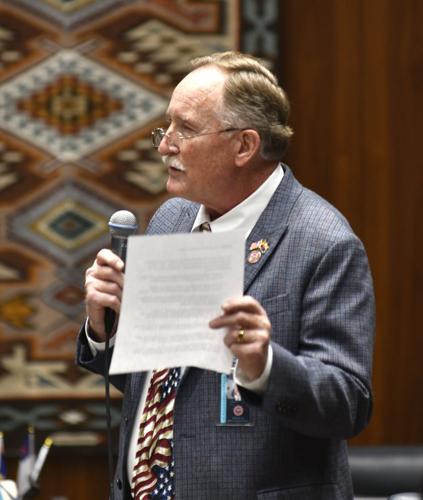
Rep. Khyl Powell sponsored legislation that created the new fund.
"When people are erroneously found convicted and they're sentenced to a life in prison and their life is completely destroyed, and they lose everything they had ... isn't it right to compensate them, isn't it right to somehow pay the restitution they are deserving?'' Powell asked as the bill came up for a final, successful, vote.
The legislation sets out a schedule on how to calculate that restitution: For each year of the individual's prison term, the equivalent of 200% of the median household income in Arizona based on the date the individual was incarcerated, and adjusted for inflation.
The law also permits up to $500,000 for each case for other damages, and provides funding for behavioral and physical health care, educational costs, financial literacy or financial planning services and attorney fees.
Nuanced cases
While the bill's intent is clear, it lacks the details that would resolve some of the issues the Attorney General's Office has identified as it reviews the applications.
The office is charged with forwarding the applications to the court with a request that the court order approval of an erroneous conviction claim. If the office disagrees that such an order is needed, the court must hold an evidentiary hearing before issuing a final determination.
"It's just not always simple,'' said Nick Klingerman, chief of the agency's criminal division. There are nuances in these cases, such as the case of a man whose conviction was vacated due to an innocence claim.
"It's not clear cut that he didn't commit the crime,'' Klingerman said, which raises the question of whether the new law applies.
Another case has raised eyebrows.
"We're looking at this thing, you say you are innocent — but are you?'' he said. There have to be hard facts that show an applicant did not commit a crime, he added.
Lindsay Herf of the Arizona Justice Project said the law isn't intended to relitigate criminal cases. Her organization was a key advocate for the law, and some of the cases it worked on are now applications before the attorney general.
"The government pays you if they take your property for a freeway,'' Herf said. So the same rule should apply if the government took away a person's liberty, she said. Compensation is the remedy.
There's also the obvious problem of not enough money to pay all the stated claims. With 11 applications already on hand, with more expected, it's unclear how to handle any prospective payouts.
"I'm guessing we have now maxed out the fund,'' Klingerman said, noting one case could eat up two-thirds of the $3 million the Legislature allocated for the program's first year.
However, it is unclear if claims can be paid in full or if "first-come, first-served'' should rule, among other yet-unresolved questions, he said.
The funding runs out as of July 2027.
Other issues include how to resolve the liability of cities and counties, where most cases originate.
"It's a big learning curve,'' Klingerman said, echoing the observation of attorneys for the applicants.
Although 40 other states have a system for resolving erroneous convictions, Arizona can only draw partial guidance from them, he said. Lawmakers took "bits and pieces'' from other programs and knitted them into a law specific to Arizona.
The Attorney General's Office was not involved in the bill's creation and only had nominal input as the legislation was nearing the finish line, Klingerman said.
Program fixes proposed
Powell, a freshman Republican lawmaker from Gilbert, has authored legislation this year that he says will "refine'' the program's requirements.
A key provision revolves around who is responsible for paying the compensation, given the state and local jurisdictions can both have a role. Rather than hold up any payment to a wrongfully convicted individual, Powell said his bill would direct the state to seek payment from a local jurisdiction if it had liability in the case.
"Everybody was concerned about who would be held accountable for the compensation,'' Powell said. "We don't want them quarreling between themselves.''
He's also looking around for an ongoing funding source so the program does not run out of money. He's counting on the upcoming state budget to continue the initial $3 million in funding, since the program is slated to end in July 2027.
He argues that once the state gets through the initial applications, some of which stretch back to sentences imposed more than 40 years ago, demand on the compensation fund should dwindle. That's because the law is intended to make prosecutors more diligent as they press cases.
House Bill 2766 has been assigned to the House Judiciary Committee but has not yet been scheduled for a hearing. This is the last week for the committee to consider bills, but there are always ways around that deadline.
42 years in prison
Meanwhile, expect delays. The law requires the Attorney General's Office to make referrals to the court within 30 days of receiving an application, with the option to seek a deadline extension.
That's already happened. In one case, Leader is objecting to the state's request for a 90-day delay.

Louis Taylor, now 70, is among those seeking state compensation for wrongful conviction under a new fund. He spent 42 years in prison on arson charges in the 1970 Tucson Pioneer Hotel fire that killed 28 people. Taylor maintained he was innocent. In 2012, his lawyers presented new evidence, including that the fire was not arson. County prosecutors maintained Taylor was guilty but offered him a plea deal that led to his being released.
One of his cases involves Louis Taylor, a Tucson man who spent 42 years in prison on arson charges after the Pioneer International Hotel in Tucson burned, leading to the deaths of 28 people.
Now age 70, and incapacitated, Taylor does not have a lot of time to wait for his case to be resolved.
Klingerman said his office is working as quickly as it can on the applications, and will likely forward some to the Maricopa County Superior Court in coming months.
But that could pose another issue: If lawmakers amend the law, it likely would not take effect until September, creating a situation where the office would be working under two potentially different sets of rules.

