




Pablo Miles grew up around frybread. His mom likes to eat it with beans and cottage cheese. His grandparents sold it at festivals on the Tohono O’odham Nation.
“(My grandmother) would talk about when her mom would take her out to the main rez, different little villages out there where they would be having the festivals, and they’d be doing the frybread. It wasn’t necessarily a frybread stand, because back then the community was a little more structured, like a tribe.
“So we would have feast houses where they would cook for everybody, the whole village. They’d have morning feeding times where they would have menudo, eggs, bacon, stuff like that, morning stuff. And the women would be cooking in the kitchens and stuff like that. They would be preparing the stuff for the evening meals. While that was going on, the men would be chopping the wood, keeping the fire going, keeping the community fires going, like at night. They would have the big festivals with the live bands playing waila. Waila music, we call it chicken scratch. It’s a little polka kinda sound, gets your hips moving,” Pablo said.
“They’d be going around and conversing and stuff like that. It goes all the way from feeding in the morning, to the evening, and making sure everyone is OK and got home safe. That’s the same with me. That’s how I am. I try to treat every customer like that, the same way, even if I never see the customer again,” he said.
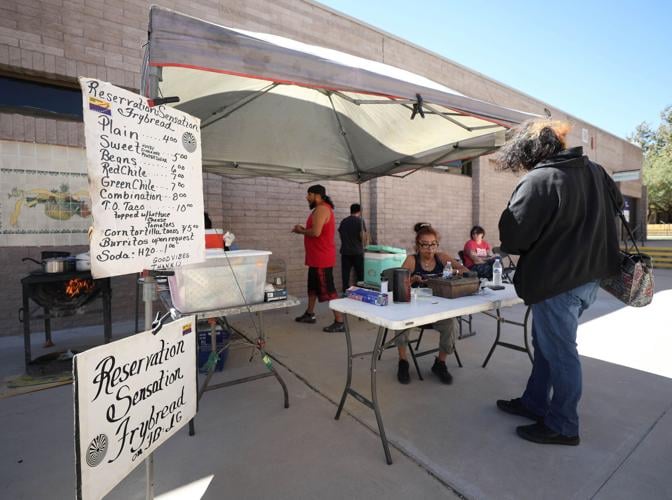
Pablo sells frybread through his pop-up, Reservation Sensation. You might have seen him cooking over a mesquite fire outside of The Loft Cinema or Casa Video at night, or outside jiu jitsu gyms during the day.

A customer places a frybread order at Reservation Sensation on Sept. 30.
Pablo’s relationship with frybread is connected to his memories of the community his grandparents built. But Native attitudes toward frybread are not a monolith: the flour, sugar and oil used to make frybread were forced upon Indigenous communities as the U.S. government forcibly removed tribes from their lands, traditional foods and customs.
While some Indigenous people take pride in the delicious treat, forged out of hardship, others like Ruben Cu:k Ba’ak see it as a deadly legacy of colonialism. Ruben is the former curator of education at Himdag Ki, the Tohono O’odham Nation Cultural Center and Museum.
Ruben used to sell frybread himself, to raise money for Indigenous affinity groups in college and to help support his family. He doesn’t anymore, and he only eats it when he's trying to be polite at someone else's house.
“So, boarding schools ... that’s where my people, most of my people, learned how to make it, was in the boarding school,” he said. In efforts to assimilate Indigenous people, the U.S. removed generations of children from their families and sent them to boarding schools, where they could be abused or starved if they spoke their native language or practiced their own traditions.
Due to boarding schools, Ruben said, “Every native tribe in America, they know how to make (frybread). To me, it’s poison. It’s another form of genocide for me, because it’s killing people. It’s literally killing people.”
Fried foods are linked to diabetes. In 2001, USDA reported that over 50% of Tohono O’odham adults have type 2 diabetes, the highest rate in the world at the time. USDA also found that O’odham foods before European contact, like tepary beans and ciolim (cholla buds), help regulate blood sugar and reduce the incidence and effects of diabetes.
Frybread’s popularity both inside and outside of Indigenous communities adds another layer to the complex legacy of the food: as a profitable commodity. In Tucson, you’ve most likely seen popovers at events like Tucson Meet Yourself or at restaurants like Cafe Santa Rosa. For Pablo, frybread is also means to the end of supporting his family and his jiu-jitsu team.
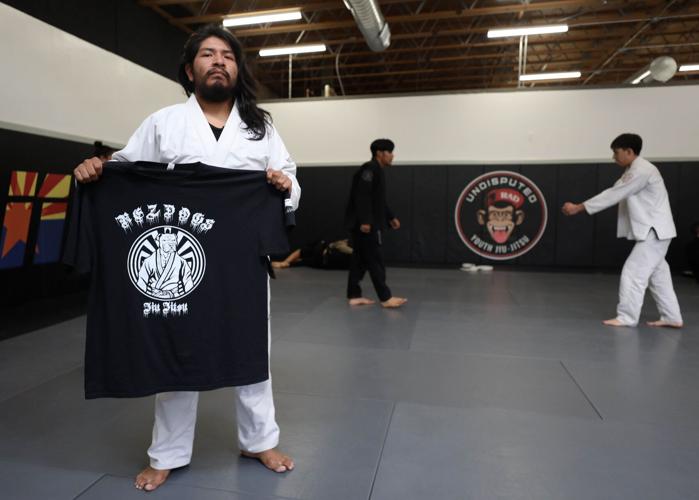
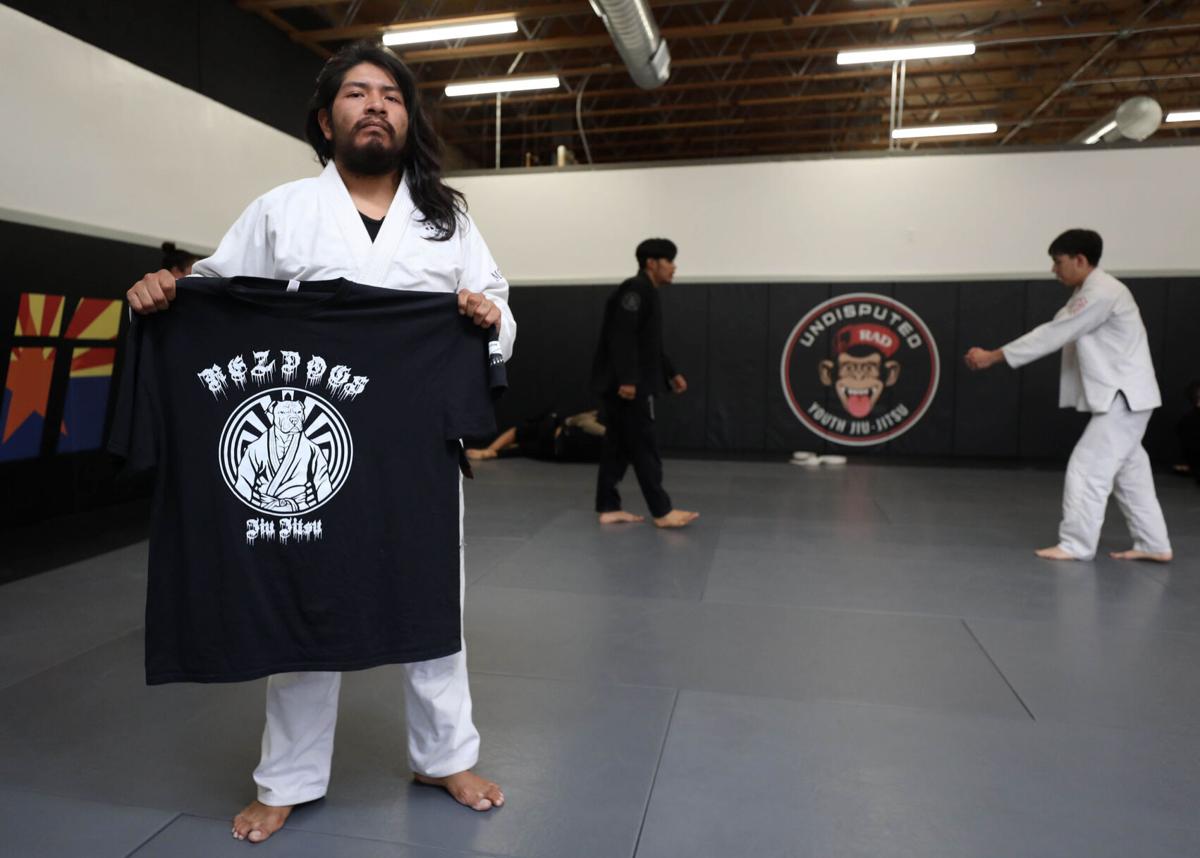
If frybread was a tool Pablo’s grandparents gave him to make a living, jiu jitsu is what Pablo chose to make his life. When he’s not selling frybread, he’s coaching a team on the Tohono O’odham Nation, called Rez Dogs Jiu Jitsu.
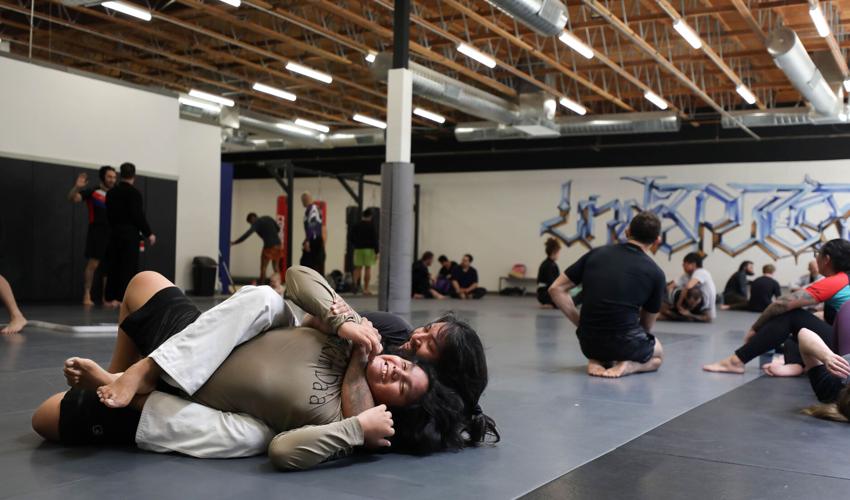
He started Rez Dogs as free jiu jitsu lessons and sparring for kids, teens and friends in his parents’ backyard. The team now practices regularly at the Tohono O’odham Recreation Center. They don’t just attend jiu jitsu tournaments, they win medals.

Pablo Miles spars with his student Anthony Pablo on Sept. 30.
“Pretty much the start of Rez Dogs, it all came from my cousins. We would all kind of watch cartoons of Ninja Turtles, Power Rangers, and kind of mimic the moves (we saw in) martial arts movies, Mortal Kombat, Bruce Lee. You know, have fun with it.
“My brother did judo, came back and taught us in the wash. In the washes, we’d soften up the sand and get thrown around by him, throw him around, throw each other around, have little contests. That’s where the root of it came from.
“As I progressed more in life, I kinda had it by my side but never dove deep into it. And then finally, you know, when I kinda reached rock bottom at a certain point of my life when I got older, with the drinking, drugs, pretty much out every night kind of thing. I wanted to change.
“One day I just remember, having a bottle in my hand and getting rid of it, throwing it out into the desert and saying that I didn’t want to be this way anymore. I didn’t want to hurt anybody at all. I wanted to help people.
“I pretty much started running. I ran as far as my legs could take me, that whole day,” he said.
He ran from the earliest morning into the day. It was the summer and he knew it was going to get hot. He started at two or three in the morning, and in the summer, the sun can come up as early as 4:30. “That was me just running,” he said.
“Ever since then it’s been a nonstop progression. From there, one of my friends talked me into joining a jiu jitsu gym, Gracie Barra, and I did some training there for a bit, and then I went to 10th Planet Tucson and trained over there for a good five years. And during that time, I wanted to be a competitor.
“I was every day just grinding for myself, until one day, one day I got a story from one of my friends that one of these little boys out in one of the rural, rural parts of the rez — I think it was Santa Rosa, I believe. His name was Oliver Brown. I found out that he got beaten to death and was left out in the desert.
“So, I remember one day coming into class and crying to my coach, and telling him about it, and,” Pablo paused. Emotion made his voice tense. “Just, telling him I didn’t want that for our tribe. So he sent me on a path and he guided me. He guided me to where I needed to be.”
“And so with that, I pretty much just knew I needed to cut all the bulls—t, the bad stuff in my life that was kinda weighing me down, 'cause I still had some vices that I gave into. I knew what I needed to get rid of in order to progress. Ever since then it’s been a straight road of fixing myself, so that way, one day I would be able to give back to these kids, help them out. And maybe help some adults along the way, 'cause, you know, no matter where we are, we all still need help.”

Johnny Morrillo prepares a frybread order as part of Reservation Sensation on Sept. 30, 2023.
Frybread has become means to an end for more than just Pablo: the teens on his team help him sell it, too, to earn money and help pay for their tournament fees.
“So with our frybread stuff, usually if we have tournaments, stuff coming up, I talk with our treasurer about funds (from) sponsorships and stuff like that. With that, we’ve done payments for the tournaments (like) War Under The Lights (through) that. I’d ask the kids if they could come work, and as they’d work, they’d get paid half their payment and then half would go toward the tournament fee,” Pablo said.
“Some of them (who recently graduated from high school) are pretty much providing for their whole families, their whole lives, so they’re trying to find work wherever they can, and something stable,” Pablo said. “I think, with this, not only does it teach the discipline in them and pushes them forward ... but they can see now it’s not just the coach who’s trying to push them to win medals. It’s a coach that, I’m trying to push them in life and help them out and guide them, pretty much, in a positive direction.”
Ruben wants to show that there’s more than one way of advocating for a stronger, healthier young generation.
“Honestly, I feel it’s our duty as O’odham today in the present to change so each generation doesn’t go through it, so it’s a collective effort. It’s an individual effort as well as a collective effort, it has to be ... There’s no way around it.”
While Reservation Sensation mostly serves frybread to people of all backgrounds at events in Tucson, Ruben emphasized the need for decolonized food options on the reservation. Frybread is easily accessible, more accessible than other traditional O'odham foods, but Ruben hopes that O’odham people can change that for themselves.
“That’s a big attribution to that problem, is our diet. Popovers (are) a real part of the O’odham diet,” Ruben said.
Ruben might eat frybread once a year, to be polite to someone who’s hosting him. Pablo and his jiu jitsu team eat frybread as a reward after a long practice or tournament, as a treat. But Ruben knows families for whom frybread is a cornerstone of their regular diet.
“Once a year or something, but we eat it on a continuum, you know what I mean? Probably two, three times a week is even bad,” he said.
“Offer them something healthy. It can’t just all be junk food. It has to be something better. I remember when I was working on the rez, I’m looking for something better. I wouldn’t buy a popover. I would buy maybe a squash plate or burrito. I was looking for something with our foods,” Ruben said. “(Other than) the Desert Rain Cafe in Sells — I would go there because their food was really good and really healthy. They were actually using the right O’odham foods in their meals. In their menus, they used traditional O’odham foods. I loved it. And then they shut down. When they shut down, there was nowhere to find any of that.”
“If diabetes rules our people, then what’s going to be left in 100 years?” Ruben said.
“This is kind of part of the plan, the bigger plan for the annihilation of our people. This is definitely a direct reflection of all that, the American Holocaust ... But it’s still our responsibility to change that, because nobody else can do it for us. We know better, we have resources to do better, then we need to do better,” he said.
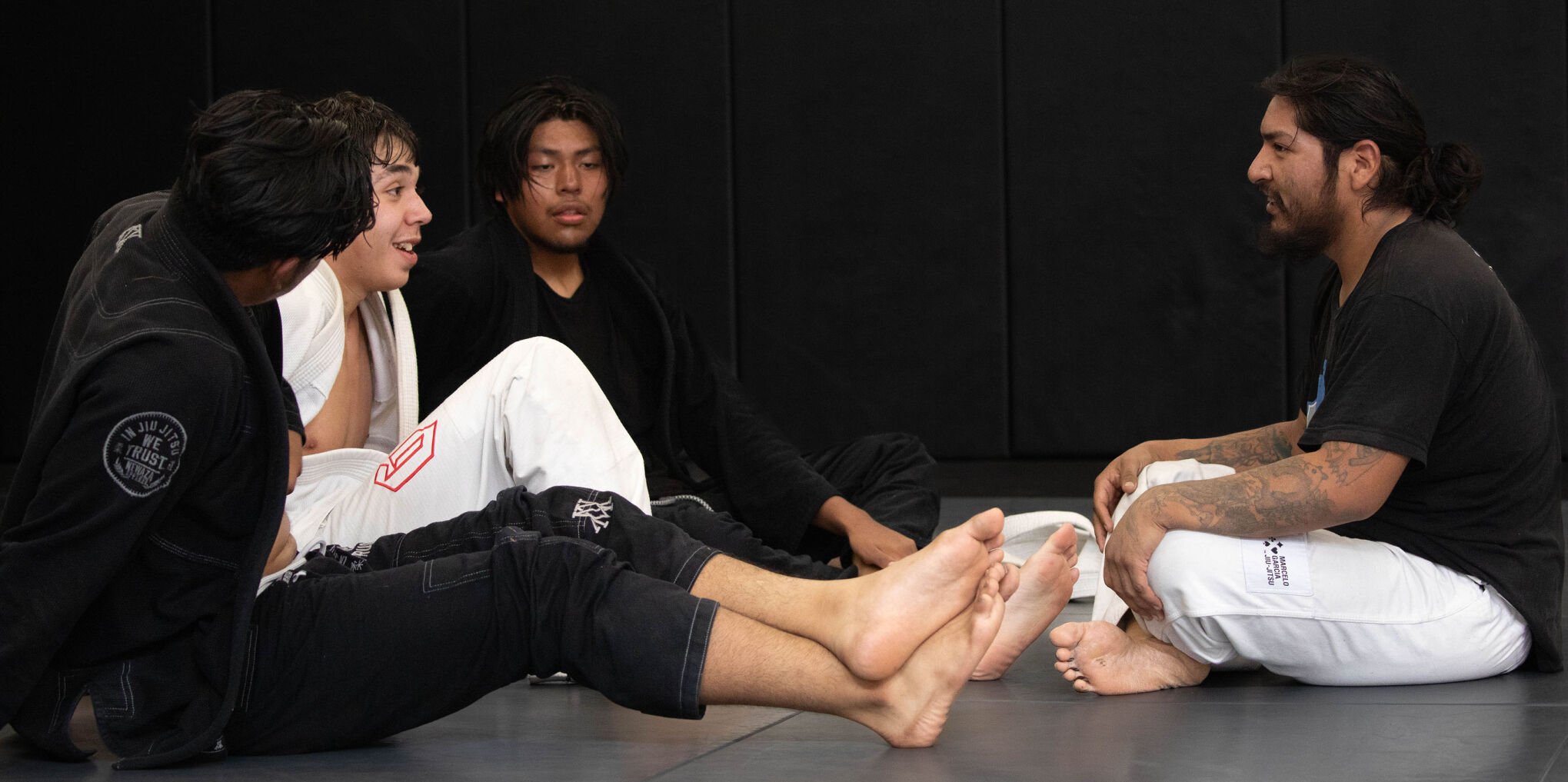
Pablo Miles talks to his students during practice on Sept. 30.
Rez Dogs’ latest community event will be a self-defense course at the San Xavier Recreation Center, tentatively scheduled for Nov. 8. The workshop honors Missing and Murdered Indigenous Women, Girls and Two Spirit Individuals during Indigenous Heritage Month. It’s part of Pablo’s larger goal of empowering kids and adults with martial arts.
“I’m not trying to take advantage of these kids — ‘Hey, work for me, hey, go get gold medals for me.’ No. It’s like, ‘Do this for yourself, because I want you to become somebody.’ I want you to, you know, not work as hard (as me), you know, but still have that drive and work ethic, that fire in them so one day they’re running their own Rez Dogs branch.
“That’s pretty much the whole goal of our gym and our philosophy is reaching out to our other districts in our Tohono O’odham reservation. There’s 11 of them, and they’re all in rural parts of Arizona right near the border, where there’s nothing out there, and that’s where a lot of missing and murdered Indigenous women, girls, men, all of that comes from. So all of this is, like I said, just to get these kids out there to those rural parts and help out the kids from there, who don’t have anything more, even the resources to start something like this.
“Even our non-Native students — 'cause we reached out to South Tucson people and we’re starting to grow there, we’re getting different backgrounds coming in, stuff like that. So, I’m pretty sure we’ll grow into town and will have Chicano Rez Dogs or Rez Dogs Barrio. It’s not just jiu jitsu. It’s a way of life. It’s a tribe. It’s something that’s kinda lost, but now pretty much is found in the f—king, in the darkness of the rez — it’s where all of this started — and pushing ourselves out of there and towards the light.
“Outreach. Outreach for these kids to outreach to other kids to continue future generations so we’re not just stuck on the rez anymore. We’re getting out there to different parts of Arizona, different parts of the USA, and the world, hopefully, we’ll have travel (with) the Rez Dogs. And sharing not just jiu jitsu, (but) their stories,” Pablo said. “Pretty much letting people know that we’re still here. Natives are still fighting out here for themselves and trying to make their name.”

