



Barbara Grygutis has big ideas.
The Tucson-based three-dimensional artist has shaped those ideas into about 80 large-scale public art installations in about 15 U.S. states and Canada, Italy and Switzerland.
As you travel the country or venture into Canada and Europe, you may encounter one of her huge, robust art installations.
Rolling waves in West Palm Beach, Florida.
A baseball player poised to hit one out of the park in Jacksonville, Florida.
A glowing wall memorializing fallen firefighters of Kansas City, Missouri.
A sculptural gateway topped with a tilde at Olympic College, Bremerton, Washington.
Each of Grygutis’ powerful, intricate, compelling works in urban public spaces like roadways, gardens, plazas, courtyards and bridges define and enhance their built-environment settings and are rich in theme, symbolism and messaging.
Through her public art, Grygutis hopes to enable civic interaction, reveal unspoken relationships between nature and humanity and connect people.
Grygutis is “one of only a handful of pioneering women in the world who work at the scale of city building, infrastructure design, and shaping large, active public spaces,” said Jack Becker in the introduction of the book “Public Art/Public Space: The Sculptural Environments of Barbara Grygutis” published in 2016.
“She brings a human touch to our often over-engineering world, balancing craftsmanship with technical savvy, nature with design, and contest with poetics, resulting in places that resonate with meaning,” said Becker, who in 1978 founded Forecast Public Art, a Minnesota-based nonprofit that’s the go-to resource for public art. He served as its executive director from 1978 to 2016.
Grygutis creates timeless work that is dignified, sophisticated and relatable, says Julie Sasse, chief curator at the Tucson Museum of Art.
You don’t have to travel far to see Grygutis’ works. In Tucson, “Sonoran Passage” is a gateway to downtown Tucson and the University of Arizona at the interchange bridge connecting Kino Parkway over 22nd Street.

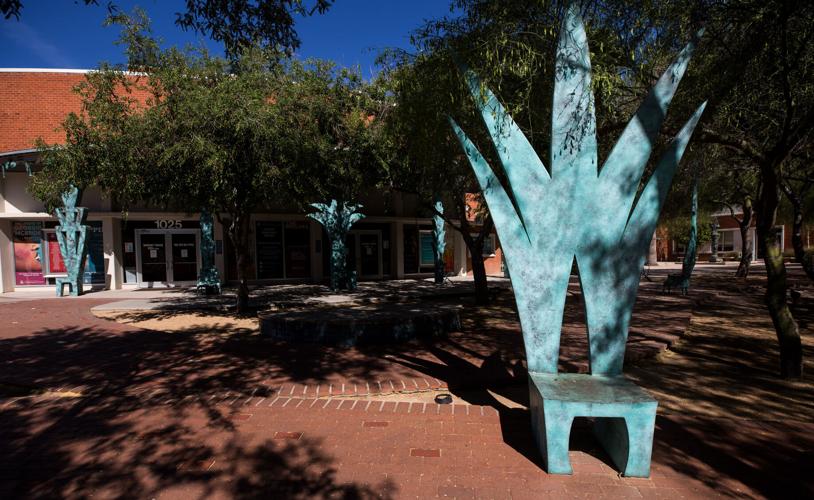
Barbara Grygutis' work can be found all over the country, but you don't have to travel far to experience it. Ten large bronze chairs by Grygutis are featured in "Front Row Center" in front of the Marroney Theatre at the University of Arizona.
Or you can sit on one of the 10 large, bronze chairs of “Front Row Center” (1999) that are integrated into the front landscape of the Marroney Theatre in the UA Fine Arts Complex.
In 1985, Grygutis designed the Alene Dunlop Smith Garden, 312 N. Granada Ave., a pocket park and sculpture garden in the El Presidio National Register Historic District.
When River Road widened in the early 2000s, she created “Riverband,” along River Road from North First to North Campbell avenues, which Grygutis described in the Star in 2011 as a “continuous band of desert forms which float on top of the sound walls.”
Grygutis received a Master of Fine Arts degree from the UA. Recognized for her work with clay early in her career, she was commissioned to design and produce place settings used for the Senate Wives Luncheon at the White House in 1977.
Her work evolved into public art and large-scale, 3D works. Now aluminum, steel, concrete, glass and lighting are among her media.

Local artist Barbara Grygutis creates massive art installations that can be found in Tucson, nationally and internationally.
Tapping into technology
Grygutis has worked in her studio in a historic building in downtown Tucson since 1988. She is usually working on four to five projects at a time, all in different stages of development, she says. It can take up to four years from beginning to end for each project.
Technology’s influence on art is astonishing, says Grygutis.
“I love it. It’s exciting,” she says. “Technology is a tool — just like the brush.”
She’s stayed right on top of technology, says Sasse, who has followed Grygutis’ work since the ’70s.
The technology has enabled precise laser-cut aluminum, says Sasse. Grygutis’ use of lighting creates powerful nighttime themes.
Much of her work is done on a computer, Grygutis says. Studio manager Katie McCann uses software to turn Grygutis’ ideas and designs into specifications. Grygutis uses about 10 fabricators around the country to build the large, heavy sculptures. She has worked with Tucson’s CAID Industries for multiple projects out of state.

“Wave,” by Barbara Grygutis, features five sculpted forms in aluminum and evokes waves rolling off the north façade of the Palm Beach County Convention Center.
Resonate, engage
Grygutis’ creates public art that has universal themes, is site-specific and has the voice of the artist.
She wants her projects to resonate with and engage with the community with themes like connectivity, empowerment, education, healing and nature. She also hopes her work stays relevant for “300 years.”
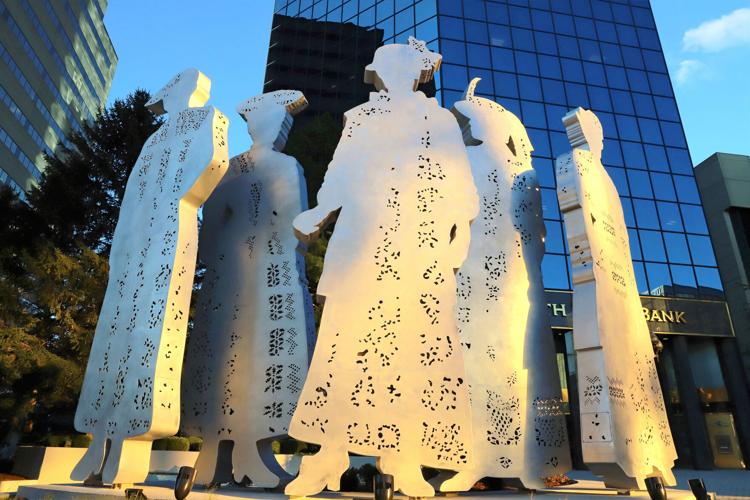
If you’re visiting Lexington, Kentucky, you can see Grygutis’ engaging homage to the courage, willpower and tenacity of the suffragettes.
Last summer, amid the pandemic shutdown, Grygutis’ “Stand” was part of a celebration in downtown Lexington to commemorate the suffragists and the 100-year anniversary of the passage of the 19th Amendment.
“Stand,” 20 feet high and 30 feet wide, is made of aluminum with integrated lighting. Its five anonymous silhouettes create a palette to suggest the many women from different walks of life who marched.
The suffragettes were not us, 21st-century women, she says.

“Stand,” by Barbara Grygutis, features five silhouettes intended to be a reminder of the historic significance of the women who pushed for suffrage, the 19th Amendment, and the struggle for women’s rights. You can find the 20-foot-high, 30-foot-wide aluminum sculpture in Lexington, Kentucky.
“They were women of a different culture. They had very serious constraints. Some of them had to march in secret because their husbands would not allow it,” Grygutis says.
“We don’t understand how difficult that was and I am trying to convey who these people were. They weren’t us,” she says.
“This was a great privilege to do this,” she says. It was both universal in theme and a monument to the women of Fayette County.

In creating “A Path for Water” in a neighborhood pocket park in Phoenix, Barbara Grygutis listened to neighbors who wanted an inviting, accessible, walkable space.
Behind the pieces
“Public art is a beast,” says Sasse, noting that committee reviews and discussion to determine the scope of work can be cumbersome and overwhelming.
“Grygutis has mastered the process and has been able to develop timeless work that all enjoy,” says Sasse.
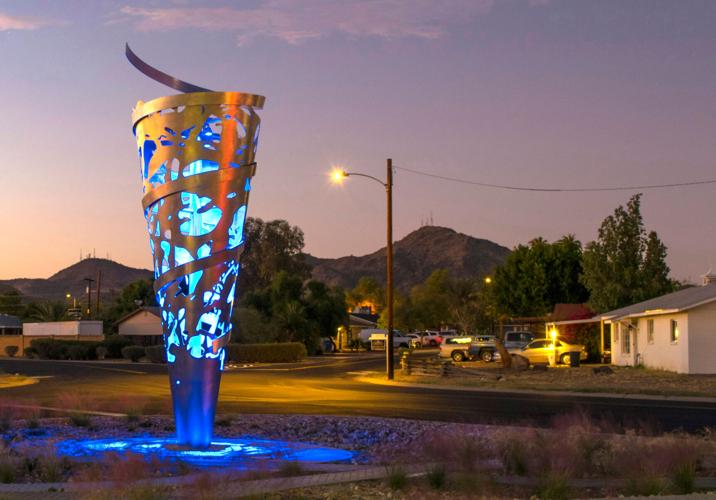
In creating “A Path for Water” in a neighborhood pocket park in Phoenix where a water department monitoring station once stood, Grygutis listened to the neighbors who wanted an inviting, accessible, walkable space, and did not want a place in which people could sleep.
The result is a towering 25-foot stainless steel ribbon-looking project with integrated lighting that symbolizes the complex relationship between nature, humankind and water. She collaborated with landscapers and paths surround the sculpture and flow through the park.
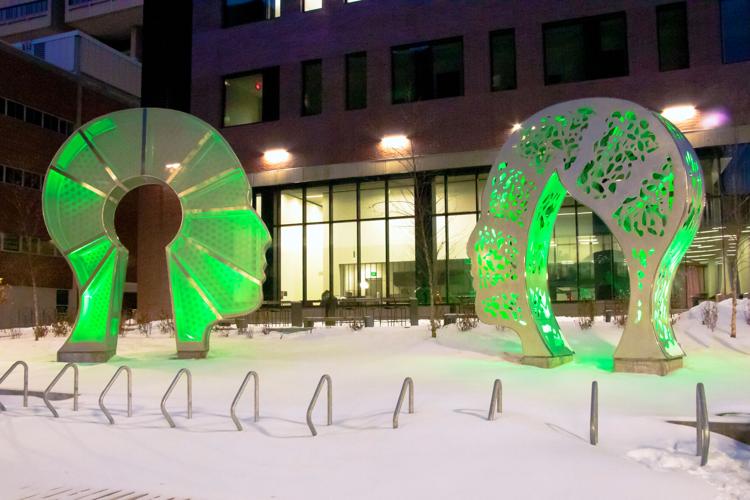
If you head into L’Étoile du Nord, you can catch “Dialogue” at the University of Minnesota Health Sciences Learning Center in Minneapolis. It features two 20-feet-high aluminum sculptures shaped as generalized human heads to convey humanity, not gender or race. The overarching theme is to relate the importance of human interactions necessary for public health.

The two human heads in “Dialogue” by Barbara Grygutis, are designed to convey humanity, not gender or race. They are on display at the University of Minnesota’s Health Sciences Learning Center.
This project required many discussions, some of them intense, with the doctors and nurses who use the adjacent buildings, Grygutis says.
While Grygutis creates site-specific sculptures, she sometimes sees ideas percolate within a theme that are appropriate for other areas.
“Dialogue” is among a series Grygutis calls “Conversations,” which includes “Portal” in Venice, Italy, and “Conversation,” in the All Abilities Playground in Dublin, California, in which silhouetted human heads symbolize humanity’s differences and similarities and emphasize the ability to find common ground through conversation.
Environmental, site-specific themes are evident in Grygutis work.
In Phoenix, Grygutis’ “Creosote Lace” brings art, light and shade to the 50th Street Light Rail Station. The art is a tribute to the creosote bush and to the healing powers that exist in the Sonoran Desert.
At another light-rail station, about 1,500 miles north of Phoenix, at the Northwest Crowfoot Light Rail Transit Station in Calgary, Alberta, Canada, architectural-grade glass, laser-cut galvanized steel and galvanized steel railing panels create “The Color of Snow.” It was inspired by the molecular structure of snowflakes and the concept that the beauty of small elements brings meaning to our daily lives.
Grygutis went to Germany to oversee the fabrication of the glass for “The Color of Snow.”
A lasting impression
Free-standing numerals in the grass outside of Dreese Laboratories at The Ohio State University in Columbus, Ohio, are spots for students to do their homework, the backdrop for pictures of young children to mark birthdays, and settings for portraits of engineering, math and science faculty.
You could snap a photo during your next visit to the Buckeye State with Grygutis’ “Garden of Constants,” which is woven into the campus fabric. It is comprised of 10 large numeral sculptures and 50 individual formulas are cast in bronze and embedded in handmade pavers, set into the main walkway.
It was chosen from among 130 artist submissions because Grygutis’ design best reflected the academic disciplines in the surrounding area, according to news reports. The 1994 piece was refurbished, ensuring decades more family photos.
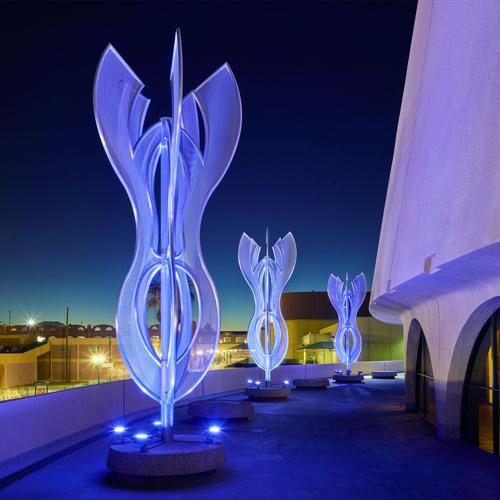
Another refurbished Grygutis’ installation is about five hours east of Tucson: “Silver Lining” features 14 18-foot-tall aluminum sculptures with synchronized lighting.

"Silver Lining," by Barbara Grygutis, replaced trees that surrounded the El Paso Civic Center when water from the trees began damaging the basement of the 1960s building. The sculptures have synchronized lighting.
The sculptures replaced trees that surrounded the El Paso Civic Center when water from the trees began damaging the basement of the 1960s building. Grygutis says she worked with the existing planters so the sculptures rise 20 feet into the sky.
Seeing her work refurbished, knowing her art is appreciated and worthy of maintaining is rewarding, Grygutis says.
Sculpture power
Grygutis knows “the power of public sculpture” and works to spread the word, says Sasse.
Grygutis is one of the founders of nonprofit SculptureTucson, a nonprofit that aims to enhance Arizona’s cultural landscape with sculptures in public spaces.

Barbara Grygutis usually works on four to five projects at a time, all in different stages of development. It can take up to four years from beginning to end for each project.
SculptureTucson debuted a sculpture exhibit at Brandi Fenton Memorial Park in January. The nonprofit presented the Sculpture Festival Show and Sale, a large outdoor juried sculpture show, and is the impetus behind the Sculpture on the Street program, which allows businesses to purchase or lease large, 3D works of art to display along heavily traveled Tucson roads.
“Art adds to a more personal and direct way of relating to the built environment,” says Grygutis.