

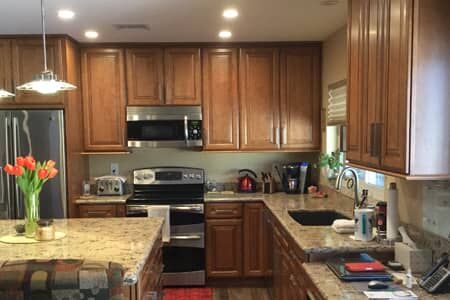
Q: We moved into our house 10 years ago with the intent of remodeling. We are just now able to carve out the finances to start updating the home. We have old fixtures and bathrooms from the 1970s and a sunken living room. What projects do you recommend to update the home and make it more livable?
A: There are things about that era that really age a home. Here are five ideas for you to consider, but a few cautions first:
Permits: Most of these projects require a permit. Permitting is an important step to ensure that projects are done safely. If you decide to sell your home and have not permitted the work, it could mean a delay or loss of sale.
Lead: If your home was built before 1979, it may contain lead paint. For more details, call 1-800-LEAD to receive more information or go to epa.gov/lead.
Asbestos: Homes built between 1940 and 1980 could have building materials that contain asbestos. Visit epa.gov/asbestos for more information.
1. Bring carbon monoxide, fire and smoke alarms up to code for safety.Before you start any remodel, check with your municipality about the current requirements for smoke, fire and carbon monoxide detectors. Many cities will not issue any permits on a house that needs to be renovated until the house is brought up to code.
The requirements can be quite specific and include the bedrooms, hallways, kitchen, living areas and even the garage. The requirements include alarm systems that are on a dedicated arc-fault circuit, i.e., hardwired.
2. Fill in the sunken living room.Sunken living rooms were all the rage in the 1950s and 1960s; to some extent, they are popular today. But they do present some problems. Most of them take up a whole living space that can be a step of 6-8 inches down from another room. That can be a hazard for aging baby boomers and small children.
But you can raise the level of the floor to fill in the sunken room. After you empty the living room of furniture and remove any floor covering, have a termite inspection. Get the area treated for termites to avoid future problems. Then, remove all the wood pieces surrounding the old floor, including baseboards.
A contractor may have to adjust some things in the surrounding walls as well, like raising electrical outlets and switches. Next, workers will bring in the aggregate base course and new concrete to fill the sunken area. The new concrete can sometimes be pumped in, depending on the distance from the street where the concrete truck will be and your living room.
You want to match the new subfloor’s height to that of the subfloor in the adjoining room. You may also have to match the flooring in other areas. You can stay in the house while all this is going on, but it’s going to be slightly humid for the next couple of days because of the wet concrete.
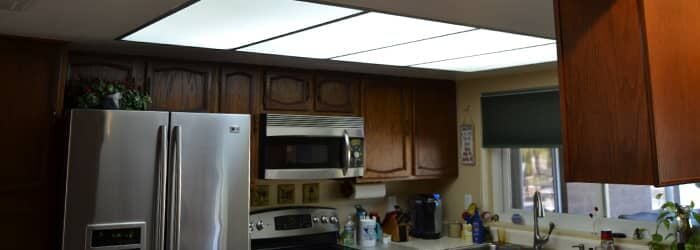
One tip for updating an aging home: Get rid of the fluorescent lights and put in recessed can lights.
3. Get rid of the fluorescent lights and put in recessed can lights.Maybe a box was built into the ceiling over your kitchen or bathroom and was covered with sheets of plastic. Behind the plastic, a builder hung fluorescent lights. Now, you’d like to switch to individual recessed can lights.
You shouldn’t just build the can lights into the empty box as they would cast unsightly shadows. In a case like that, you must add insulation as well as add electrical connections for new lighting, but you also must put in new sheetrock to create a level ceiling.
If you’re just removing a fluorescent fixture that’s on top of a level ceiling, you need to remove the old fixture, repair the drywall and rewire and insulate for the can lights. Some painting will have to be done in both cases.
If you still have that plastic-covered recessed ceiling in your kitchen, we admire your tenacity. The recessed surface is typically the bottom cord of your roof trusses and the rest of the solid ceiling is non-load-bearing framework that can be removed. We think it’s time to remove the “dropped” ceiling, lose the ubiquitous florescent light fixture and install some energy-efficient recessed LED lights.
Finishing the project can include painting the ceiling, cleaning the upper cabinets from drywall and dust and tacking crown molding to the top face of the cabinets to create a finished look. You will love the new headspace that gives the kitchen a larger look and feel.
4. Replace all your original toilets even if you don’t remodel the room itself.A 20- to 30-year-old toilet will be less efficient than newer models. Modern toilets use significantly less water and a new one can enhance the appearance of a bathroom. They come in more shapes now than they used to.
This project can become a bigger project if you choose a new toilet that has a smaller base and is shaped differently than the one you are replacing, as you might have to change the flooring to fit the new fixture.
5. Turn your carport into a garage.Closing in a carport is a great way to add square footage to your home, but don’t just put up walls on a slab under your wide-open 1950s-era carport or you could have flooding problems in the next big storm.
You or a contractor must build up a masonry stem wall that is about 6-8 inches high, around the perimeter of the concrete slab of the carport/garage. A concrete block system can be used to do this, but don’t skip this step. If you use wood, instead of masonry for the stem wall you can end up with mildew, dry rot and termites.
For a wood wall construction, a series of 2×4 plates, studs and bearing posts needs to be tightly installed on top of the stem wall to support the roof and walls.
For more photos and more step-by-steps, visit rosieonthehouse.com.
Mold is very common in homes, it can grow on tiles, fabrics, carpets, wood and other materials when moisture is present.

