


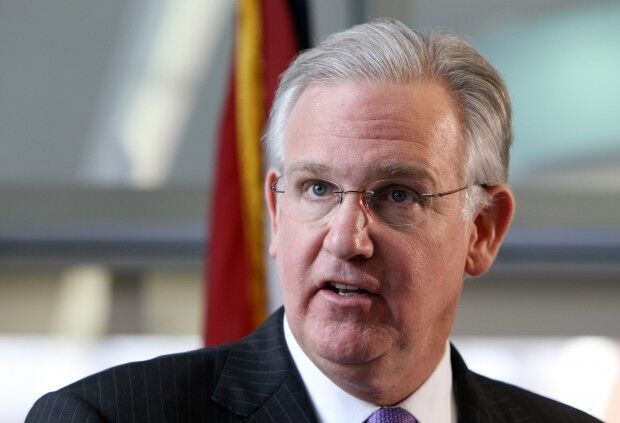
JEFFERSON CITY • Gov. Jay Nixon has set a personal record.
The governor, a Democrat, acted Friday on the last remaining bills from the legislative session, bumping his veto tally for the year to 29 — the most in a single year since he took office in 2009.
The Missouri Legislature, which has veto-proof Republican majorities in both the House and Senate, will return to the Capitol in September for a chance to override him. A successful override needs support from two-thirds of the members of each chamber.
“In the next 30 to 60 days, we’ll have a better sense of what members on both sides of the building want to do,” said Senate Majority Floor Leader Ron Richard, R-Joplin.
Among the bills vetoed this week: one that would give special legal protection to the Doe Run Co., one that would change how an abrupt vacancy in the lieutenant governor’s office is filled and one that sought to name a portion of I-70 in Montgomery County as “Graham’s Picnic Rock Highway.”
Nixon also signed several bills into law.
The Missouri Department of Revenue will no longer be involved in issuing concealed gun permits, effective Aug. 28. State education leaders will be able to intervene in struggling school districts more quickly. And banks will be able to offer short-term loans at rates comparable with payday lenders.
The governor took no action on four bills — including one that places additional restrictions on the use of abortion-inducing drugs — in effect allowing the legislation to become law without his signature.
With all bills now out of the governor’s hands, all eyes are on the veto session.
Republicans entered the session with veto-proof majorities in both chambers for the first time ever. They used that advantage to push through several GOP-priority bills, so few were surprised at the spike in vetoes this year.
“I suspect there will be an interesting veto session coming up,” Richard said.
Business groups and other anti-tax advocates have launched a campaign in support of overriding Nixon’s veto last month of a tax cut proposal.
A political action committee was set up earlier this week to help with that effort. The Grow Missouri PAC has received $1.3 million from political mega-donor Rex Sinquefield of St. Louis. Sinquefield also gave $200,000 to the Missouri Chamber’s fundraising arm and $100,000 to that of the Associated Industries of Missouri.
But it remains to be seen whether Republicans will have success on that attempt.
Richard said he’d be following the lead of leaders in the House, which would need every Republican to vote in favor of the bill or some help from Democrats for a successful override.
“I don’t know how many votes they can muster on that thing,” Richard said.
Rep. Jeff Roorda, a Democrat from Barnhart who voted in favor of the tax cut during the session, said he hadn’t yet decided how he would vote if there was an override attempt.
“I’m very much in the analytical stage on that bill,” he said. “I’m going to wait and talk to constituents.”
The centerpiece of the bill is a 50 percent tax cut, phased in over five years, for businesses that “pass through” their income to the owner’s personal return.
The bill also would drop the top personal income tax rate by one-half of a percentage point, to 5.5 percent. The corporate tax rate would fall by 3 percentage points, to 3.25 percent. Those cuts would be phased in over 10 years.
In a 10-part veto message last month, Nixon called the tax cut legislation an “ill-conceived, fiscally irresponsible experiment that would inject far-reaching uncertainty into our economy, undermine our state’s fiscal health and jeopardize basic funding for education and vital public services.”
Supporters say it will produce other opportunities for growth by putting more money in people’s pockets and helping the state compete with its neighbors, including Kansas and Oklahoma, both of which have recently reduced their income taxes.
Nixon already has put a hold on $400 million in funding for education, health care, building repairs and other areas of the state budget that began July 1 in case lawmakers override him.
“You’re either for (the tax cut bill) or you’re for public education, but you cannot be for both,” Nixon said.
Roorda appeared more confident in the chances of overriding Nixon on the Doe Run bill. The Missouri Association of Trial Attorneys opposed the bill, which would limit lawsuits by people who say they have suffered injuries from exposure to lead mine tailings and chat piles in St. Francois County. The Doe Run Resources Corp., which owns the old mining sites, would face no more than $2.5 million in punitive damages for each lawsuit.
“This keeps 1,500 good Doe Run jobs here in Missouri and attracts another 500 jobs if we can get this bill passed,” Roorda said, and he predicted that the Legislature would do so “overwhelmingly” if talks aren’t derailed in the Senate.
Nixon cited the state constitution in his veto of the bill.
“A bill that carves out a special exemption for a specific entity at the expense of Missourians injured by lead poisoning simply cannot become law,” he said.
Other bills likely to be considered as potential contenders for an override include legislation that seeks to void federal gun laws in Missouri, one that would bar the implementation of the United Nation’s voluntary Agenda 21 plan and one that sought to protect the celebration of federal holidays on public property.
Nixon appeared to poke fun at the Legislature’s priorities on Friday.
“I want to assure everyone that Christmas will be celebrated in Missouri this year, without interference from the U.N. or Sharia Law,” he said.
Nixon vetoed 14 bills last year, 14 in 2011, five in 2010 and 23 in 2009 — his first year in office.
He said his administration carefully combed over every piece of legislation.
“Some of the bills passed by the Legislature represent well-drafted, bipartisan efforts to address important issues,” Nixon said. “Other bills fell far short of these high standards.”

