



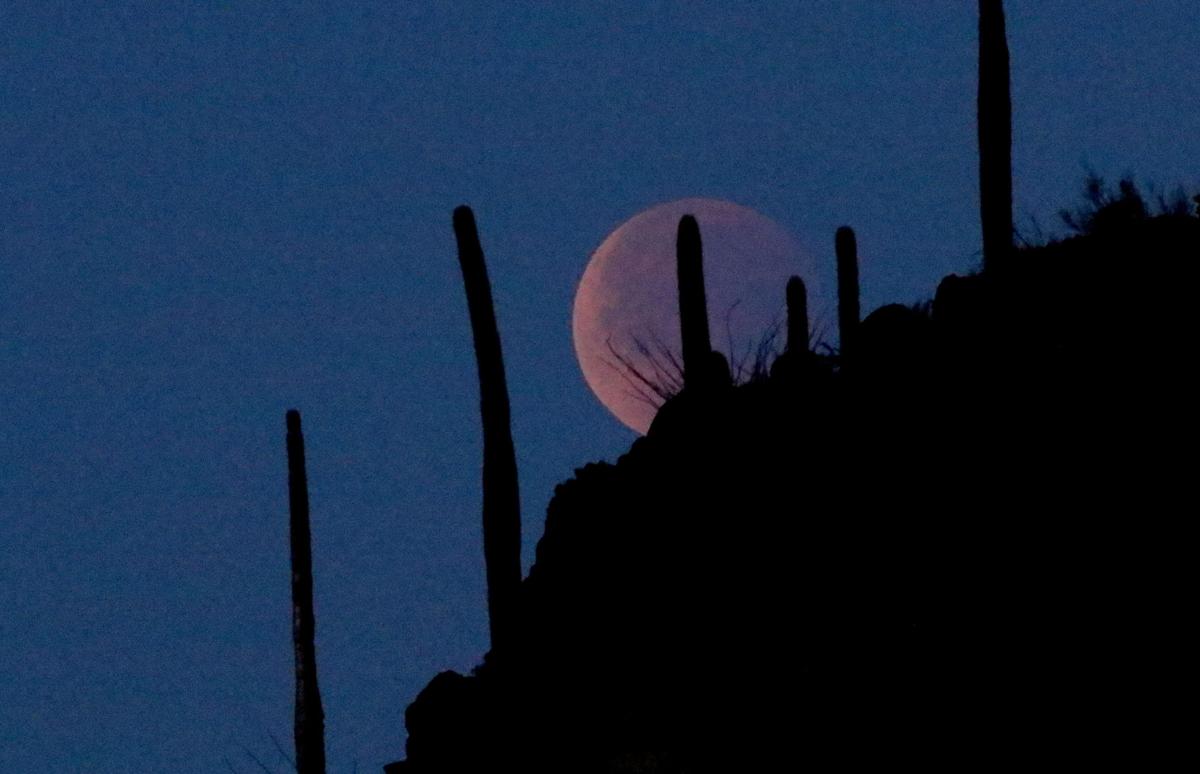
On the evening of Thursday, March 13, skywatchers across the world will get a rare treat: a total lunar eclipse, the first of its kind since November 2022.
This celestial event, which can occur once every two to three years, will be visible across North America.
Time and Date, a well-known website that provides accurate astronomical information, reports that 13.41% of the global population will be able to witness a reddish-orange moon, known as a “blood moon.”
A total lunar eclipse is the most dramatic type of eclipse, visible to only half of the Earth. It occurs during a full moon when the moon and Earth align on the same orbital plane as the sun, causing the Moon to pass through Earth’s darkest shadow.
This alignment also provides a clear view of Earth’s curved shadow cast onto the moon’s surface.
“ It’s the first and really the only method that most of us humans have for proving that Earth is round,” said Steve Kortenkamp, associate professor of practice in the University of Arizona Department of Planetary Sciences. “If we’re not able to go into space, then this is the way that we prove it, and it’s because we can see the curved shadow of Earth on the moon during a lunar eclipse.”
The moon appears red when the sun hides behind the earth and casts a deep red or orange glow onto the moon.
“Earth’s atmosphere kind of acts like a lens and it focuses light on the moon, even though the moon’s in our shadow,” Kortenkamp said. “The light that gets focused predominantly is the red light instead of the blue light.”
This lunar eclipse is particularly unique because of the ongoing space missions to the moon and those orbiting it. With spacecraft in lunar orbit, there’s the possibility of capturing images of the Earth from above, with the planet framed by a red ring caused by the eclipse. These images could offer a rare perspective of Earth from the moon, enhancing our understanding of this cosmic event.
According to NASA, the moon will begin to dim at 8:57 p.m. Tucson time as it hides behind the Earth. It gets darker as it moves into the earth’s shadow before reaching total eclipse at 11:26 p.m. and taking on a red hue for about an hour before gradually fading. The event concludes at 3 a.m.
You’ll need binoculars or a telescope to get a clear view of the eclipse, although you can still see the eclipse with your naked eye. The best viewing conditions are in a dark area, away from artificial lights.
“In a way, it kind of pulls us all together for a few hours at least,” Kortenkamp said. “Anywhere where you can see the moon when this is happening, everyone will be able to see the eclipse.”

