


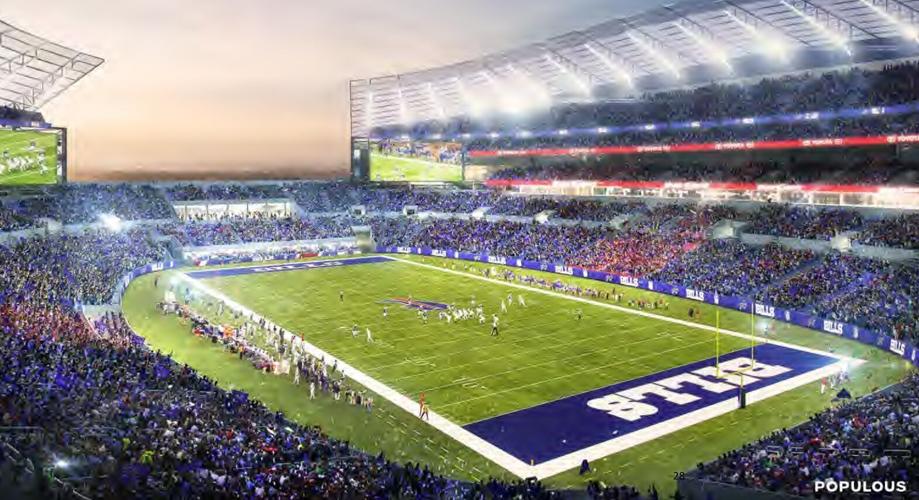
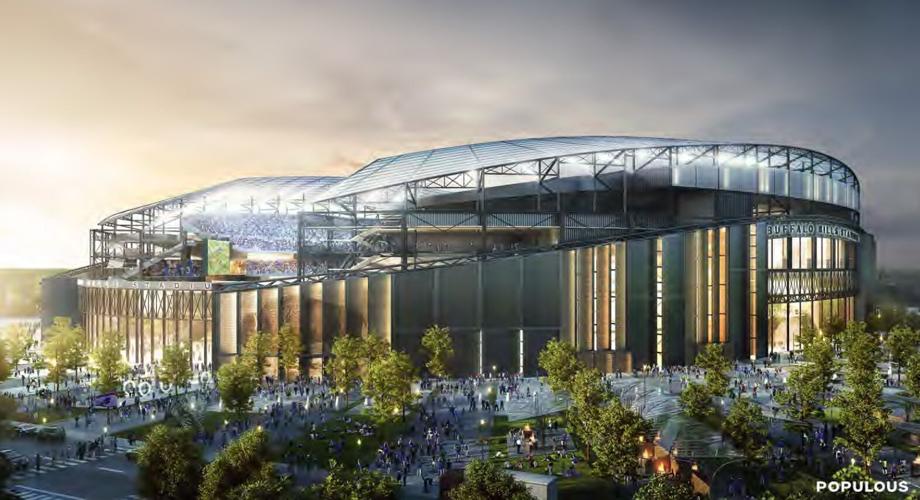
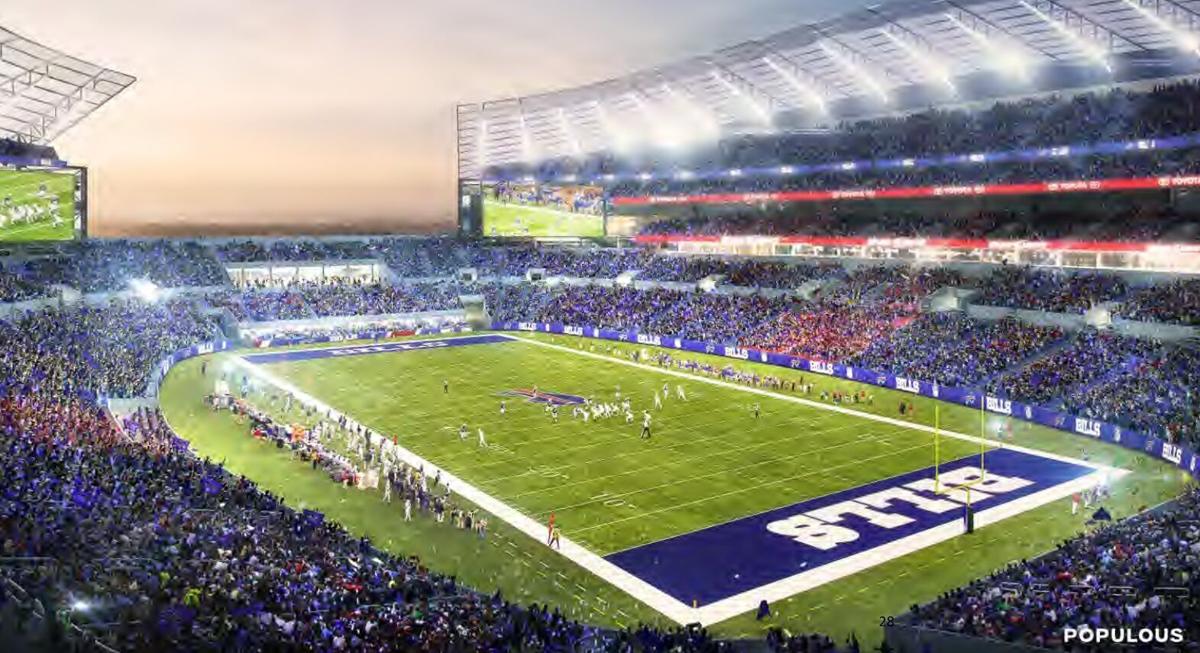
Buffalo Bills fans were offered a glimpse of what a future stadium experience might entail – but not what the venue will actually look like.
New York State on Thursday released a study commissioned by the Bills to compare three potential stadium sites: Orchard Park, South Park Avenue on the outskirts of downtown and the University at Buffalo's North Campus.
The Bills ultimately decided to focus on Orchard Park as the site of a new stadium, which they hope to open in 2026 if an agreement is reached soon with New York State and Erie County.
The report, which was completed in late 2019, also included art depicting a futuristic Bills stadium, which grabbed fans' attention online but is not indicative of a design being considered, according to Ron Raccuia, executive vice president of Pegula Sports and Entertainment, the company that oversees Bills owners Terry and Kim Pegula's holdings.
Perhaps the most striking aspect of the images is a partial roof or overhang covering a portion of the seating bowl, a design feature that is expected to be included as part of the new venue to keep fans dry.
While the reports do indicate the Bills plan on an outdoor stadium, the actual plans for a venue don't yet exist.
“We haven’t designed it yet,” Raccuia said. “Does (the partial roof) cover 360 degrees of the stadium? Or does it cover just the sidelines? Or is it horseshoe shaped? Some of that’s going to be predicated on wind and sun analysis. Some of that is going to be predicated on whether the stadium is completely enclosed or not. … We’re not there yet. We’ve got to figure all that out.”
The study analyzed each of the three locations and the feasibility of renovating Highmark Stadium. State and team officials had previously refused to make the documents public because they were produced on behalf of the Bills by consultants CAA ICON and Populous. But the state posted a cache of documents on the website of Empire State Development, along with a note stating it was doing so with the Bills’ permission.
“There’s nothing in it that we haven’t been saying since May,” said Raccuia, who leads negotiations with the state and Erie County on behalf of the Pegulas. “The idea that there’s something (additional) in our reports, this was our way of saying, ‘No there’s not.’ ”

New York State's economic development agency on Thursday made public portions of four documents that were part of a study commissioned by the Buffalo Bills on possible sites for a new stadium.
A group of Republican and Conservative members of the Erie County Legislature previously introduced a resolution calling on PSE, the state and the county to publicly release the report.
Empire State Development's posting of the closely held documents comes after the agency received several public-records requests seeking their disclosure and after Investigative Post filed a lawsuit seeking their release.
The state had earlier released its own report, produced by the consultant AECOM, which recommended constructing a new stadium over renovating Highmark Stadium but did not recommend a site.
Ideas for the stadium experience
Included in one of the documents prepared by the Bills' consultants is a brainstorm list that hints at the team's priorities for a new stadium. Among the highlights:
• Making the stadium multipurpose (“support more uses than football,” the report says) and entice people “to do more around the stadium” by attracting year-round use. This fits a revenue-driving strategy seen across pro sports that focuses on using facilities to generate revenue on a near-daily basis, making spaces available for conferences, conventions and other gatherings, in addition to large-scale events such as concerts.

A CAAIcon study commissioned by Pegula Sports Entertainment and published on Friday online by Empire State Development includes drawings that depict a a new stadium in various locations, including the Orchard Park site where the Pegulas want to build the facility.
• Make plans to accommodate sports betting and esports, both of which are identified as a “future use and revenue opportunity.” The Bills have identified sports betting as a priority for years. “I am for having the opportunity,” Kim Pegula told The News in 2019. “I’m not saying I’m necessarily morally for betting, but we need to have that opportunity to provide (the) amenity for our fans. ”
• Though the list is just that – a list, not a fully molded plan – it does seem to bluntly settle the question of whether a new stadium will have a dome. It says: “No roof. Outdoor football.”
• Fan experience is emphasized in multiple ways. As expected, tailgating is identified as a priority, as is replicating the “intimacy” of Highmark Stadium: “Seating bowl should dominate,” the report says. It also notes the importance of giving a “better game-day experience for families, provide distinct experiences from beginning to end.”
• The stadium may have a broader variety of suites, wider concourses, more tunnels and “higher quality” concessions. It may also have a natural grass field that is heated, and larger playing surface dimensions “to accommodate soccer/other events.” In addition to exclusive entry points, suite holders may also have access to premium merchandise retail areas. The report notes the “potential for (a) tunnel club” – presumably a premium ticketing area – as a revenue opportunity. Fans in general admission will have access to heated areas.
Evaluating the sites
Another part of the report scores the three final sites considered for a new stadium. It found:
• South Park had the strongest “Place Making Ability,” a term used in the report to evaluate criteria including district identity, future land use prospects, site characteristics and market trends. “A new stadium in South Park would add a major architectural icon and entertainment anchor to downtown Buffalo, contributing to the Buffalo Billion and One Buffalo initiatives,” the report said.
• South Park scored higher than Orchard Park on transportation, earning higher scores for walkability, its proximity to the transit system, ride-sharing and long-term transportation plan. Orchard Park was marked higher for its existing road network, and for parking, including both on-site and off-site.
• While South Park scored higher for its revenue-generation prospects, which include ancillary development possibilities, Orchard Park emerged as the preferable choice in three areas: costs, schedule and intangibles, which includes property development concerns, community engagement and politics. In essence, the report reinforces the Bills’ contention that a stadium in Orchard Park can be built with more speed, predictability and cost-effectiveness. That is likely why Orchard Park has emerged as their favored location, even though the idea of building a stadium in the city garnered considerable support from some politicians, developers and community members – and the South Park site scored higher overall in the study.
Economic impact
The state also released a 156-page economic impact report completed by CAA ICON on behalf of PSE. Portions of the study were previously reported on by The News based on a summary released by PSE. The full report gives insight into the Bills’ and PSE’s own spending, as well as the economic activity generated by the team and stadium.
For example:
• PSE compensated its employees an estimated $396.5 million in 2019. That includes salaries paid to Bills employees, as well as hockey’s Sabres and Rochester Americans, lacrosse’s Bandits and Rochester Knighthawks, plus LECOM Harborcenter and headquarters staff. That resulted in an estimated $30.2 million withheld in state income tax, two-thirds of which is attributable to the Bills.

The study was prepared in 2019, so priorities for arena renovations could change when the time comes for improvements.
• The Bills averaged a net ticket revenue of nearly $5.2 million per game from 2015-19, which averaged to about $51.7 million per season.
• Based on surveys, the researchers estimated that Bills patrons generated $49.4 million in net new direct spending in New York during 2019. That includes dollars spent on restaurants, grocery, retail, hotel, gas and rental cars. They also estimated $59.6 million in net new direct spending in Erie County, and $22.3 million in Buffalo.
• The Rolling Stones were the biggest cash winner of the non-football events held at Highmark Stadium between 2015-19. The Stones pulled in nearly 48,000 fans and almost $8 million in ticket sales – higher than U2 and Jay-Z/Beyonce (both at $4.3 million), Guns N’ Roses ($2.6 million), One Direction ($2.4) and the World Juniors hockey tournament ($2.2 million).

