



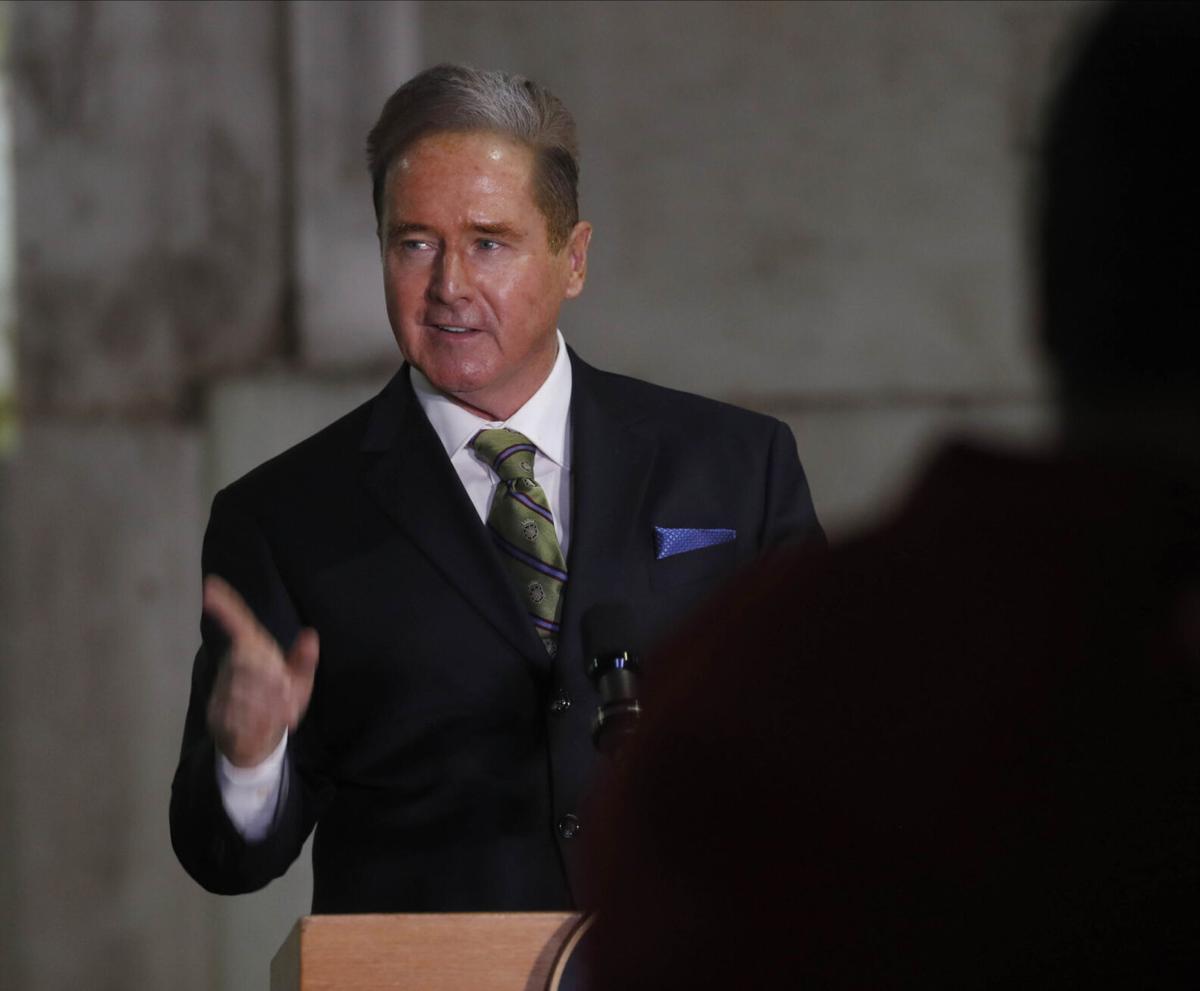
WASHINGTON – Rep. Brian Higgins has grave doubts about building a new Buffalo Bills stadium in downtown Buffalo, saying the team prefers a site near its current home in Orchard Park and that many fans would prefer a suburban site with expansive parking where they could continue to tailgate.
Gov. Kathy Hochul and Erie County Executive Mark C. Poloncarz would like to push the Bills toward a downtown site, "but I think the Bills are very set on Orchard Park," Higgins said in his first extended comments on the stadium issue.
In a recent interview in his Capitol Hill office, Higgins stressed that a downtown stadium might fit in alongside his recently announced proposal for $189.5 million in investments to improve the Buffalo waterfront as well as access to it. Even so, he cast doubt on the concept of building the stadium downtown for a number of reasons.
With a downtown stadium – with less outdoor parking than at a suburban site – "the game-day experience dramatically changes," Higgins said.
"Once you get into it, you know, people begin to say: 'Well, wait a minute, what about my tradition of tailgating?' " Higgins, a Buffalo Democrat, said. "I'm not a tailgater, but it's a thing."
Downtown bar owners may be pushing for a downtown stadium to boost their business, "but is that the experience that people want?" the congressman added.
Higgins acknowledged that as a federal lawmaker, he has little role in deciding where the stadium will go. But as Buffalo's leading advocate of waterfront development for two decades, he will inevitably have an informal role in contributing to the debate on the stadium site.
His remarks come just weeks after a consulting firm hired by the state produced a report estimating that it would cost $1.354 billion to build a new open-air Bills stadium adjacent to Highmark Stadium, the team's longtime home. A downtown stadium would cost at least $350 million more for a number of reasons, including land acquisition and the cost of building parking garages.
AECOM, the consulting firm that prepared the study, also noted that costs would be higher because of required street and highway-access improvements. And Higgins said bluntly which highway the consultants were discussing.
"We'd have to redo the Thruway," Higgins said.
That's because the proposed 35-acre downtown site is sandwiched between the I-190 and South Park Avenue, with Louisiana Street on the west and Hamburg Street on the east. Thruway interchanges at those two streets would provide access to the stadium site.
Developer Rocco Termini and architect Benjamin Siegel co-founded a group called Bills in Buffalo to push for the downtown site and brought a consultant to a recent Common Council meeting to argue for it.
"There is no doubt that the downtown location is superior," said the consultant, Thomas Chema, former CEO of Gateway Economic Development Corp. in Cleveland, which developed what are now Progressive Field and Rocket Mortgage FieldHouse. "If you build a football stadium out in the suburban community, you do not stimulate any economic development to speak of."
But Higgins questioned whether any football stadium would produce a big economic payoff.
"Everything that I've read is that stadiums really don't add to the economic viability of an area," he said.
Between Bills games and concerts, a new Bills stadium is likely to be in use only about a dozen times a year, said Higgins, who questioned whether such a facility should be dropped into an area that's already benefiting from development along the Buffalo River and elsewhere.
"You put a stadium in there: Is that really a complementing land use?" he asked.
He stressed, though, that the stadium could coexist alongside the projects that are part of his $189.5 million plan for waterfront improvements. That plan includes new parkways at Tifft Street and Louisiana Street, although it's conceivable that the Louisiana Street project might have to be altered to accommodate more traffic if the stadium were to be built at the downtown site.
Higgins made his comments during an extensive interview in which he described that waterfront development plan, which relies in part on tens of millions from the recently approved $1.2 trillion federal infrastructure bill.
And while money from that bill could not be used to help pay for the stadium, those federal funds could conceivably be used for access roads to the new facility, Higgins said.

