




Erika Hamden is an Ivy League-educated astrophysicist and the director of the University of Arizona Space Institute, so you can trust her when she tells you just how weird the universe is.
Innumerable worlds spin through galaxies separated by unfathomable distances in a void that is boundless yet somehow expanding at an ever-faster rate.
Relatively new discoveries like black holes, dark matter and dark energy continue to defy our understanding, but so do some of the most familiar and fundamental things we experience directly every day.
“Gravity is such a weirdo,” said Hamden from her office at the U of A’s Steward Observatory. “I think that if we can understand gravity, that will get us like 95% of the way to truly understanding the universe in a deep way. The remaining 5% is time.”
The internet-famous professor takes readers on a romp through some of astronomy’s biggest mysteries and most magnificent discoveries in her popular science debut, “Weird Universe: Everything We Don’t Know About Space (And Why It’s Important).”
As the title suggests, the book, released a little over a month ago, is aimed at anyone with an interest in the cosmos.
Hamden said she wanted it to be fun and easy to understand — sort of a breezy, beach read, albeit one with a whole chapter about the inevitable heat death of the universe, when nothing will remain but subatomic particles suspended alone in a vacuum of extreme coldness. Or, as Hamden describes it, the day the universe “becomes both sad and boring.”

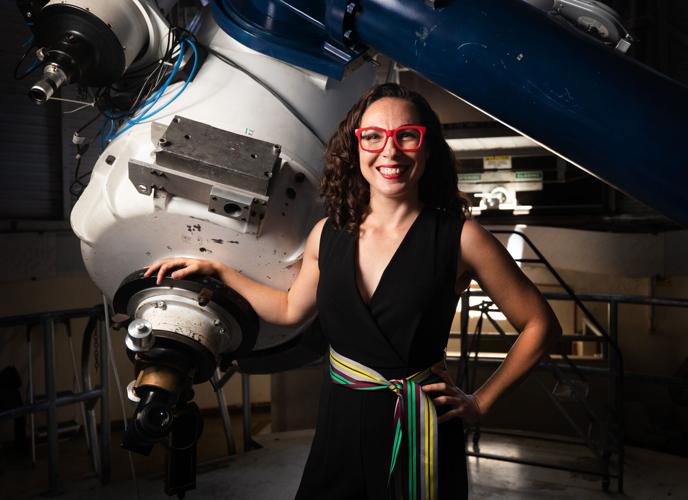
University of Arizona astrophysicist Erika Hamden takes readers on a romp through a “Weird Universe” in her debut popular science book.
Other chapters focus on strange stars and perplexing planets, how our own sun will eventually snuff itself out and the secret recipe for a seriously spicy cosmic dish scientists call “nuclear spaghetti.”
“I think light is also pretty weird,” Hamden said. “Like, why is there a speed of light? Why do photons have no mass, but all other particles have some tiny amount of mass? Why are the rules different for light than for everything else?”
Hamden also sprinkles the book with a bit of love for the underappreciated, including the “real” first planets discovered outside of our solar system and some pioneering women whose work in astronomy might have been appropriated or overlooked.
“And then there’s a lot of stuff that’s more esoteric, like how big is the universe? What’s beyond the horizon that we can’t see?” she said. “Maybe we can never answer those questions, but they’re really fun to think about.”
A star is born
Hamden tried to keep each chapter short enough to read in one sitting and the overall book skinny enough to sit on a shelf without looking intimidating. That meant cutting whole sections and skirting entire topics she decided to save for possible sequels someday. “I always figured ‘Weird Universe,’ ‘Weirder Universe,’ ‘Weirdest Universe,’” she said.
Though her research work involves a lot of writing, she said it’s mostly technical articles for science journals or “proposals that nobody ever sees except for the NASA people.” This book was a whole new thing for her.
Hamden said “Weird Universe” grew out of some “fun little videos about space” that she started recording and posting on social media in 2022.
“I think anybody can learn anything if you give them the right information and if they’re taught in the right way,” she said. “I try to talk about relatively complex subjects in a straightforward way. People really like it.”
The one-to-two-minute spots have gained Hamden almost 92,000 followers on TikTok and 116,000 on Instagram. The videos also attracted the attention of Miami-based Mango Publishing, which approached her about writing a science book for general audiences in the same conversational voice she uses online.
Hamden said she started working on the project in secret in the spring of 2024, because she was worried she wouldn’t be able to finish it or that the publisher would reject whatever she came up with.
“It’s one thing to say, ‘Yeah, I’ll write a book,’ and it’s a totally other thing to actually write the book,” she said with a laugh. “So I didn’t tell anybody, even my family, until (the publishers) literally said they were sending it to the printer. Then I was like, ‘Okay, I guess this is real.’”
She considers science communication a key part of any researcher’s job.
“Scientists need to be out there talking about not just what they’ve discovered, but how they discovered it,” said Hamden, who also hosts “New Frontiers,” a local public television show about research at the U of A. “I think that is super useful, especially now when there’s so much misinformation, and a lot of it isn’t geared towards proving or disproving something. It’s more just to cast doubt on our ability to know anything really, and then to replace knowledge with a kind of mush.”
Ready for launch
The future astrophysicist, author and social media influencer was born and raised in New Jersey, where she began checking out books about space from her local library almost as soon as she could read.
She also poured over the family’s set of encyclopedias, pulling out volume B to look up the Big Bang or the atlas at the back to study maps of the solar system, the Milky Way and the known universe — or at least as much as was known back in the 1980s.
“I’ve been a nerdy kid since the beginning,” Hamden said. “I used to tell people that I was either going to be a chef or an astronaut, my two career paths.”
She earned her undergraduate degree in astronomy and astrophysics from Harvard in 2006 and her doctorate from Columbia University in 2014, with a year off in between to study at Le Cordon Bleu in London and work as a chef at a high-end restaurant in New Jersey.
She did her postdoctoral research at the California Institute of Technology, where she led the development of FIREBall, a balloon-mounted ultraviolet telescope designed to float to the edge of space to observe diffuse clouds of hydrogen surrounding galaxies.

A weather balloon carrying an ultraviolet telescope called FIREBall floats next to the moon above Los Alamos, New Mexico, in September 2018. University of Arizona astrophysicist and author Erika Hamden led the team that built the telescope.
After the balloon deflated and the telescope crashed in the New Mexico desert, she turned the experience into a TED talk about the painful but important role that failure plays in the process of discovery. Her 2019 speech, called “What it takes to launch a telescope,” has since been played more than 1.9 million times on YouTube and the innovation conference’s online platforms.
Hamden joined the U of A faculty in 2018 and became a tenured professor in 2023, the same year she was named director of the Space Institute.
Her research still revolves around building ultraviolet sensors and telescopes to probe the universe for faint intergalactic gas clouds. She currently has three remote space missions in the works, including the NASA-funded Aspera UV telescope set for launch next year.
“For the work that I do, the U of A is the best place in the world, basically,” she said.
Our weird world
But at age 42, Hamden hasn’t given up on that other childhood career choice of hers.
“I’ve applied four times to be an astronaut,” she said. “Since 2012, I’ve applied every time.”
Last year, NASA deemed her “highly qualified” for the program — ranking her among the top 450 applicants out of more than 8,000 — but she wasn’t invited to Houston for the interview portion of the screening.
“The fifth time that I apply, maybe I’ll get there,” she said. “I feel like the best I can hope for is to get a first-round interview and then get knocked out for some random health thing that I didn’t even know about. I’d be happy with that.”
If Hamden had to pick a favorite weird thing about the universe, she said it might just be the Earth itself.
Though scientists are still in the very early stages of studying planets in orbit around distant stars, what we’ve discovered so far is that our habitable home and the conditions that allowed it to form might actually be quite rare, Hamden said.
“I feel like a lot of the weird things are us being weird about stuff. We assumed that our solar system was the model solar system, and then we found out that actually our solar system is pretty unusual,” she said.
Of course, that’s based on our current sample size of about 6,000 exoplanets in a galaxy that probably contains something like a billion of them. “So, just statistically, there must be many Earths,” Hamden said, “but for right now, this one is the weird one.”
It’s something she can’t wait for science to be wrong about. She’s rooting for a cosmos teeming with intelligent life.
“I don’t want us to be the only ones here to see things,” she said. “The universe is so amazing. I feel like there should be more people — more creatures — around to experience it.”

