





A University of Arizona-led team using a camera orbiting Mars has captured the closest images yet of an interstellar comet so rare that it has sparked wild speculation about its alien origins.
The comet known as 3I/ATLAS is just the third known object to pass through our solar system from elsewhere in the Milky Way galaxy. It was discovered on July 1, and astronomers have been trying to learn more about it ever since, using every telescope and space probe at their disposal.
One of the nearest sets of eyes turned out to be NASA’s Mars Reconnaissance Orbiter, which has been circling the Red Planet since 2006 with what still ranks as the most powerful camera ever sent to another planet.
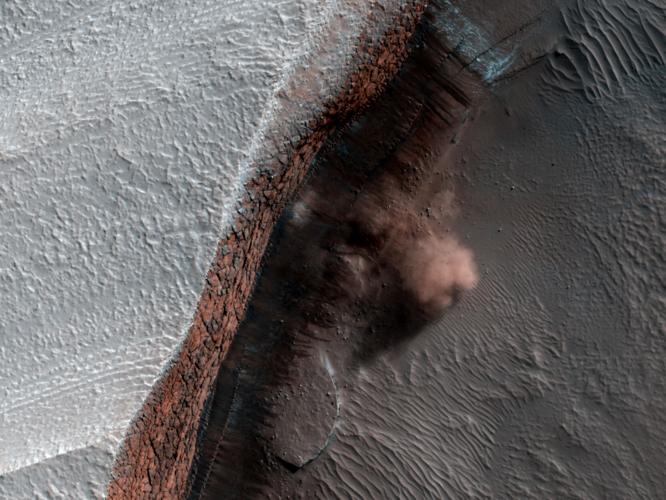
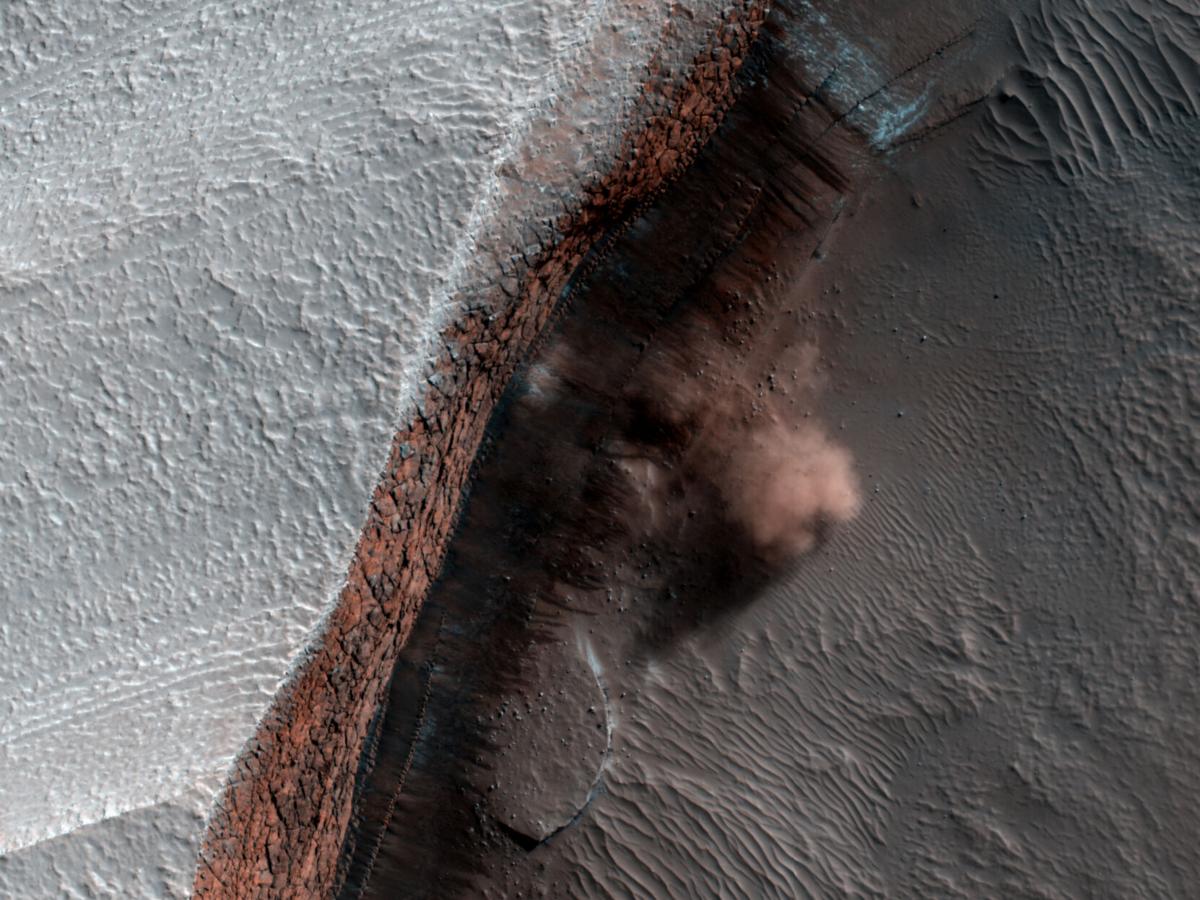
Designed and operated by scientists at the U of A's Lunar and Planetary Laboratory, the High Resolution Imaging Science Experiment, or HiRISE, can resolve objects as small as a large beach ball from more than 150 miles away. It has been used to scout safe landing sites for Mars rovers, track them as they move around the surface and document natural forces such as avalanches, dust devils and the movement of sand dunes.

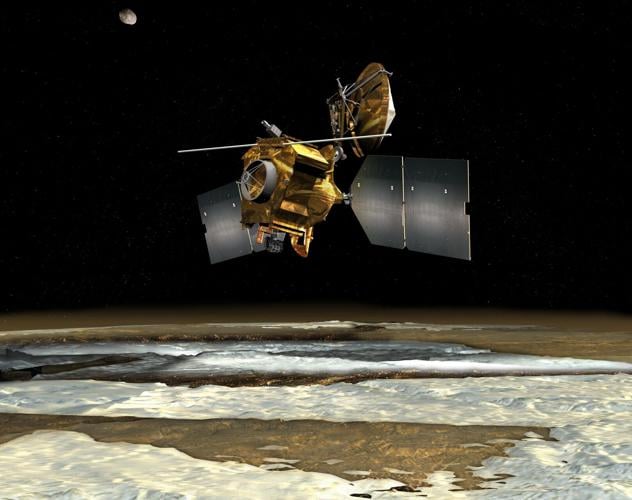
An artist rendering of NASA’s Mars Reconnaissance Orbiter, which has been circling the Red Planet since 2006 and recently trained its University of Arizona-operated HiRISE camera on a rare interstellar comet currently passing through our solar system.
But using the $40 million camera and the spacecraft carrying it to track a faint comet roughly 19 million miles away proved to be “very difficult,” said Shane Byrne, the planetary scientist and University of Arizona professor who serves as principal investigator for HiRISE.
“We’re designed to take fast exposures of the bright Martian surface. We can’t stare at dim astronomical objects for long times like a traditional telescope, as noise in the detector becomes too high,” said Byrne in an email Thursday from Switzerland, where he is on sabbatical until July.
To photograph the comet, he said, they had to turn the orbiter away from Mars, point it in precisely the right direction and then sweep the camera’s field of view across the target at a much slower rate than the spacecraft was designed for.
The comet’s brightness wasn’t well known in advance, so “we hedged our bets with a few different exposure times,” Byrne said.
It took about two hours on Oct. 2 to collect four photos, only two of which turned out to be useful.
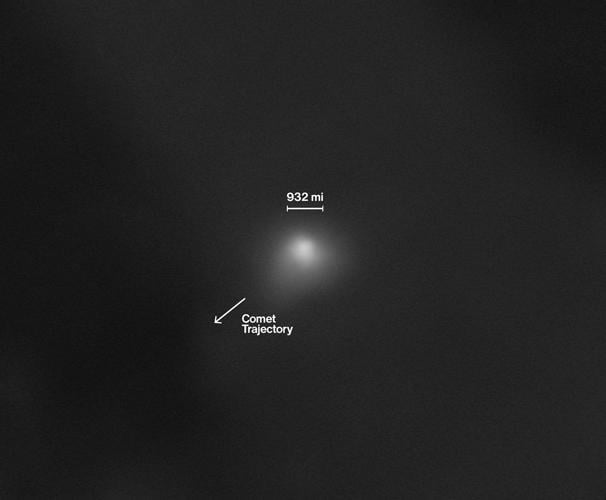
The data in those images is still being processed at the U of A and elsewhere to try to tease out more details, but the versions released on Wednesday show the comet as a fuzzy white orb surrounded by a wispy cloud of dust and gas.

An image of interstellar comet 3I/ATLAS taken on Oct. 2 by the University of Arizona-operated High Resolution Imaging Science Experiment camera onboard NASA's Mars Reconnaissance Orbiter.
“We hope to better pin down the size of the comet nucleus,” Byrne said. “It’ll be a lengthy research project to get the most out of the data.”
HiRISE is one of 12 different NASA instruments that have been trained on 3I-ATLAS as part of what the space agency called “an unprecedented solar system-wide observation campaign” to better understand the unusual interstellar traveler.
The Hubble Space Telescope was used to estimate the comet’s size, while infrared readings from the James Webb Space Telescope and ultraviolet readings from another Mars orbiter called MAVEN helped shed light on its chemical composition.
Even NASA’s Perseverance rover managed to grab a faint glimpse of the comet from the surface of the Red Planet.
"Observations of interstellar objects are still rare enough that we learn something new on every occasion," Byrne said. "We're fortunate that 3I/ATLAS passed this close to Mars."
An artist rendering of NASA’s Mars Reconnaissance Orbiter, which has been circling the Red Planet since 2006 and recently trained its University of Arizona-operated HiRISE camera on a rare interstellar comet currently passing through our solar system.
But in spite of the clickbait stories you may have seen circulating on social media, scientists do not expect to find any little green faces peering out through portholes in 3I-ATLAS.
Controversial Harvard astrophysicist Avi Loeb made headlines just a few weeks after the comet was discovered, when he suggested it could be an extraterrestrial spacecraft, maybe even a hostile one — something he also said about 1I/ʻOumuamua when that strange interstellar object zipped through the solar system in 2017.
He has since called what he is doing a mere thought experiment about something that’s “fun to explore, irrespective of its likely validity."
Other scientists have criticized Loeb for creating a baseless distraction around something that already qualifies as an astonishing discovery: a giant ball of rock and ice that has been sailing around the Milky Way possibly for the past 7 billion years or more, making it about 1½ times the age of our solar system and by far the oldest comet ever seen by humans.
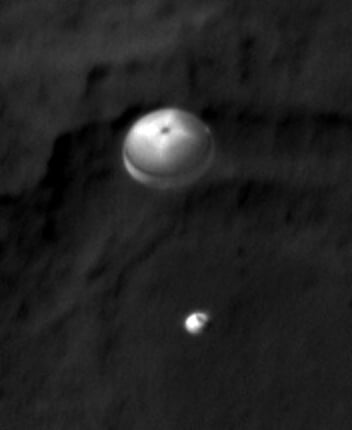
The University of Arizona's HiRISE camera onboard the Mars Reconnaissance Orbiter captured this photo on Aug. 5, 2012, as NASA's Curiosity rover descended by parachute to the surface of the Red Planet.
As astronomer Samantha Lawler told news website Live Science, “extraordinary claims require extraordinary evidence, and the evidence presented (by Loeb) is absolutely not extraordinary."
Byrne was less diplomatic.
“It’s a bunch of nonsense,” he said, with nothing more to add.

