




Pluto seemed hopelessly cold and distant until 2015, when NASA’s New Horizons space probe beamed back images of the giant heart-shaped mark that dominates the dwarf planet’s surface.
Now researchers from the University of Arizona think they have discovered more evidence of romance at the farthest reaches of the solar system: a cosmic kiss that started Pluto’s extremely long-term relationship with its largest moon, Charon.

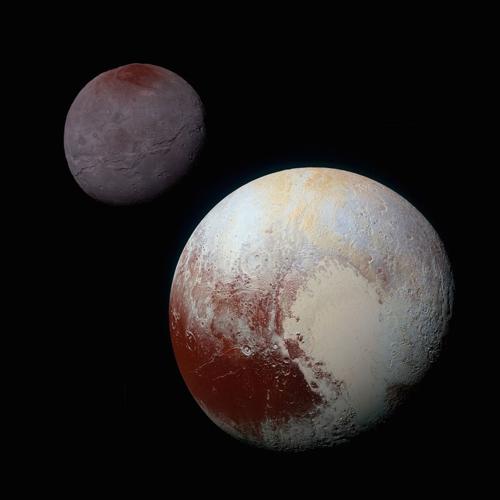
A composite of enhanced color images shows Pluto, lower right, and its largest moon, Charon, as they looked when NASA’s New Horizons spacecraft passed by on July 14, 2015. A new study by University of Arizona researchers explains how Pluto and Charon may have formed.
A study led by Adeene Denton, a NASA postdoctoral fellow at the U of A Lunar and Planetary Laboratory, describes a new type of planet-forming process called a “kiss and capture” that seems to explain how the pair of icy worlds came together and stayed together billions of years ago.
It started with a collision — one that didn’t destroy the two balls of rock and ice but spun them into the unmistakable shape of a snowman, until tidal forces separated them into their current orbital dance.
“Most planetary collision scenarios are classified as ‘hit and run’ or ‘graze and merge,’” Denton explained in a written statement. “What we’ve discovered is something entirely different — a ‘kiss and capture’ scenario where the bodies collide, stick together briefly and then separate while remaining gravitationally bound.”
The findings, published earlier this month in the journal Nature Geoscience, challenge the widely accepted notion that Pluto and Charon formed the same way the Earth and moon did, with a cataclysmic impact that caused the two bodies to stretch, deform and mix like fluid.

Denton
But Denton and her fellow researchers got a different result when they accounted for the materials that make up the dwarf planet and its unusually large companion.
“Pluto and Charon are different — they’re smaller, colder and made primarily of rock and ice. When we accounted for the actual strength of these materials, we discovered something completely unexpected,” Denton said.

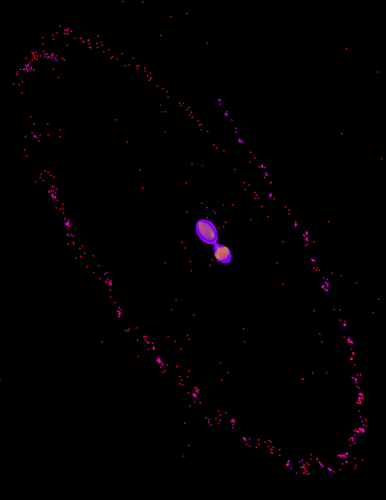
A computer rendering of the proposed “kiss and capture” of Charon by Pluto shows the two bodies separating within hours of their collision.
The research team reached their conclusion by running advanced impact simulations through the U of A’s high-performance computing cluster. Instead of stretching like Silly Putty during the collision, the most likely simulation showed Pluto and Charon surviving the impact largely intact but becoming temporarily stuck together.
The computer modeling doesn’t just explain the formation of the dwarf planet and its largest moon, either.
“The compelling thing about this study is that the model parameters that work to capture Charon end up putting it in the right orbit. You get two things right for the price of one,” said senior study author Erik Asphaug, a professor with the Lunar and Planetary Laboratory.
The other authors on the study are fellow U of A researcher Robert Melikyan and Alexandre Emsenhuber from the University of Bern in Switzerland.
Denton, Asphaug and Emsenhuber teamed up on another Nature Geoscience publication last year examining the possible origins of Pluto’s Tombaugh Regio, that heart-shaped feature named in honor of Clyde Tombaugh, the astronomer who discovered the dwarf planet in 1930 while working at Lowell Observatory in Flagstaff.

Asphaug
Denton and company are already planning follow-up studies to build on what they have learned so far.
“We’re particularly interested in understanding how this initial configuration affects Pluto’s geological evolution,” she said. “The heat from the impact and subsequent tidal forces could have played a crucial role in shaping the features we see on Pluto’s surface today.”
Including our solar system’s far-flung heart.

