



After decades spent clinging to existence in a single, spring-fed oasis in southwestern Pima County, the endangered Sonoyta pupfish is giving indoor living a try.
Four dozen of the feisty little desert fish were released on Friday into an artificial spring pool built especially for them inside the glass pyramid at the University of Arizona’s Biosphere 2 in Oracle.
With an enthusiastic crowd of about 50 people looking on, the 48 fish seemed to take to their new habitat right away.
“You can see the males are already starting to fight,” said Peter Reinthal, an adjunct associate professor with the U of A’s Department of Ecology and Evolutionary Biology. “That means they’re happy. They’re already establishing territories.”
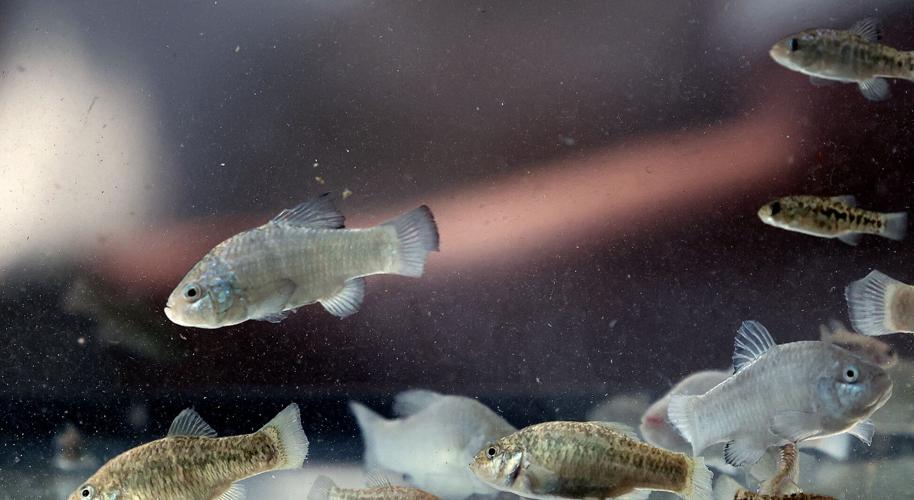
Sonoyta pupfish are about the size of a pinkie finger, with bulky bodies, upturned mouths and a sometimes-aggressive demeanor.
“I always think of them as little bulldogs in the water,” said Brett Montgomery, topminnow and pupfish specialist with the Arizona Game and Fish Department.
The males sport a flashy, metallic blue color that grows brighter during mating season. The females come in a dusky green or brown, with vertical bars or stripes.

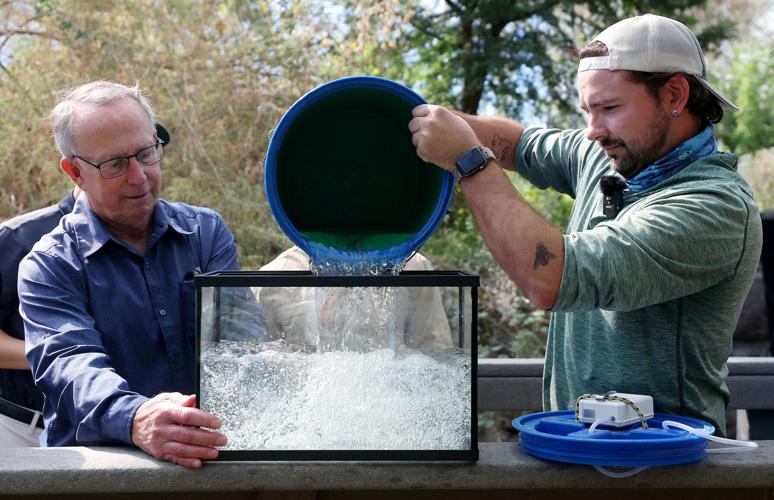
Forty-eight Sonoyta pupfish were placed into a tank before they were released Friday into an artificial stream in the University of Arizona’s Biosphere 2.
The only place the species can still be found in the wild is at Quitobaquito Springs, just north of the U.S.-Mexico border in Organ Pipe Cactus National Monument, which explains why it’s also commonly referred to as the Quitobaquito pupfish.
The species’ historic range includes the Rio Sonoyta south of the border, but the river has mostly run dry as a result of groundwater depletion and deepening aridification. “No fish have been observed there in years,” Montgomery said.
To stave off extinction, backup supplies of pupfish have been established at seven different locations throughout Arizona, including this newest one.
Moving indoors
The Game and Fish Department, Biosphere 2 and the U.S. Fish and Wildlife Service collaborated on Friday’s release as part of a Safe Harbor Agreement designed to make it easier — and less legally perilous — to establish reserve habitats for endangered species in places not under federal government control.
“Ultimately, we’d like to create more refuge populations (of pupfish), just in case something catastrophic happens to Quitobaquito,” Montgomery said.
The Biosphere’s rare new residents arrived in a five-gallon plastic water jug, after Montgomery collected them from a reserve population at a private residence in Phoenix. “It’s just a guy with a pond in his backyard,” he explained.

Brett Montgomery, right, of Arizona Game and Fish, pours a bucket of 48 Sonoyta pupfish into a tank as Peter Reinthal watches inside the University of Arizona’s Biosphere 2 in Oracle on Friday. Reinthal is with the U of A’s of UA’s an adjunct associate professor with the U of A’s Department of Ecology and Evolutionary Biology. The endangered pupfish came from Phoenix and were released into an artificial stream inside the Biosphere.
Other refuge-population sites include Scottsdale Community College, the visitor centers at Organ Pipe Cactus National Monument and Cabeza Prieta National Wildlife Refuge and another backyard pond at a house on Tucson’s east side.
Montgomery said he originally wanted to stock the new habitat at Biosphere 2 with pupfish from the National Park Service’s Desert Research Learning Center at Saguaro National Park, but the ongoing federal shutdown kept that from happening.
As soon as the government reopens, Montgomery said, he plans to collect as many as 200 pupfish from the learning center’s pond and add them to the ones he just delivered to the Biosphere.
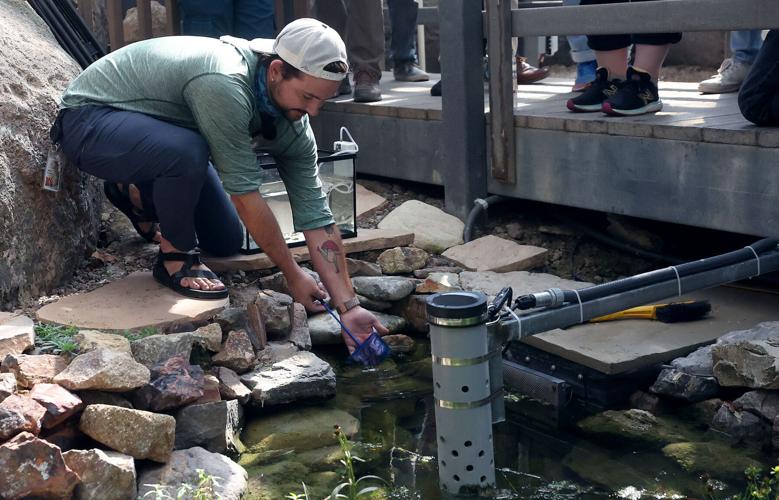
The new habitat features a gurgling stream of recirculating water that cascades down a rocky slope to a small pool in the desert biome area at the world-famous ecological research facility 30 miles north of Tucson.

Brett Montgomery, of Arizona Game and Fish, places a couple of Sonoyta pupfish into an artificial stream inside the University of Arizona's Biosphere 2 in Oracle.
It was Reinthal who first floated the idea of building a stream for desert fish at Biosphere 2 during a field trip there with some of his students in 2021. He ended up writing the proposal that secured about $50,000 in federal grant money for the project through the Desert Fish Habitat Partnership.
“It’s nice for an academic to produce something that’s real, not just data or another paper,” he said.
Asked where the inspiration came from, Reinthal smiled and said, “I think about endangered fish all the time.”
A valuable fish
The natural-looking water feature was constructed over the course of four or five months last year by Jason de Leeuw, terrestrial biome manager for Biosphere 2.
The stream is about 80 feet long, two feet wide and runs 24/7, thanks to a pump and some hidden plumbing. It has been landscaped with a variety of plants found in desert wetlands, and there’s a smaller stream that branches off to form a narrow marsh. To create the 3-foot-deep pool where the pupfish now live, de Leeuw and his crew had to dig down to the concrete subbasement of the building, Reinthal said.
It’s more than just a safe home for an endangered species, he said. It’s a living laboratory to study such things as genetic divergence in isolated populations. “This presents good research opportunities for students and faculty,” Reinthal said.
And if all goes well, Montgomery added, another small endangered desert fish called the Gila topminnow could be introduced into the same habitat sometime in the future.
Technically, the Sonoyta pupfish has been protected under the Endangered Species Act since 1986, though at the time of its original listing it was still being lumped in with the desert pupfish. Scientists later determined that what they thought were two subspecies of the desert pupfish were actually separate species of their own: the Sonoyta one and a now-extinct pupfish once found only in Monkey Spring, along Arizona Highway 82 north of Patagonia.
Thankfully for the Sonoyta variety, the wild population at Quitobaquito Springs seems to be thriving, especially after a Park Service project in 2023 that reshaped and relined the outflow pond to retain more water. Montgomery said the last time he was out there he saw “thousands upon thousands” of the fish.
But the future hangs in the balance for Quitobaquito itself, after a decades-long drop in output from the artesian spring that feeds the oasis about 170 miles southwest of Tucson. Experts blame the decline on a combination of factors, including rising temperatures, extended drought and unchecked groundwater pumping by farmers and others in Mexico.
The Sonoyta pupfish may be small and isolated and obscure, but it deserves our protection all the same, Montgomery said. “For me, there is a natural, intrinsic value to saving a species that has evolved in the same ecosystem as us,” he said. “It has a value of its own just to exist and not go extinct.”
Friday’s crowd at Biosphere 2 included students from Reinthal’s advanced ichthyology class at the U of A, some of whom jumped at the chance to take part in the release by netting a few of the captive pupfish and lowering them into their new home.
“The real reason I did this is because pupfish are cute,” Reinthal told the gathering of fellow fish enthusiasts. “If you don’t like pupfish, you’re a mean person.”

