
Project Blue in Tucson is toast.
The all-Democratic Tucson City Council voted unanimously Wednesday to kill its role in the controversial effort to open massive data centers here. It was not immediately clear how the vote could affect potential sites in other parts of Pima County — including Marana, where the mayor is expressing interest.
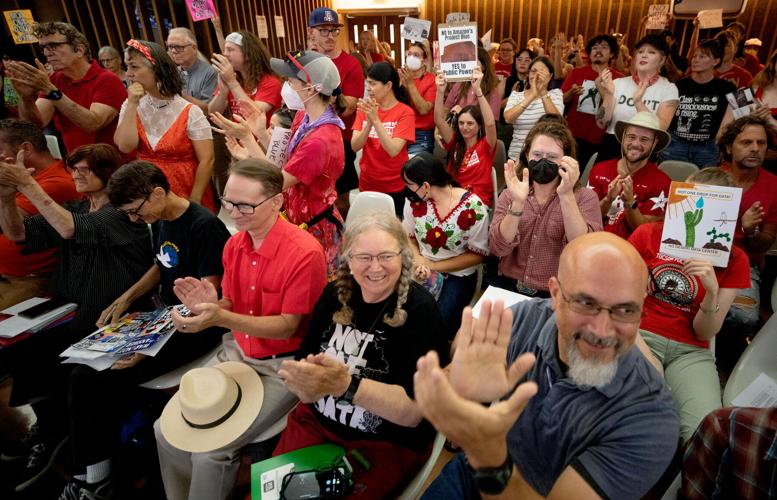
The vote drew a standing ovation from a crowd of more than 100 people opposed to Project Blue who packed the Tucson council’s study session. There were nearly as many signs as there were people, with messages like “Greedy Goblins,” “Don’t Sell My Future,” “Are you my Representative or not???” and “Amazon Doesn’t Care About Our Desert,” to name a few.
The data centers would have been the single largest customer of both Tucson Electric Power and Tucson Water.
Following the vote, a stern-faced Beale Infrastructure representative in the front row was met with jeers, boos, middle fingers and a “goodbye” chant from the crowd as he prepared to leave, while a member of the audience yelled out to thank the City Council members “for having a spine” just before they went into a closed-door executive session.
Beale later released a statement saying company officials are disappointed in the council vote and “it is a missed opportunity for the city to gain tens of millions of dollars in tax revenue, hundreds of millions of dollars in infrastructure to serve the community, and thousands of high-paying local and union jobs.”
Beale planned to develop the complex near the Pima County Fairgrounds; the end user would be Amazon Web Services, according to a 2023 Pima County memo. Beale has said the project, with several phases and multiple potential complexes, would support 3,000 temporary construction jobs and 180 long-term jobs. The city was projected to receive nearly $10 million per year in revenue under its first phase.
The City Council started the meeting with an executive session that lasted for about an hour before they came out to discuss Project Blue. During that time, city staff asked the audience on three separate occasions to keep it down, as the council could apparently hear the raucous crowd from a different room. One of those three moments was prompted by an audience member calling on the rest of the crowd to boo Project Blue, to which they responded in kind.
On Tuesday, Councilman Kevin Dahl had said he planned to introduce a motion to kill the negotiations for the proposed Project Blue data-centers complex.

Residents cheer after the mayor and city council unanimously voted down the Project Blue data-centers proposal at their meeting Wednesday.
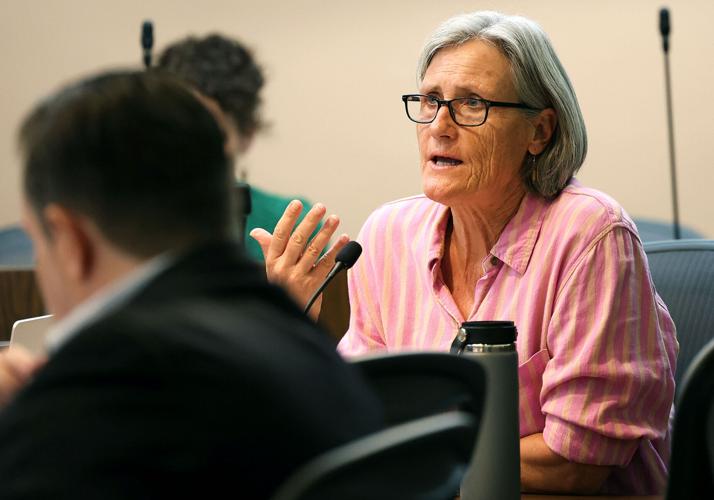
On Wednesday, Councilwoman Karin Uhlich instead made the motion, which was seconded by Lane Santa Cruz. The motion was to direct city staff to end all negotiations with Project Blue immediately and to rescind the city’s intent to annex the area.
Uhlich said Dahl and others were ready “to make it clear to the community that we’re done with Project Blue, and for many, many good reasons.”
Likewise, Councilwoman Nikki Lee said Project Blue “got off on the wrong foot” and that during public meetings over recent weeks, the City Council heard the public’s opinion.
“I heard loud and clear, across the board, that this is not the type of development that the residents in Ward 4 want,” she said. “All in all, I think that putting the burden on our communities to advance the AI race so that we win is not a fair and sustainable thing.”

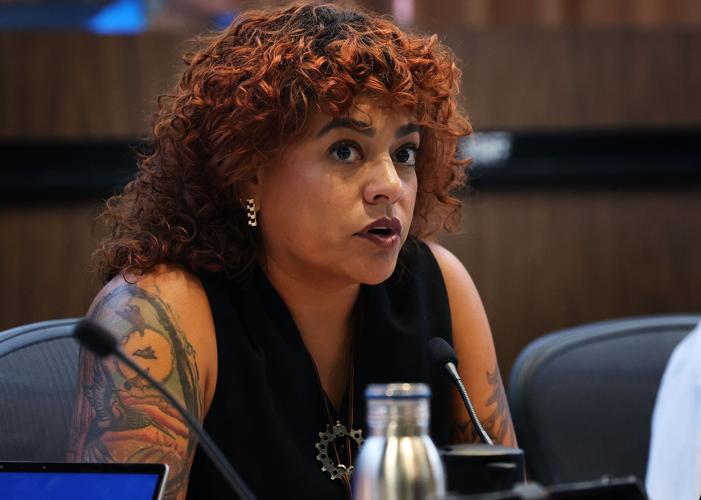
Council member Lane Santa Cruz spoke harshly about city staff during the council meeting Wednesday at which Project Blue was voted down.
Council member Santa Cruz offered possibly the strongest rebuke of Project Blue. She said Wednesday’s study session wasn’t just a meeting, “it’s a turning point” for the City Council.
“This project does not align with our values, our climate reality, or the long-term economic vision our community has consistently called for,” Santa Cruz said. “Giant corporations prefer to operate in the shadows, but Tucson is not for sale. We deserve transparency and accountability.”
Santa Cruz said the Tucson community is being told that Project Blue “will bring jobs and prosperity, but our people know if it sounds too good to be true, it probably is.”
“So let’s be real: these data centers aren’t being built to uplift our communities, they’re being built to serve private profit and government surveillance,” she said. “We don’t need to be scientists to understand that building a massive data center in the middle of a desert is a terrible idea — even though they say this is inevitable, that if we push back we’re anti-progress. I’m not anti-tech, I’m anti-extraction.”

Logan Craig, far right, vice president for development for Beale Infrastructure, casts his eyes downward as the mayor and city council votes down Project Blue during a study session in Tucson, Ariz. on Wednesday. The council voted unanimously. Ron Gantt, second from right, and Christina Casler, second from left, also with Beale Infrastructure, look on.
Santa Cruz also took aim at the city’s Office of Economic Initiatives because she said Project Blue “should have never made it this far.”
“Our economic initiatives team brought Project Blue to mayor and council just as we were heading into summer recess, limiting public input and transparency from the start,” she said. “It feels like our city staff is taking cues on economic development from the Chamber of Commerce instead of from the people of Tucson or from the elected officials tasked with representing them.”
Santa Cruz’s remarks were met with boisterous applause from the audience.
Mayor Regina Romero said the council’s discussion Wednesday, and the public showing up in numbers, “is exactly a reflection of our city.”
To large applause, she placed blame partially on the Pima County Board of Supervisors “and their team,” saying they should have stopped Project Blue “right there.” The county board voted 3-2 in June to sell 290 acres for the project site.
“As a community,” Romero said, “as a mayor and council, we need to take the reins of economic development, and the community needs to be our partner in how we decide to create prosperity in our city. We cannot leave it to others anymore, because it is our resources. It is our communities, it is our children that we want to make sure are proud of each and every one of us and have an opportunity to thrive in our beautiful desert city.”
Councilman Paul Cunningham, who came out against Project Blue previously, said his biggest concern about the project was the city’s lack of a municipal-owned power utility.

Council member Karin Uhlich made the successful motion to end negotiations with Project Blue.
“Probably the biggest piece to this project that concerned me was we have a flawed system with not having public power here,” he said. “... If we did build this data center, there was no guarantee that some partial out-build for the power supply to the data center wasn’t going to be passed on to our ratepayers.”
Cunningham also expressed concern over the push for data centers by the big-tech industry.
“I’m the most realistic, non-conspiracy theorist guy of all time, but some of these tech bros, some of the things they do is very concerning,” he said. “We need to keep our eye on the ball.”
The remaining votes against Project Blue quickly fell into place.
Dahl had said his move was an effort to put an end to an “ill-conceived project.”
“There were some good aspects to this. This would have been a boon to the trade unions, it would have gotten us some infrastructure that would have been very helpful. (But) it’s the wrong way to do all of that,” he said. “Maybe there will be much better way to get those incentives, to have industries that are much more sustainable and much more in tune with our values, while providing all those jobs and amenities.”
Councilman Rocque Perez urged Pima County, municipalities in Southern Arizona and the public “to pay attention closely to what happens next, because data centers aren’t going anywhere, and this battle is just the beginning for Tucson.”
In its statement, Beale said the company was founded on the belief that data centers “can and should be designed sustainably, working on close partnership with communities. Beale’s mission is to push the industry forward and enable a responsible digital infrastructure future.
“Beale was invited by the City of Tucson to participate in this public process to provide transparency on conceptual plans for Project Blue, which was executed through multiple public information sharing sessions. We are disappointed in the mayor and city council’s decision not to pursue this opportunity for Tucson, despite close collaboration with municipal engineering teams on plans directly compatible with Tucson’s Climate Action and Adaption and One Water plans,” said the company, in its statement released through the Caliber Group public relations firm.
Looking ahead, a Beale spokesperson said, “When Beale has definite plans to announce any new development plans in the region, they will issue a news release (or new statement at that time).”
Tucson City Manager Tim Thomure spent a lot of time during the debate over Project Blue saying the community could live with its reclaimed water use and that the city’s reclaimed supply would have been adequate to serve it. But after the vote, he said the council made “clearly the right call based on our community.”
All along, the project raised two questions, he said. One was whether Tucson Water serve Project Blue, which was possible, he said. The other was whether the utility should serve Project Blue, a question only the mayor and council could answer.
“And the second part brought a lot of issues to the table and Mayor and Council reviewed the information and made a well-informed choice,” said Thomure, a former Tucson Water director himself.
The activist group No Desert Data Center Coalition, which formed to oppose Project Blue, praised the City Council “for standing strong and not folding to Beale’s intimidation tactics and greenwashing propaganda.”
The coalition has said Beale’s contention, reported by Councilwoman Lee, that the project has other potential sites in the Tucson area and will be built here — with or without city approval, annexation, regulatory input or direct benefit — amounted to intimidation.
“The rejection of Project Blue by Tucson City Council is a huge victory for our desert community and would not have happened without thousands of Tucsonans coming out to vehemently oppose it,” the coalition said in a news release. More than 1,000 people packed a public meeting Monday night on the project and about 800 turned out a previous meeting, most voicing loud opposition to the data centers.
“Tucson made the right decision to halt Amazon’s harmful data center in its tracks and protect our water, air and a livable climate,” the coalition said.
Fletcher McCusker, treasurer of the Southern Arizona Chamber, a major backer of Project Blue, declined to comment, citing a nondisclosure agreement signed with the project.
As for Marana, officials representing Project Blue already discussed their project with Marana Town Manager Terry Rozema and other town staffers, Mayor Jon Post told the Star Wednesday afternoon after the Tucson City Council vote. Various officials have said for some time that Marana or somewhere else on the northwest side was a potential option for a separate data-center site.
Marana has already adopted a set of data-center requirements and a very prominent one is that a data center would have to find its own water supply. That requirement doesn’t exist in Tucson, whose Tucson Water utility was willing to deliver first potable and then reclaimed water to Project Blue.
But Marana’s requirement wouldn’t necessarily be an obstacle to Project Blue there, because the project could get water from one or more farms and irrigation districts that operate in the area, Post said. They include Kai Farms, BKW Farms and the Cortaro-Marana Irrigation District.
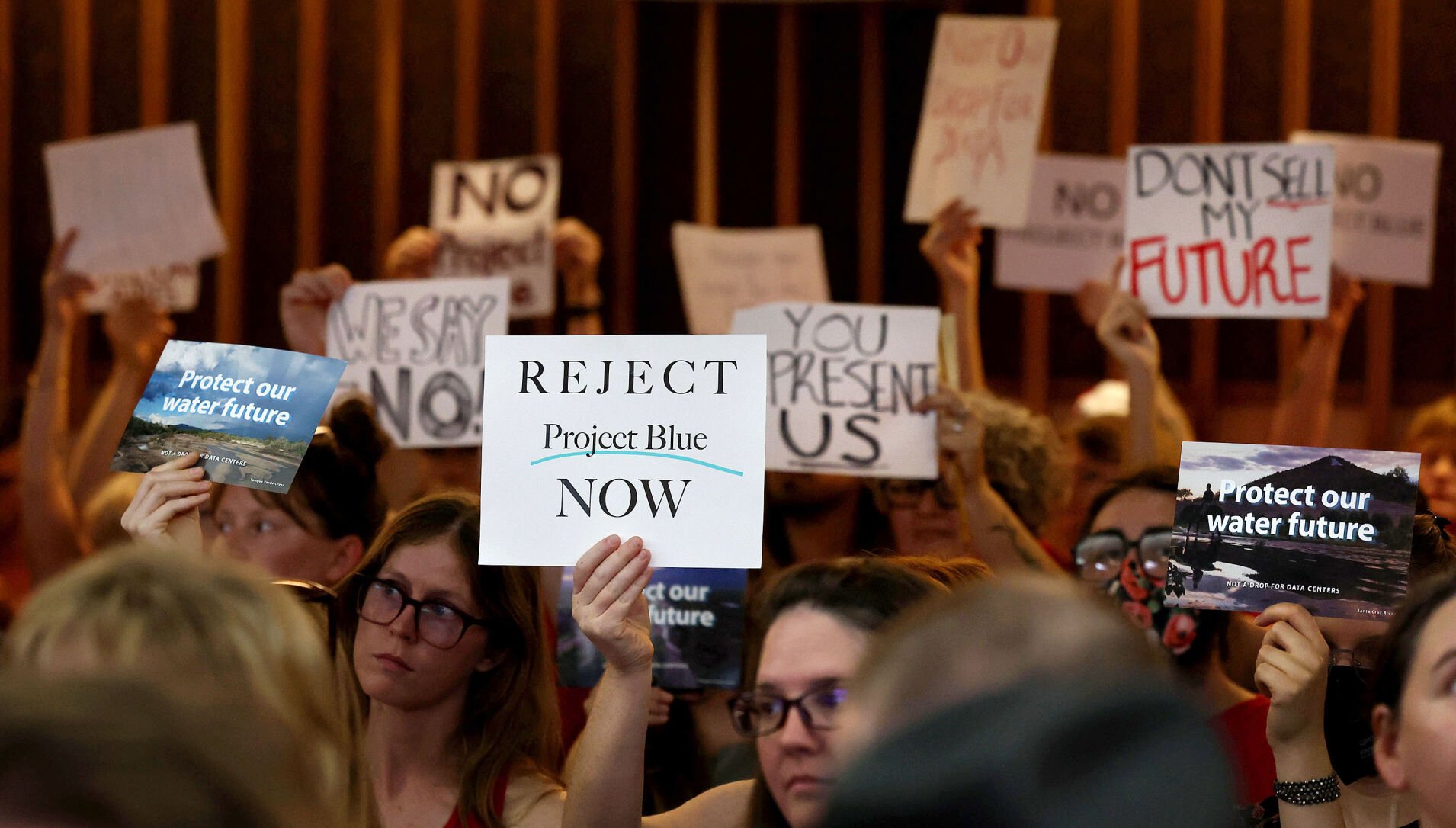
Residents against Project Blue held signs and filled the chamber Wednesday at the meeting where the mayor and council voted unanimously against moving forward with the data-centers proposal in Tucson.
“And that would be fine,” Post said about the prospect of a data center in Marana buying and using water on what’s now farmland. “It’s just not going to come from the municipal supply, from the town’s water portfolio.”
He noted that it would be a substantial water savings for a data center to buy farmland and draw from that land’s water rights. The center could only use the farms’ water on what’s now agricultural land. While farms can use 4 to 5 acre-feet per acre a year, “my absolute guess” is that the data center would use 1 and one-half acre-feet per acre yearly, Post said. An acre-foot can serve four Tucson-area households over a year.
“It would be a substantial savings over what’s currently being used for agriculture,” Post said
The decision to allow a data center there would be up to the Town Council, he said. “We’d really have to weigh the benefits to the town of Marana,” he said. “I can’t say right now what that would look like. I don’t want to become a community fully covered up with data centers. I don’t think they offer stuff to our residents for the amount of resources that they require.
“I’m not saying no data centers, not by any means. I just don’t think Marana wants to be known as a data center community,” he said.