


Tucson City Councilman Kevin Dahl will introduce a motion Wednesday to kill the proposed Project Blue data-centers complex before the council can seriously consider it.
“I do not want to waste any more of the public’s time on this ill-conceived project,” Dahl told the Star Tuesday afternoon. “This thing needs to die now so we can move on with appropriate conversations about what economic development looks like in the midst of extreme heat and depleting water supplies.”
It would take four votes out of the seven-member council, which includes Mayor Regina Romero, to pass Dahl’s motion.
Councilman Paul Cunningham offered the strongest support for Dahl’s motion as of Monday, saying, “I’ll probably vote for that. If we want to do anything like this and let’s be fair and there’s a really big revenue opportunity for the city, it’s irresponsible not to do it. But this one, we’re past the point where we need to move forward. We need to start over.”
Cunningham said his opposition to the project is based on “everything start to finish. No one knows what technology we’re using to cool it. No one has given us a straight idea how water will be recharged so it’s not water neutral. Sorry, man. This just isn’t for me.”
But Councilwoman Nikki Lee, whose Ward 4 would house the project's first data-center complex, said she isn't willing to support Dahl's proposal. In her newsletter to constituents Tuesday, she wrote that after meeting the day before with Project Blue officials, she had concluded, "The reality is this: Project Blue will be built in the Tucson metropolitan area, regardless of what the City of Tucson decides."
She said she's concerned that if Project Blue goes elsewhere in the Tucson area, it will be able to operate with fewer environmental restrictions and avoid having to use reclaimed water, as it has pledged to do in Tucson after its first two years of operations here. If it builds elsewhere in the metro area, the city itself wouldn't have any control over its development or its activities, she said.
Lee met Monday in her council office with representatives of Project Blue developer Beale Infrastructure, who told her “they have a short list of other sites they’ve identified ... their alternative sites in our backyard.”
“It’s now top of mind for me; I do know they are looking at federal land on (Davis-Monthan) Air Force Base in city limits. There are other locations where this can and very, very likely will be built, in our watershed, in TEP’s service area. To me that’s a very important risk we’d understand, of the city losing the ability to control how these things are moving forward,” Lee said.
Councilwoman Karin Uhlich said she thinks it would be wise to not proceed now with annexing Project Blue; before the project can win formal City Council approval for its zoning, the council must also agree to annex it. But Uhlich said Monday she can’t commit to signing onto Dahl’s motion when she hasn’t seen it.
As for the possibility that the developers could find an alternative site if Tucson turns them down, Uhlich said, “Right now there’s no way to gauge that risk, no way to know if these things are negotiating, hardball tactics. I’m not inclined to react to that kind of statement. I don’t know whether there are actually viable data center sites, with state land or federal land, and what are their water rights and water sources. It doesn’t make sense to me to react, to try to make those decisions, when we just don’t know.”
Romero, who hasn’t taken a public stance on Project Blue, did not comment on Dahl’s plan. “The study session item on 8/6 is agendized so that Mayor and Council can have a public conversation on Project Blue,” the mayor said in a written statement.
Tuesday evening, the group No Desert Data Center Coalition blasted Beale's statement that it will find a place to build elsewhere in Pima County if Tucson turns the project down.
“Our coalition completely rejects this latest corporate intimidation from Beale. ... Beale and Amazon will still have to pass regulatory muster for any project proposed in Arizona before it becomes final. And they will always have the community to contend with," said Maria Renee of the group.
Dahl’s motion will come on a day the council was already scheduled to discuss Project Blue. The agenda for Tuesday’s council meeting called for a discussion of a draft economic analysis of the project, prepared by a consultant, and a draft development agreement for the project that has been negotiated between Project Blue developer Beale Infrastructure and city staff.
1,000 packed meeting Monday to blast project
Dahl’s announcement of his effort to kill Project Blue came less than a day after the project underwent its second stormy public session in the past two weeks.
Distrust, skepticism and outright suspicion flowed at the last of three city-run public meetings on the proposed Project Blue data-centers complex.
The overwhelming majority of more than 1,000 people in attendance at Monday night’s meeting vented anger, frustration and sadness as they took turns blasting the project’s planned water and energy use as excessive, and taking Tucson’s city government to task for not installing strong enough guardrails to insure the project would meet its commitment to be “water positive.”
Project Blue is proposed to be a two-complex set of data centers in Tucson; one planned for the far southeast side near Interstate 10, the other still lacking a specific location but likely to rise near the first center. Monday night’s contentious meeting came as the Tucson City Council is scheduled to hold its first Project Blue discussion at a study session Wednesday afternoon.
A third center may be built later in the Marana area.

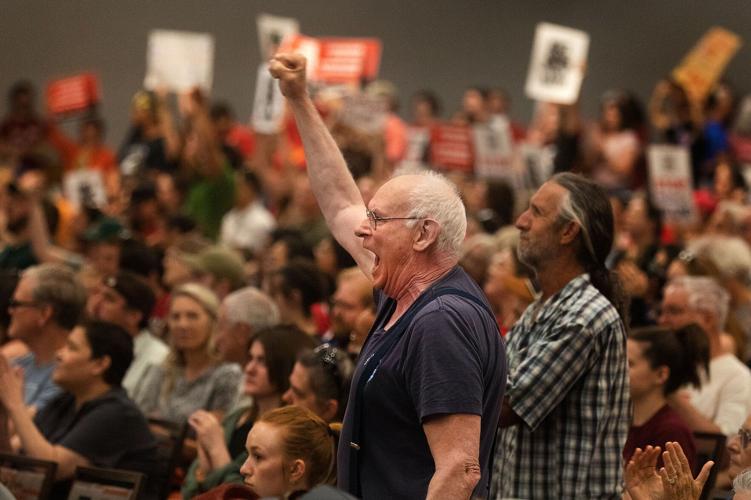
Citizens shout their opinions during a public meeting about Project Blue at the Tucson Convention Center on Monday night. Representatives from the city of Tucson, Tucson Electric Power, and Project Blue developer Beale Infrastructure provided information and answered community questions about the project.
The mood of the audience was at least as intense as that at the first public meeting on July 23, when 800 people jammed Mica Mountain High School. The second public meeting, on July 31, was held virtually. In the early part of Monday’s session, the audience that filled a Tucson Convention Center meeting room at times acted like a mob.
Crowd members’ angry outbursts of boos, jeers and heckling repeatedly drowned out talks by officials from the city, Tucson Electric Power and Project Blue developer Beale Infrastructure. The end user of the data centers would be Amazon Web Services, according to a 2023 Pima County memo.
When individuals got their chance to stand at a microphone and speak out, their comments generally came across as heartfelt, sad, fearful and brimming with anger. And unlike at the first meeting, members of building trades unions who came to support the project were largely silent.
Like adding a city to electric grid
One comment that cut deeply with the audience was a simple factual claim about Project Blue’s expected energy use that ended up being verified by a TEP official.

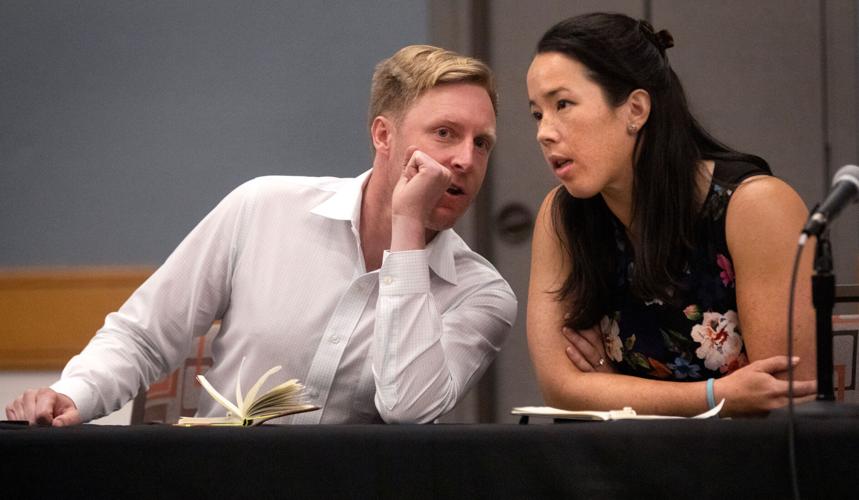
Logan Craig, vice president of development, and Christina Casler, director of water, for Beale Infrastructure, talk to each other during a public meeting for Project Blue at the Tucson Convention Center Monday night.
“We calculated that Project Blue will use more energy than every home in Tucson combined. That’s actually a conservative estimate,” said Ed Hendel, co-founder of Sky Island AI, a Tucson-based AI business that has posted its analysis of Project Blue’s energy and water use on an online dashboard. “Most likely it will end up using more energy than every home, business, and industrial facility that TEP serves. It would essentially be like adding an entire second Tucson to the grid.”
He said the lower electricity use estimate assumed the project’s data centers would run at 50% of capacity all the time, and that under the higher estimate they would run at 80% of capacity.
TEP hasn’t released projections for Project Blue’s electricity use, citing a non-disclosure agreement it signed with project officials. But after Hendel’s comment drew a chorus of boos from the audience, TEP’s Ryan Anderson replied, “You’re right.”
He cited figures released by the city of Tucson showing the project’s two data-center complexes would require TEP to have enough additional capacity totaling 1.3 gigawatts.
“That’s a lot of energy. I think your calculations are probably correct when you look at overall consumption,” Anderson, TEP’s business development manager, told Hendel.

Citizens shout their opinions during Monday night's public meeting about Project Blue at the Tucson Convention Center.
Hendel also noted that TEP spokesman Joe Salkowski told the Star last week that the utility would probably have to build at least one new natural gas plant to serve Project Blue’s second data-center complex, and that a Pima County environmental official has warned that would make it impossible for the city and county to reach their goals of achieving net zero greenhouse gas emissions by 2050 at the latest.
“Our mayor has rightly earned a national reputation for climate leadership,” Hendel said. “In order to avoid undermining the mayor’s climate legacy, we need to get a binding agreement with TEP to have the plant run on 100% clean energy.”
Anderson replied, “We feel it’s inappropriate to look that far ahead.”
Water issues
Speaker Caryl Clement, a landscape architect, said to officials at the meeting, “I took an oath to be a steward of the land, and at your July 23rd meeting, you said you are trying to be stewards of the land. You are talking the talk but not walking the walk.”
In particular, she singled out the project’s plans to use drinkable water — 143 million gallons total — during its first two years, before an 18-mile-long pipeline carrying reclaimed water to the project is built, at Project Blue’s expense.
“Would you consider building a recharged water facility, a reclaimed facility first and foremost, and not use 143 million gallons of potable water?” Clement asked to loud applause.

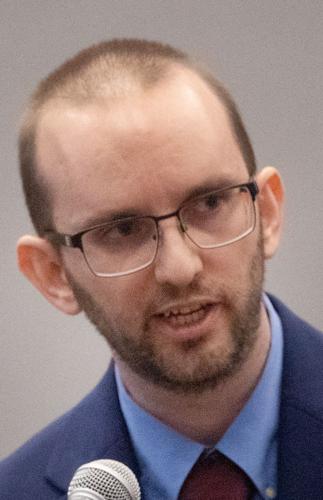
Ed Hendel, co-founder of Sky Island AI, a Tucson-based AI business, and a critic of Project Blue.
Christina Casler, water director for Beale Infrastructure, said Clement has a very valid point, but “the truth is we are already in our planning phases; we can’t start building. We don’t have a project.
“We will do what we can to start work on a reclaimed system. We realize it’s such a crucial element. We can’t use reclaimed water from the start. There’s not reclaimed water there,” Casler said.
Clement responded, “build it first,” meaning the reclaimed line. Casler quickly replied that any future Project Blue development after its first phase can start on reclaimed water because the pipeline will by then be there.
“I know there is some skepticism about this, but every drop will also have a requirement for water replenishment, and for PFAS remediation,” said Casler, referring to the company’s promise to clean up some of the city’s 30 wells contaminated with PFAS-based “forever chemicals” to compensate for its water use.
Clement shot back, “I’m sorry, but you don’t get it. That land that you are on should be designated as a wildlife sanctuary. I ask that you care for it and love it as we do.”
Developer: “Best possible project”
Asked by an opponent of the project what the data centers’ lifespans would be, Beale vice president Logan Craig estimated — to a booing crowd — that in his experience, it should be 15 to 20 years. Asked by Andy Squire, a spokesman for the Tucson city manager’s office, what Beale would do if the City Council turned down the project, Craig replied the company will “absolutely” look at alternatives outside the city.
“We believe this project is the best possible project. It will have the largest reclaimed (water) system ever. There will still be a need for cloud infrastructure for Southern Arizona,” said Craig, a reference to the data centers’ work in serving various kinds of “cloud computing.”
Robert Jaramillo, who described himself as a longtime Tucsonan, told the crowd, “We’re in a desert. We’re in a drought. Every single summer, it’s not good. I’m not against data centers, but not here. We’ve been conserving water for many years. We took our landscaping out. We took our swimming pools out. We ‘beat the peak’, way back when. For us, we conserved water for the future.”
Jaramillo added, “Can you guarantee us water for future generations? It breaks my heart to see these grandkids not having water for the future. Native Americans should be at the table on this. They’ve been dealing with this for hundreds of years. If you decide to go ahead with this program, man, put it to the vote of the people,” a comment followed by loud applause.
Rocky Rivera, a south-side resident, advocated to the crowd that the 290 acres that would hold Project Blue’s first set of data centers should be used instead for a regenerative farm, one whose leaders would work with University of Arizona researchers to create sustainable food production along with training programs for people to work there.
“This isn’t just a fight over land, power and water. It’s a fight for our futures here. Can we please put this to the people to vote on this and decide what is best for our city,” said Rivera, whose remarks were followed by an audience chant, “Let us vote. Let us vote. Let us vote.”
Photos: More than 1,000 blast Project Blue during public meeting at Tucson Convention Center
Project Blue public meeting
Updated
Citizens shout their opinions during a public meeting about Project Blue at the Tucson Convention Center on August 4, 2025.
Project Blue public meeting
Updated
Citizens shout their opinions during a public meeting about Project Blue at the Tucson Convention Center on August 4, 2025. Representatives from the city of Tucson, Tucson Electric Power, and Project Blue developer Beale Infrastructure shared information and answered community questions regarding the project.
Project Blue public meeting
Updated
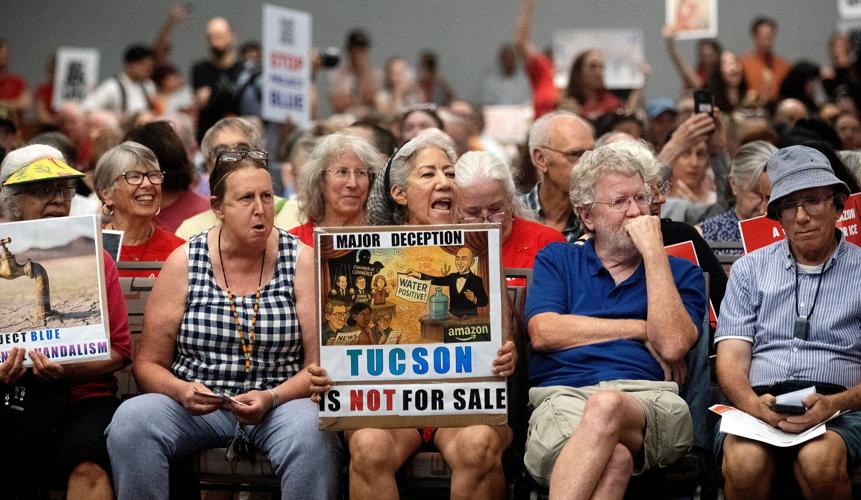
Citizens hold up signs during a public meeting about Project Blue at the Tucson Convention Center on August 4, 2025.
Project Blue public meeting
Updated
Kalyanraman Bharathen voices his opinion during a public meeting about Project Blue at the Tucson Convention Center on August 4, 2025.
Project Blue public meeting
Updated
A woman holds up a sign against Project Blue during a public meeting at the Tucson Convention Center on August 4, 2025.
Project Blue public meeting
Updated
Fiona Taylor, upper right, shouts during a public meeting about Project Blue at the Tucson Convention Center on August 4, 2025.
Project Blue public meeting
Updated
Logan Craig, vice president of development, and Christina Casler, director of water, for Beale Infrastructure, talk to each other during a public meeting for Project Blue at the Tucson Convention Center on August 4, 2025.
Project Blue public meeting
Updated
Citizens shout their opinions during a public meeting about Project Blue at the Tucson Convention Center on August 4, 2025.
Project Blue public meeting
Updated
Melanie Cooley, of Watershed Management, makes some comments regarding water during a public meeting about Project Blue at the Tucson Convention Center on August 4, 2025.
Project Blue public meeting
Updated
Eden Cornejo-Enrique, far left, and Raelyn Orozco, second from left, talk to Mayor Regina Romero to voice their opposition to Project Blue after a public meeting at the Tucson Convention Center on August 4, 2025.
Project Blue public meeting
Updated
Raelyn Orozco hugs Tucson Mayor Regina Romero, after speaking with her about Project Blue as Fiona Taylor, far right, wipes away her tears after a public meeting at the Tucson Convention Center on August 4, 2025.

