



University of Arizona Faculty Chair Leila Hudson is looking forward to a new school year, but also back on the “intense” first six months of the Trump administration’s impact on universities and higher education.
Hudson, an associate professor of Middle Eastern and North African studies, said the university was doing two things simultaneously — transitioning into a new UA administration with a new president at its helm, and weathering this “moment of national turbulence” in higher education.
“Whether it’s international students, attacks on federal funding models that we’ve grown very accustomed to, and the very explicit challenge to some of our core practices and values around diversity, equity and inclusion, looking back on the last six months, I think we have a good idea now,” Hudson said in a recent interview.
“We’ve (also) gotten to know our new (UA) president a little bit and sort of understand how to work with him.”
Speaking of faculty and shared governance in the current political climate, Hudson said it shouldn’t have to be a struggle. Faculty leaders would like an administration that is eager to talk to them, seeks them out, and asks for their advice at every turn, she said.
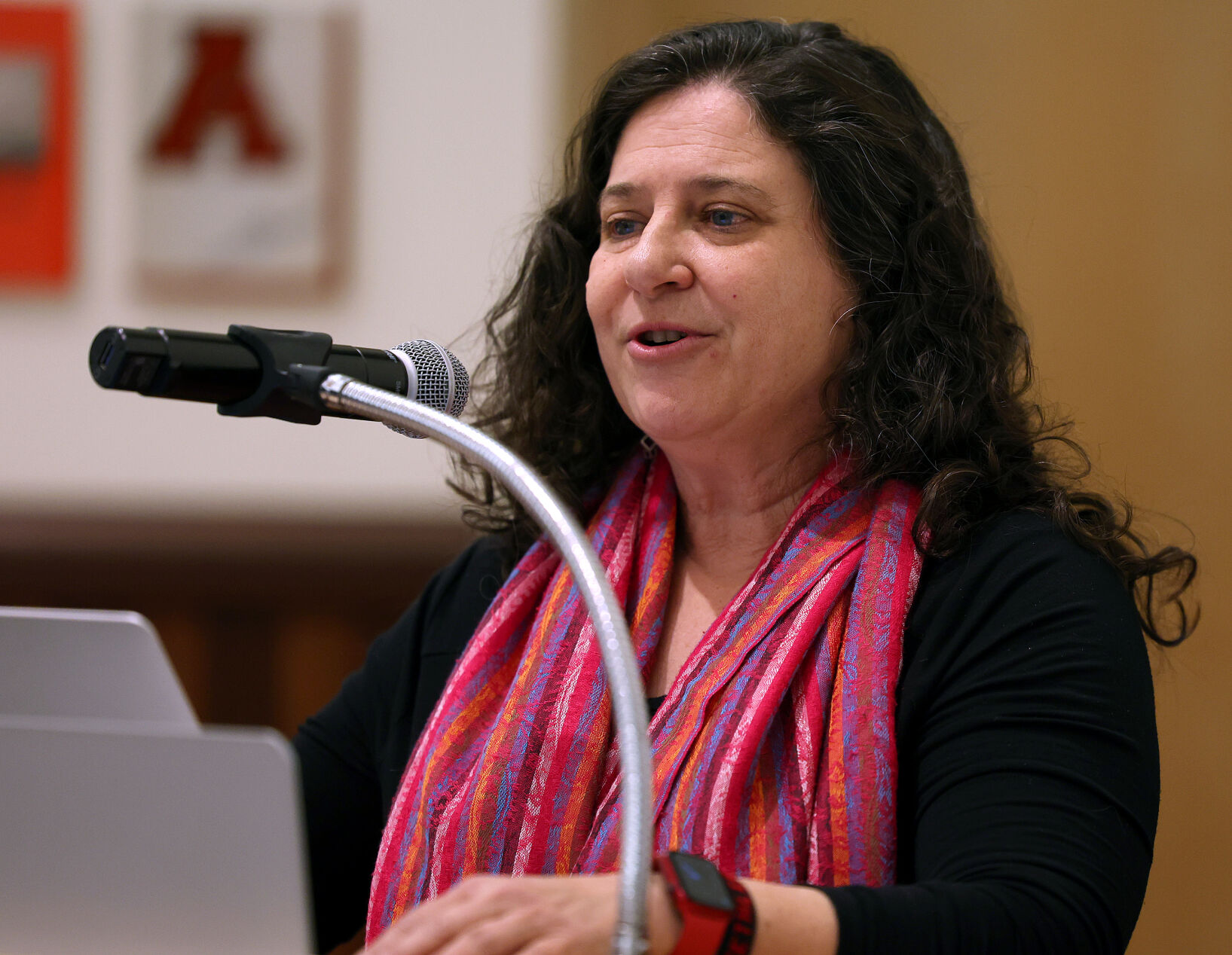
Leila Hudson, chair of the faculty.
“The ongoing struggles around how we continue to be inclusive of everyone and how we support everyone on campus, those come with some budgetary threats specifically from the state,” Hudson said. “So, you know, the real challenge is to build a better model in real time in a high-pressure environment. And of course, I think we’re up to that job.”
Since January, the Trump administration has eliminated numerous federal research grants at universities and capped overhead research costs. President Donald Trump has ordered universities to end diversity, equity, inclusion and accessibility (DEIA) activities, under threat of losing federal funding.
Arizona’s Republican-controlled Legislature threatened universities with the loss of state funding if DEIA activities — which it calls illegal discrimination – aren’t ended.
Additionally, in April, the U.S. Department of Homeland Security under Trump eliminated the SEVIS (Student and Exchange Visitor Information System) records of thousands of international students studying at universities across the country and revoked their visas, making them vulnerable to arrests, detention and deportation by U.S. Immigration and Customs Enforcement or ICE agents.
International students, visa revocations
Hudson said the “international student restrictions and traumas” will almost certainly lead to a decline in some of UA’s international and other non-Arizona-based enrollments.
She said there is no “quick fix” solution to international students’ complications, instead saying the solution is in the larger restructuring and reallocating of UA resources to prioritize student success. She pointed to UA’s announcement at the June Arizona Board of Regents meeting about offering a first-semester study-abroad option to international students as a pilot program in London, to keep students on track toward their degrees.
“It’s part of this re-dedication of our resources to ensuring that we attract and serve the best students from all over the world, regardless of what the local, political or cultural climate is,” Hudson said.
If UA’s stance of not releasing numbers on international students’ visa revocations continues into the fall semester — as U.S. Secretary of State Marco Rubio says the U.S. will now aggressively revoke the visas of Chinese international students — Hudson said she will continue to push for more transparency.
In April, the UA used arguments of “privacy” and the Family Educational Rights and Privacy Act, or FERPA, through which schools are generally prohibited from “disclosing personally identifiable information from a student’s education records without the student’s consent.”
“There’s never a case in which the publicness and transparency that we aspire to is more important than a particular student’s privacy,” Hudson said. “But we also don’t want to use the privacy argument or the confidentiality argument to obscure what the entire public and community needs to know. So, as we move forward, we always will be weighing and balancing those different interests.”
Hudson said it’s also worth thinking about having faculty governance resources and expertise looking specifically at international students’ cases.
In February, she sent an email with a know-your-rights card that informed faculty of their constitutional rights in case they were stopped by law enforcement.
She said she was trying to “educate people, including non-internationals as well, as to what their constitutional rights were, to give people a little script should they find themselves in the very unprecedented situation of being asked for their papers or confronted by law enforcement for simply being who they are.”
To support international students, Hudson said she is continuing to work with student governance leaders; advocating for specific student cases with the administration to amplify voices; and working on a long-term mandate to have civics education as part of UA’s general education package.
Two months after Hudson’s know-your-rights email, the UA sent a communication to international students, faculty and scholars, asking them to carry their passports, I-94s and proof of status at all times, and be prepared to allow immigration officials to inspect their mobile devices, including their social media posts.
“What I do know is that (while) our approaches might differ, our administration certainly doesn’t differ in wanting our students to be safe and protected,” Hudson said. “I have reason to believe that the university does try to follow through with any student that requests assistance in a situation like that, and I’ll continue to advocate for that.
“We will also continue to advocate for something that we’ve not been successful in getting so far, specifically legal advice and assistance from the institution for the students who are so dependent on the institution and so central to the institution’s success.”
Elimination of federal research grants
Similarly, in terms of the elimination of federal research grants under the Trump administration, faculty leaders — including Hudson, faculty secretary Katie Zeiders and faculty vice-chair Mona Hymel — were the ones providing consistent information on the number of federal grants cancelled, the amount of money lost due to this at the UA, and the budget of the UA’s bridge funding program, which was established to help researchers whose grants were cancelled.
When asked if it was appropriate for faculty leaders to put out such crucial information instead of UA administration, Hudson said she has a statutory obligation as faculty chair to participate in policymaking for the university and that it’s a responsibility she takes very seriously even when administrators are pushing back.
“We as elected faculty leadership are in touch with our faculty. When faculty are not getting the information they want, they know to turn to us and that we can use our access and use our leverage to get information that people would like to have, or to spread information that faculty think the community should know about,” she said.
“And, whether (UA President Suresh Garimella) acknowledges it or not, this is how faculty governance and shared governance actually work. We have the pulse of the faculty especially when it’s difficult or challenging, and we will articulate those concerns.”
Hudson said the faculty governance should be a much more collaborative relationship and they haven’t established that relationship yet, but they hope to, she said.
“After all, this administration is only here because of the work that we did to unearth the issues in the previous administration,” she said.
Cultural centers and DEI
Against the backdrop of the federal and state-level pushback against DEI programming, there was a UA community outcry against the centralization of the university’s cultural and resource centers this year.
CRC directors, staff members and students protested and signed petitions against the centralization. The back and forth between them and administrators finally culminated in a centralized “Student Culture and Engagement Hub.”
Hudson expressed her outrage at the national DEI debate, saying that “catering to the needs of students who have historically been underserved by institutions like this” in meaningful ways can be seen by some as racist. “It’s made all the more absurd and outrageous when it’s coming from places that have not experienced marginalization in the same way,” she said.
Referring to the way the UA decision was finalized, Hudson said: “A culture in which decisions are made within the administration with only restricted or vetted input from people who might disagree is not conducive to smooth, good decision making. This is a case where students, faculty and staff have not been heard in the way that they should be heard.”
However, Hudson acknowledged that UA administrators are trying to preserve many aspects of the cultural centers — their physical spaces, coordinators and student workers — while complying with what they think is expected of them in this political climate. Despite this, she said students, staff and faculty against consolidation feel certain specific identities key to their experience and success are being erased.
“I think it’s less than optimal communication about intentions and support that allows misperceptions and misunderstandings to grow,” Hudson said. “So again, I think there’s always a case for having an institutional culture where people do not need to shout to be heard by the administration, and it’s on the administration to make that happen. … The students should not need to protest so loudly to have their views heard and respected.”
As for saving money through changes to the cultural centers, they’re “miniscule savings for a huge, huge hit to student experience, student success,” she said.
Hudson said faculty leaders will tackle such situations and challenges by bringing these concerns to high-level meetings and helping faculty, students and staff organize their own meetings.
Arizona bans encampments on campus
On the state level, the Arizona Legislature passed a new law this year prohibiting encampments on college and university campuses. Proponents agreed with Tucson Democratic Rep. Alma Hernandez that the law is warranted because Jewish students said they felt harassed, and had to take alternate routes across campus, during the spring 2024 protests at universities against Israel’s war in Gaza. Opponents said the law specifically targets pro-Palestinian sentiments by confusing them with antisemitism.
Hudson said the new law is an attempt to stifle the robust tradition of peaceful, non-violent protests and the exercise of people’s constitutional rights, and she finds it very disappointing.
“I’m hopeful that we’ll bounce back from that in due time as political processes in this country play themselves out, (but) until that happens, Americans and students in American universities will find other ways to make their voices heard, other places to assemble and to speak,” she said.
Priorities for the new school year
While improving communication is the overarching theme for Hudson in the new school year, she said others include:
— Repairing harm after the centralization of the cultural and resource centers;
— Restructuring what she called UA’s top-heavy administration and redirecting “scarce, precious” resources away from it to the people, places and working conditions that promote student success;
— Establishing critical faculty processes to develop UA’s online offerings including Arizona Online and the University of Arizona Global Campus;
— Increasing oversight of individual colleges;
— Stabilizing faculty and staff workloads by giving out as many multi-year appointments as they can;
— Building a new budget model to meet the university’s priorities;
— Improving the university’s government relations team to more effectively communicate the value of the UA and of higher education to state government, in particular.
Regarding the university’s approach to compliance with the Trump administration’s orders, Hudson said this is where leadership comes into play. Leadership is knowing one’s immediate cultural and political environment in a state like Arizona, where one has to recognize those realities and know how to navigate them in a sophisticated and diplomatic way, she said.
“We want a steady hand at the wheel, but we don’t want one that is ignoring information that might be difficult, challenging, critical or grounded in a community that maybe he doesn’t understand very well,” Hudson said. “So, for that reason, I would say it’s a balancing act.
“All I would say is he (Garimella) needs to listen to everyone, including people that bring sometimes difficult, sometimes challenging, sometimes critical perspectives to the table, and that will only make you better at navigating this complex environment.”

