



Go to any of Tucson’s recycling collection centers, and you may encounter this or that mess.
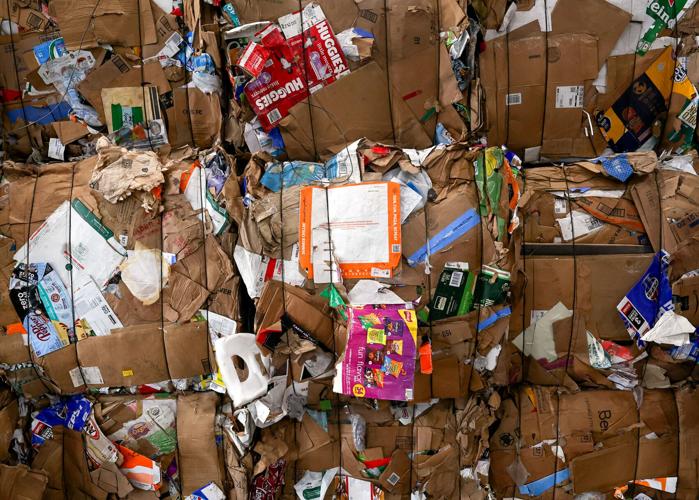
Bins may be overstuffed with cardboard. Glass piling up in its containers. A chair or table moldering away in the parking lot. Or, most likely, bags of all kinds mixing with the mandated orange bags for plastic recycling.
Tucsonans seem to love the idea of recycling. In fact, they love recycling so much they seem to be ignoring a better option — not buying disposables in the first place.
The city has accommodated this love by starting one, then another and another program for recycling plastics. The problems keep coming, though.

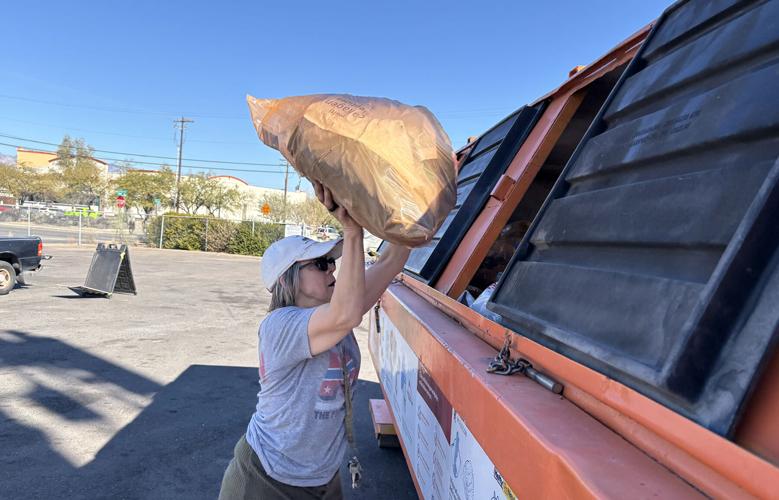
Jennifer De Metrovich drops off recycling in orange bags at the perpetually busy midtown recycling center, across the street from the Ward 6 office at 3202 E. First Street. She said while it is not necessarily convenient, using the recycling center is "better than going to the landfill."
First, then-Council Member Steve Kozachik started a pilot project for collecting hard-to-recycle plastics at his Ward 6 council office. These are plastics like bags and hangers that you can’t put in your blue container. That pilot project turned into a citywide program of collecting this same category of plastics and providing them to a company called ByFusion for making construction blocks.
That turned into an agreement with the city to build a plant for ByFusion at the Los Reales landfill. But the subsequent supply of plastics was so vast that ByFusion couldn’t handle the tonnage Tucsonans were bringing.
That’s what led the city to enter into another corporate partnership last year — joining the Hefty ReNew program. This is the program sponsored by Reynolds Consumer Products (Hefty’s corporate parent) and Dow Chemical Corp., that requires people to buy the orange bags for plastic waste and use only them for in the city’s orange bins. They then take the plastics that ByFusion can’t use for remanufacture into other products.
Our excessive exuberance over getting rid of stuff has led to the recent closure of one recycling center. The one at the Ward 4 office, 8123 E. Poinciana Drive, closed at the beginning of the year because too many people were using it as a dump for their debris.

Tucsonans seem to love the idea of recycling. In fact, they love recycling so much they seem to be ignoring a better option — not buying disposables in the first place.
A similar fate could await the perpetually busy midtown recycling center, across the street from the Ward 6 office at 3202 E. First Street. Dumping has occurred there, and the cardboard containers are frequently overflowing. Also the orange bins for recycling plastic were perhaps half-full of non-compliant bags when I visited on Thursday. Everything not in an orange Hefty ReNew bag will likely be thrown out.
Jennifer De Metrovich, who was dropping off recycling in orange bags when I was there, told me the transition to store-bought special bags wasn’t great.
“It’s been a pain in the ass, but it’s better than going to the landfill,” she said.
Council Member Karin Uhlich, who replaced Kozachik after he resigned in March, told me the biggest problem at the Ward 6 site has been people not breaking down their boxes, which leads to the cardboard bins overflowing. Then people leave cardboard on the ground outside the bins.
“We don’t want to close it down. We just really need people’s help,” she said.
The good news is that the last week work began on the plant at the Los Reales Sustainability Campus, where ByFusion will make its so-called ByBlocks — the pressed plastic construction blocks. Uhlich told me her hope is that once the plant is built, ByFusion’s increased capacity for taking hard-to-recycle plastics will reduce the need for the Hefty ReNew program.
I hope so, too. It is hard to swallow that two big manufacturers of plastic products, Dow and Reynolds, are charging us for the bags we must use for them to turn the plastic products they make into some other product.
More importantly, our urge to recycle plastics seems to have overwhelmed our awareness of the need to reduce our consumption.
“We really have to emphasize the reduce and reuse part of the equation. It’s not just recycle. It’s reduce, reuse and recycle,” Uhlich said.
In fact, local group Sustainable Tucson, which is not affiliated with the city government, came out in opposition to the Hefty ReNew program in August. A report by the group concluded “The Hefty ReNew program perpetuates wasteful throwaway systems and single-use habits.”
“What’s more,” the report goes on, “keeping us awash in plastics is ‘Plan B’ for the oil and gas industry as the world moves away from fossil fuels for energy and transportation due to mounting climate change concerns.”
Kevin Greene, one of the authors of the report, told me the city and residents “are looking at plastics as a waste issue. They’re not considering the upstream environmental impacts of plastics.”
“You’ve got to move upstream,” he said. “You’ve got to attack the problem at the source.”
Reducing the plastics we buy is an even harder problem than building capacity to reuse existing plastic. But go to any of the recycling centers and you’ll see that we need to move that direction.
Even our ambitious and inventive efforts to reuse plastic are inadequate so far to the task of handling the tons of junk we consume.

