




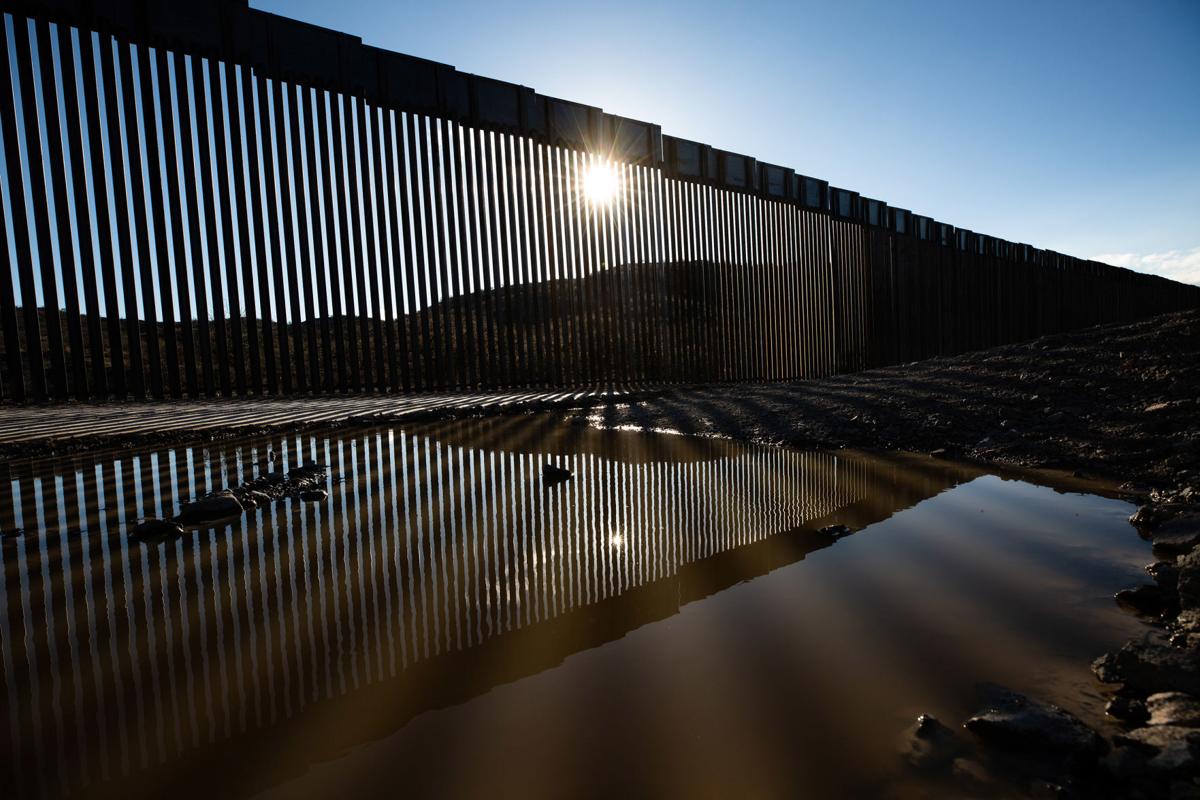
Republican Gov. Doug Ducey highlighted border security as one of his main priorities, both in his State of the State address and in his executive budget released earlier this month. But many of his comments leave questions about how his goals will be accomplished — and his office is not saying.
The executive budget includes $11.6 million to expand the Border Strike Force by doubling Department of Public Safety support and tripling local law enforcement grants. The budget also includes $50 million for the Border Security Fund for enhanced patrolling, physical barriers, detention and prosecution.
Not only do some of the measures in Ducey’s plan leave questions about how they would work, but Democrats and Republicans running county law enforcement agencies — whose help is a part of the governor’s plan — have fundamentally different views from each other on what’s happening at the border.
Ducey’s press office did not respond to numerous Star requests for comment.
Human smuggling is a federal issue
Included in the proposed budget is $20 million, yet to be allocated, for distribution to cities, towns or counties for costs associated with prosecuting and imprisoning individuals charged with border-related crimes. In addition to helping county courts and prosecutors recruit and retain workers, it is intended to expand their capacity to aggressively pursue border-related offenses.
“The human traffickers that prey on the desperation of people looking for a better life need to pay the consequences,” Ducey said during his State of the State address on Jan. 10. “It’s time for us to increase the criminal penalties against human smuggling and provide more funding to border counties to ensure prosecution and incarceration.”
However, prosecuting human smuggling is exclusively the jurisdiction of the federal government. A federal judge struck down the state’s ability to prosecute human smuggling in 2014 after finding that the state overreached into federal jurisdiction as part of SB 1070 — the controversial 2010 law that has local law enforcement ask the immigration status of anyone they think might be undocumented.
While county attorneys aren’t allowed to prosecute human smuggling or increase those penalties, they do occasionally prosecute human smugglers themselves, for crimes such as homicide, kidnapping, aggravated assault and fleeing from law enforcement, says Deputy Pima County Attorney Chris Ward. But when these cases involve a known human-smuggling group, the U.S. Attorney’s Office is likely to handle it.
Another border-related crime that the county prosecutes is drug trafficking, though most of the county’s drug trafficking cases don’t involve drugs that recently crossed the international border because the federal government often handles those cases, Ward said.
Where will state erect barriers?
The governor also announced partnering with Texas’ Republican Gov. Greg Abbott to create the American Governors’ Border Strike Force, which he said will patrol the border and erect walls or other physical barriers in areas where the state can do so along the U.S.-Mexico border.
“Our border is a patchwork of federal, state, tribal and private lands,” Ducey said during his speech. “Where Arizona can add physical barriers to the border, we will.”
Much of the Southern Arizona border is federal land and tribal land, with some private property and a small amount of state trust land. Also, most of Arizona’s southern border already has barriers.
Many places without a man-made barrier have natural barriers of mountainous landscapes that would be costly places to build a barrier, such as in the Pozo Verde Mountains, one section with state land.
Counties run by Dems left out
The executive budget also outlines funding for some border county sheriff’s departments, leaving out Pima and Santa Cruz counties — the two counties on the border with Democratic sheriffs.
The executive budget says that some funding has already been allocated from the Border Security Fund, including $3.7 million for Cochise County, nearly $1.8 million for the Cochise County Sheriff’s Office, $2.5 million for Yuma County, with the possibility of $675,000 for the Yuma County Sheriff’s Office, $675,000 for the Pinal County Sheriff’s Office, $675,000 for the Department of Public Safety and $25 million for the Southern Arizona Law Enforcement Mission, which is funding National Guard troops in some Republican-led border counties.
Santa Cruz County, which encompasses Nogales, is not dealing with an influx of border-related crimes, said Sheriff David Hathaway. Despite there being drug seizures by federal agencies at ports of entry, crime rates in the county are lower than the state averages, he said.
Hathaway said Santa Cruz and Pima counties might have been left out of border-related allocations from the state because they both declined having the National Guard on their borders.
“Ducey is having his battle with the feds. He’s trying to make the border a sensational crisis issue. He’s declared his border crisis, and the federal government has not declared a border crisis. So he has tried to do things like send National Guard troops to the border counties, and I have refused to let him militarize Santa Cruz County,” Hathaway said.
Ducey told news outlets that U.S. Department of Homeland Security Secretary Alejandro Mayorkas wasn’t doing enough to enforce “the rule of law” and should either resign, that Biden should fire him or that Congress should impeach him, following a visit by Mayorkas to the Arizona border in Yuma on Wednesday. No press was invited, but an audio recording leaked to Townhall.com shows tension between Border Patrol agents and the secretary.
The Yuma Sector of the border has seen the highest numbers of migrant apprehensions in the state in fiscal year 2021, at nearly 114,500, the third highest year on record after 2005 and 2006.
Santa Cruz County sees lower numbers of migrants crossing illicitly because of the inhospitable terrain — mountainous with high elevations and cold nights.
Hathaway said he’s seen fluctuations in trends of migrant crossings, under both Republican and Democratic presidents, which is consistent with data from Customs and Border Patrol.
“Ducey tries to make it a Republican versus Democrat thing. But if you look at it — all the years of Clinton, all eight years except for one, was well over a million apprehensions, but the same was true under Bush Sr. and Bush Jr. All the Obama years were low, under half-a-million those years and the same under Trump. So it’s kind of a cyclical thing, but it’s not a Republican versus Democrat thing,” Hathaway said, citing Customs and Border Protection data.
GOP sheriffs’ different prism
Border counties with sheriff’s departments run by Republicans have a different take on how their communities are affected by crime related to the border.
“As Arizona’s elected law enforcement leaders across the state, we continue to see the border situation deteriorate and it is having real impacts on all of our communities,” says an open letter to U.S. Sens. Mark Kelly and Kyrsten Sinema, Arizona Democrats, signed by the Cochise and Pinal county sheriffs.
The letter cites the increase in drug overdose deaths nationwide, with more than 100,000 Americans dying during a 12-month period ending in April 2021, an increase of 28.5% over the same period the year before.
Drug smuggling is one of the main border-related issues affecting Pinal County, says Sheriff Mark Lamb, citing two cases of young women he says died of fentanyl overdoses last year.
“This is becoming a real epidemic, not just for Pinal County, but for everybody in America that is susceptible to fentanyl, which is everybody,” he said.
The number of traffic stops in Pinal County where deputies find vehicles that are either smuggling humans or drugs increased dramatically over the last year, Lamb says.
“For example, a canine unit had seven traffic stops in one shift. All seven of them were human-load vehicles, people with camouflage clothes, carpet shoes, making their way into this country illegally,” he said.
The Border Patrol encountered nearly 312,000 migrants on Arizona’s southern border in 2021, about 3.8 times more than the previous year, though many of those encounters were with people crossing numerous times since Border Patrol sent many migrants directly back to Mexico.
In 2018, the Pinal sheriff’s department had virtually no fentanyl pill seizures; in 2019 it had 677; in 2020 it seized more than 200,000 pills; and in 2021 it seized 1.2 million pills, Lamb said.
The amount of potentially deadly drugs coming over the entire U.S. border with Mexico has increased. But in the last few years, the amount of marijuana seized at the border has plummeted, as Arizona and many other states legalized the once-illicit drug.
So while the overall amount of drugs seized at the southern border in fiscal year 2021 was 13% less than what was seized in 2020, as the U.S. appetite for Mexican marijuana diminished, the amount of fentanyl seized at the southern border increased yearly by 73% in 2020 and more than doubled in 2021. At the same time, seizures of methamphetamine also increased, by nearly 30% in 2020 and almost 7% in 2021.
Pinal deputies also find money and drug loads that are going south into Mexico, pursue people trying to evade contact, and recover backpacks, camouflage clothes and carpet shoes, which migrants sometimes wear to hide footprints, in the desert from people who entered the country illegally, Lamb said.
Pinal County is not on the border — the southern end is 50 to 60 miles away — but Lamb says cartels push groups of migrants through the desert on the Tohono O’odham Nation into the county. As well, drug smugglers who make it through ports of entry undetected may get pulled over on the interstate by Pinal law enforcement.
“Our workload has increased substantially, to coincide with all of the other numbers that we’ve seen on a national level,” Lamb said. “This is a huge problem. And we saw an astronomical increase compared to what we used to get under the last (presidential) administration.”
The letter to Arizona senators asks for a number of measures, drafted by Ducey’s office, aimed at tightening security between ports of entry, which wouldn’t solve the drug problem since most illicit drugs come through ports of entry.
Although the amount of fentanyl seized at the Southern Arizona border in 2021 increased by nearly 65% from the previous year, more than 86% of that was seized at a port of entry.
But Lamb says if those measures are in place, including completing the border wall, allowing asylum seekers to ask for asylum only at a port of entry, and allocating additional money for enforcement and humanitarian efforts, it would allow more manpower to be focused on stopping drug smuggling through ports of entry.
“To allow these things to happen on our watch, to allow drugs to come into our communities, to allow human beings to be exploited by the cartels, to allow criminals to come into our communities, that is not the American way, and that has nothing to do with politics,” Lamb said.
The sheriffs’ letter also cites numbers of convictions of certain crimes by migrants apprehended by the Border Patrol, including violent crimes and drug possession. The number of total convictions is nearly 4½ times higher than in 2020, especially the number of people whose crime was entering the country illegally more than once, which amounts to nearly 40% of the crimes.
Even with the increase, the number of people convicted of crimes trying to enter the country, at about 10,760, is small compared to those who don’t have a known criminal record. As well, people with a prior conviction apprehended more than once are included multiple times in this number, also enlarging the count since the rate of people crossing more than once increased in 2021 as many migrants were sent directly back to Mexico because of the pandemic. It’s also important to note, these are people who mostly were in the U.S. legal system and already served out any jail sentence. The number of migrants encountered in 2021 with outstanding warrants was slightly less than 2020, at 1,900.
And there is not a significant record of violent or property crimes committed by undocumented people in Pinal County, Lamb says.
Border is quiet, says Pima sheriff
The Pima County Sheriff’s Department averages 130,000 calls received a year, and less than 250 of those calls are from the border region and even then, few have to do with a border crime, says Sheriff Chris Nanos.
In those border communities, the Sheriff’s Department has responded to 11 homicides in the last 35 years, and none of those were related to anyone crossing the border.
Nanos said his department could use more funding, but he doesn’t need the National Guard on the border.
“I have 130,000 calls a year and yet my staffing has been reduced over the last four or five years by some 25% or 30%. That’s an issue,” Nanos said. “I need some help, but it’s not because of the border. It’s just here in Pima County, the metropolitan area, where we can actually address real problems.”
A news release the Governor’s Office put out in October equated a crime increase in urban areas with the border.
“Because our border sheriffs have to spread their personnel between the border and the rest of their counties, there are far fewer officers patrolling our streets and keeping Arizonans safe. Homicides in Tucson are up almost 60% compared to this time last year,” the news release said.
The Tucson Police Department is in the process of analyzing last year’s homicides and why there was such an increase, but there is nothing obvious showing that any of the homicides were border-related, says spokesman Sgt. Richard Gradillas. Also, no Tucson officers are covering anything to do with the border.
The Governor’s Office didn’t respond to numerous requests to explain what it meant by prosecuting human smuggling, building border barriers or why Pima County and Santa Cruz County law enforcement were excluded from the money that’s been allotted so far to law enforcement in border counties.
“I was elected here in Pima County to deal with public safety in Pima County,” Nanos said. “And I look at real data. If I have people calling me to Sasabe, Lukeville, Sells, wherever it may be, we respond. But I’m getting 0.00189% of calls down there for service.”
Photos of the U.S. – Mexico border fence
U.S. – Mexico border near Douglas, Ariz.
Updated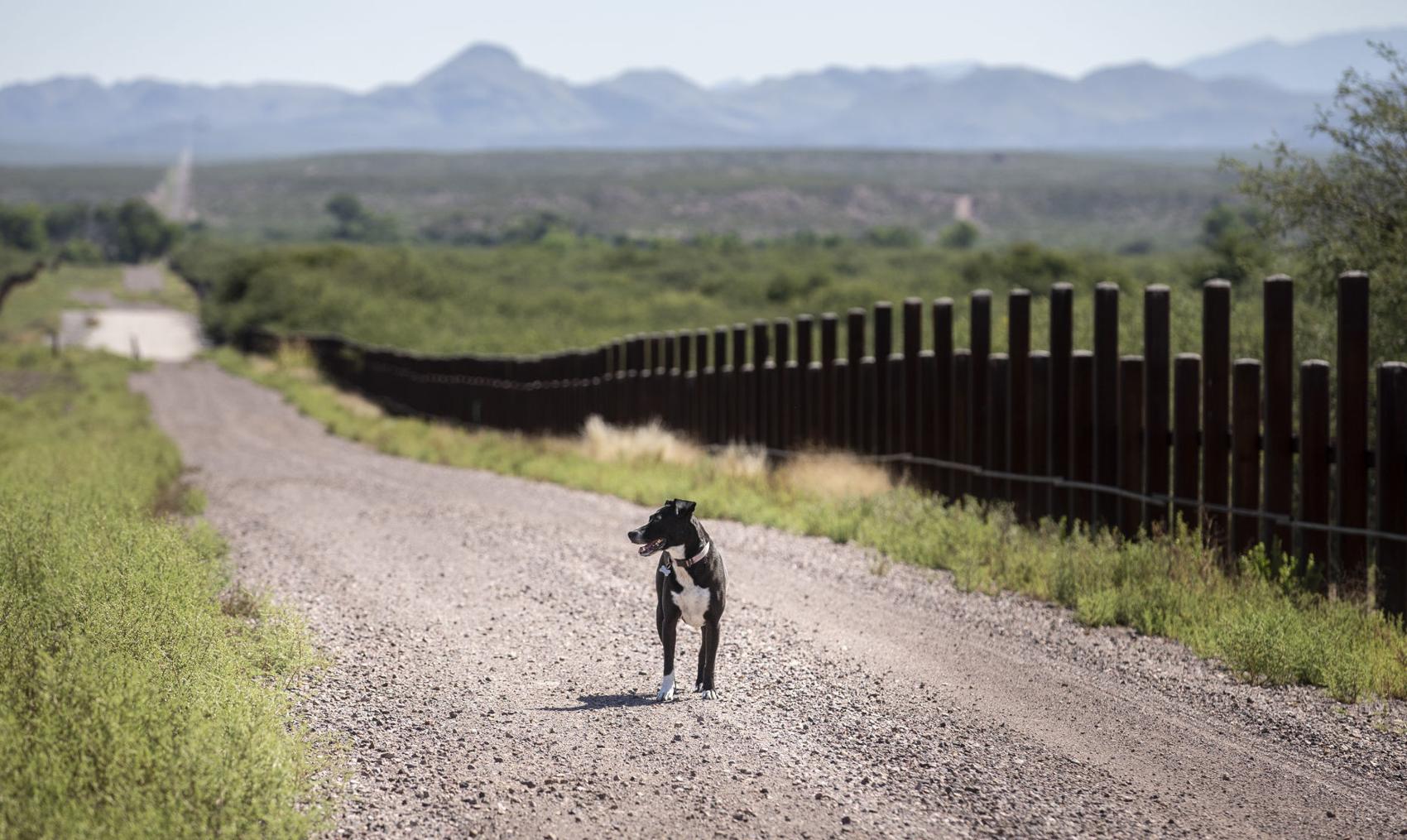
A dog stands on a road commonly used by Border Patrol near Slaughter Ranch Museum Thursday, Sept. 27, 2019.
U.S. – Mexico border near Douglas, Ariz.
Updated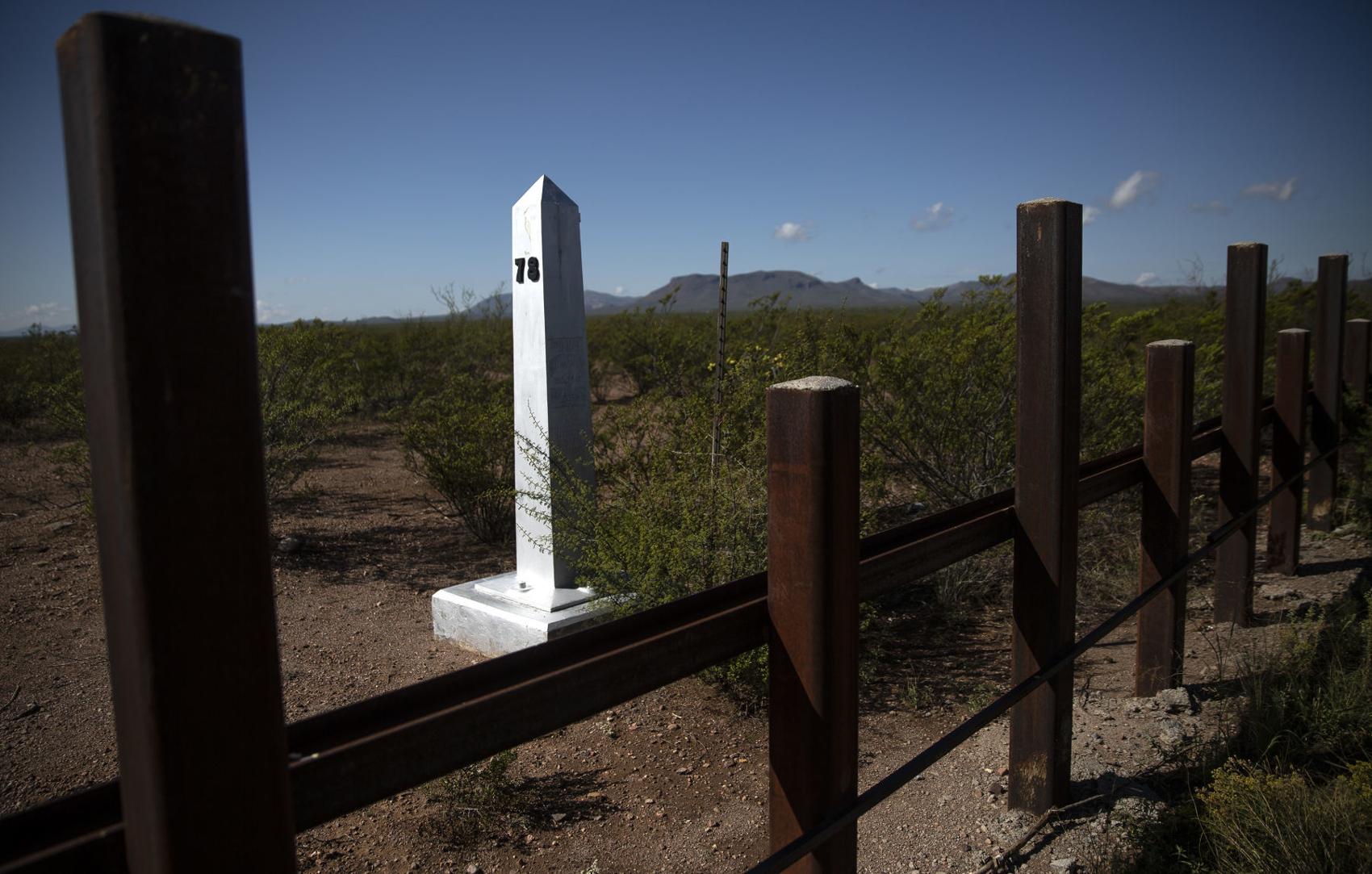
A border monument on the Mexico side of the border seen east of Douglas Thursday, Sept. 27, 2019.
U.S. – Mexico border near Douglas, Ariz.
Updated
The San Bernardino National Wildlife Refuge sits on the U.S. side of the border with Mexico east of Douglas Thursday, Sept. 27, 2019.
U.S. – Mexico border near Douglas, Ariz.
Updated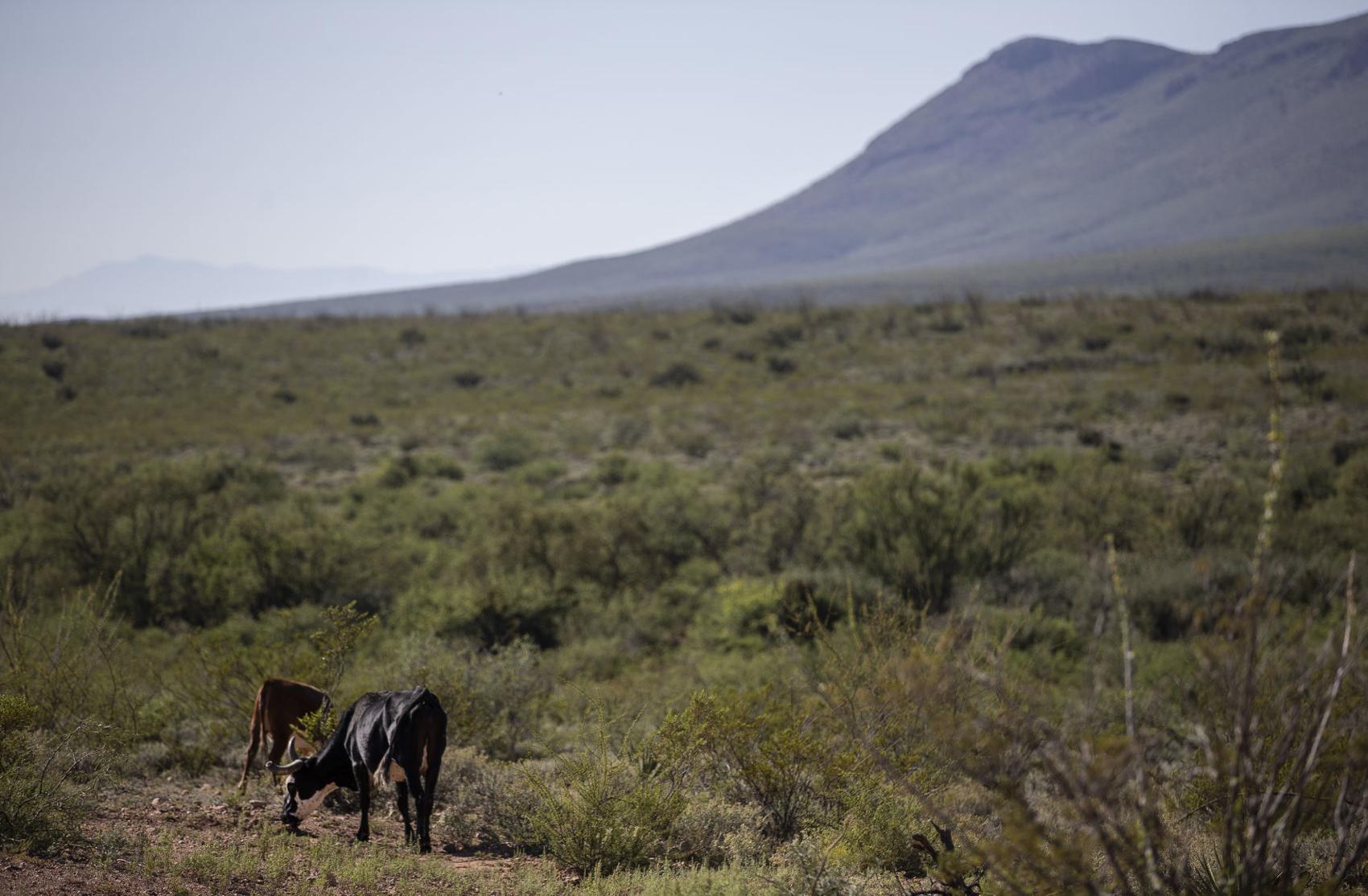
A bull and cow graze near the site of new wall construction east of Douglas Thursday, Sept. 27, 2019.
U.S. – Mexico border near Douglas, Ariz.
Updated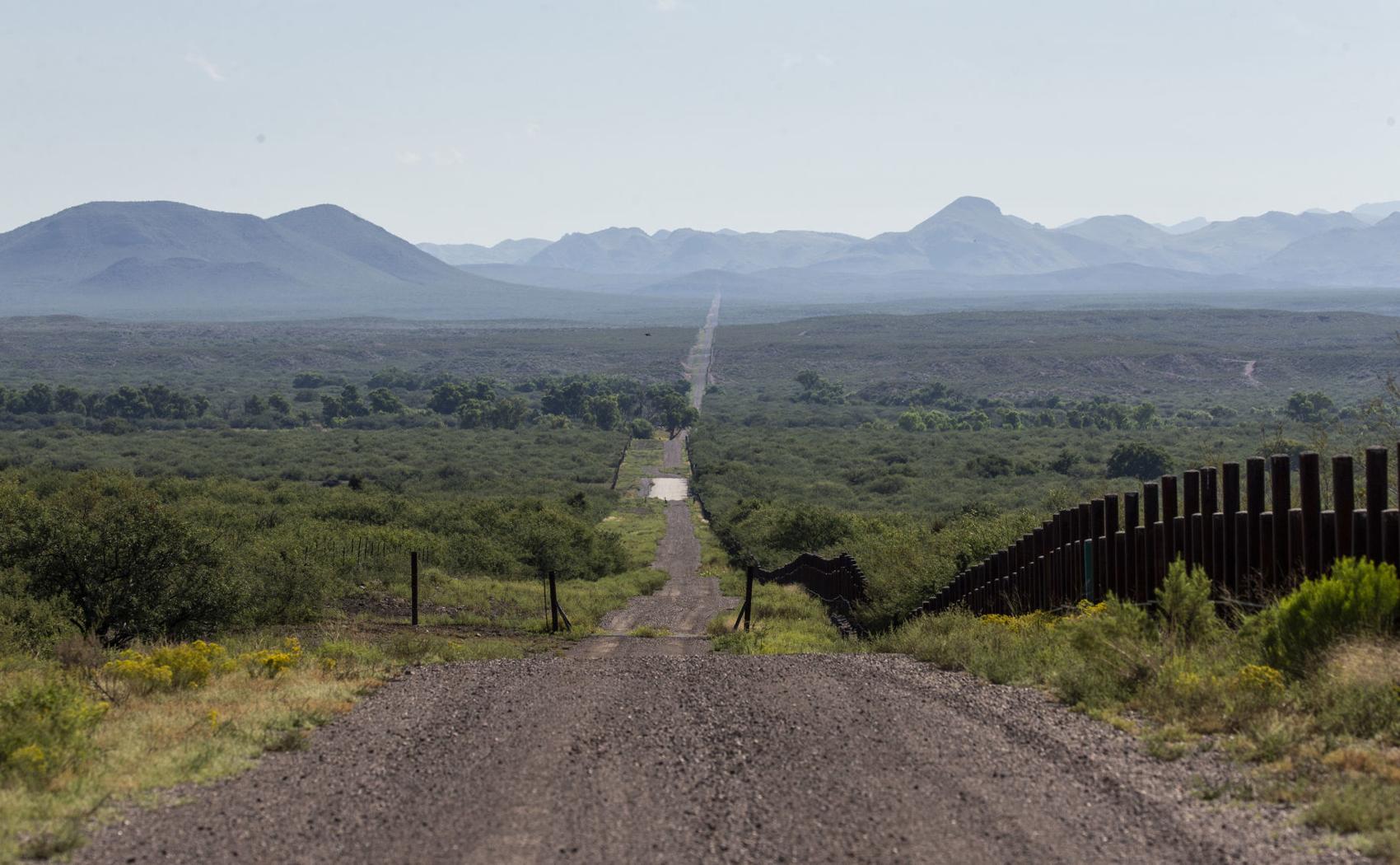
The border seen stretching from hills east of Douglas into the Guadalupe Mountains Thursday, Sept. 27, 2019.
U.S. – Mexico border near Douglas, Ariz.
Updated
Flowers grow around border fencing near the San Bernardino National Wildlife Refuge Thursday, Sept. 27, 2019.
U.S. – Mexico border near Douglas, Ariz.
Updated
Construction equipment set up at the site of new border wall construction on the US/Mexico border east of Douglas Thursday, Sept. 27, 2019.
U.S. – Mexico border near Douglas, Ariz.
Updated
A Border Patrol tower on the hills east of Douglas Thursday, Sept. 27, 2019.
U.S. – Mexico border near Douglas, Ariz.
Updated
Memorials place on graves at Julia Page Memorial Park in Douglas which sits along the U.S./Mexico border Thursday, Sept. 27, 2019.
U.S. – Mexico border near Douglas, Ariz.
Updated
A car drives through Douglas on a road parallel to the U.S./Mexico border wall Thursday, Sept. 27, 2019.
U.S. – Mexico border near Douglas, Ariz.
Updated
The Slaughter Ranch homestead Thursday, Sept. 27, 2019.
U.S. – Mexico border near Douglas, Ariz.
Updated
A lake on the Slaughter Ranch Thursday, Sept. 27, 2019.
U.S. – Mexico border near Douglas, Ariz.
Updated
A toy rocking horse placed on the side of East Geronimo Trail with a sign advertising five minute pony rides for 25 cents Thursday, Sept. 27, 2019.
U.S. – Mexico border near Douglas, Ariz.
Updated
Highway 2 in Mexico winds its way to Agua Prieta Thursday, Sept. 27, 2019.
U.S. – Mexico border near Douglas, Ariz.
Updated
The vehicle in a ditch was driven through the international border fence in Agua Prieta, Mex., into Douglas, Arizona in July 1987.
U.S. – Mexico border near Douglas, Ariz.
Updated
Mexican citizens run back into Agua Prieta, Mexico through a hole in the border fence at Douglas, Ariz., after the U.S. Border Patrol scared them back across the border in 1997.
U.S. – Mexico border near Douglas, Ariz.
Updated
The Raul Hector Castro Port of Entry on May 1, 2018, in Douglas, Ariz.
U.S. – Mexico border near Douglas, Ariz.
Updated
The Douglas, Ariz., border crossing in 1968.
U.S. – Mexico border near Lochiel, Ariz.
Updated
U.S./Mexico border fencing next to a old church building in Lochiel Tuesday, Oct. 1, 2019.
U.S. – Mexico border near Lochiel, Ariz.
Updated
Old border posts line the U.S./Mexico line near Lochiel Tuesday, Oct. 1, 2019.
U.S. – Mexico border near Lochiel, Ariz.
Updated
A Soal Off Roading sticker placed on a U.S./Mexico border post near Lochiel Tuesday, Oct. 1, 2019.
U.S. – Mexico border near Lochiel, Ariz.
Updated
Mountains in Santa Cruz County seen from Duquesne Road between Nogales and Lochiel seen Tuesday, Oct. 1, 2019.
U.S. – Mexico border near Lochiel, Ariz.
Updated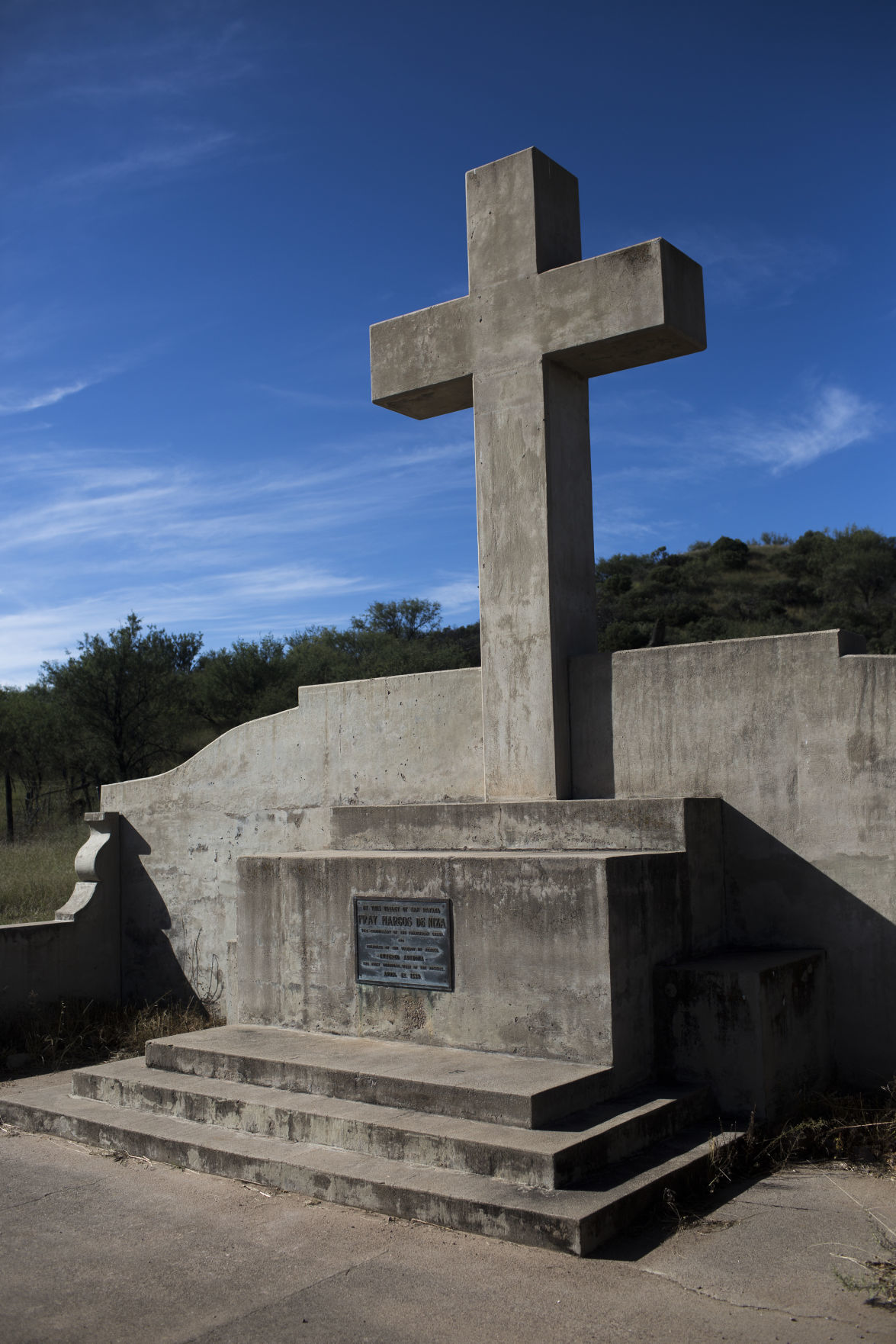
A monument in Lochiel marking where Fray Marcos De Niza entered Arizona Tuesday, Oct. 1, 2019.Tuesday, Oct. 1, 2019.
U.S. – Mexico border near Lochiel, Ariz.
Updated
Brothers Ramon and Ed De La Ossa mend fencing on their family's ranch in Lochiel after moving cattle Tuesday, Oct. 1, 2019. The ranch which used to span both sides of the U.S./Mexico border has been in the family for three generations.
U.S. – Mexico border near Lochiel, Ariz.
Updated
Ed De La Ossa mends fencing on his family's ranch in Lochiel Tuesday, Oct. 1, 2019. The ranch which used to span both sides of the U.S./Mexico border has been in the family for three generations.
U.S. – Mexico border near Lochiel, Ariz.
Updated
Ed De La Ossa moves cattle on his family's ranch in Lochiel Tuesday, Oct. 1, 2019.
U.S. – Mexico border near Lochiel, Ariz.
Updated
U.S. Customs inspector Helen Mills, right, greets Mexican counterpart Raymundo Aguirre Castillo at the U.S. - Mexican border station at Lochiel, Ariz., in 1979.
U.S. – Mexico border near Lochiel, Ariz.
Updated
The US Customs building, right, at Lochiel, Ariz., is just a short distance away from the international border in May 1972. For ten years, Mills has been managing the port of entry, which is mostly made up of five houses, a school and an vacant church, inspecting vehicles as they head into the US. During the week, from Monday through Saturday, Mills opens the border gate from 8 am to 10 am and from 4 pm to 6 pm. On Sunday the gate is open from 8 am to 6 pm. In that time barely a dozen vehicles make their way across the border but it is a major convenience to the local residents.
U.S. – Mexico border near Nogales, Ariz.
Updated
Pedestrians walk to the Nogales port of entry Tuesday, Oct. 1, 2019.
U.S. – Mexico border near Nogales, Ariz.
Updated
A pedestrian walks across North Grand Avenue in Nogales near the U.S./Mexico port of entries Tuesday, Oct. 1, 2019.
U.S. – Mexico border near Nogales, Ariz.
Updated
U.S. Customs and Border Protection officer R. Hernandez uses a density-measuring device on the rear quarter-panel of a Mexico-bound passenger vehicle at the DeConcini Port of Entry on Nov. 2, 2016, in Nogales, Ariz.
U.S. – Mexico border near Nogales, Ariz.
Updated
A Customs and Border Protection officer makes a visual check of a man's identification at the DeConcini Port of Entry on Feb. 15, 2017, in Nogales, Ariz. Busts of fraudulent border-crossing documents and the use of someone else's documents plummeted in Arizona and the rest of the border in the past decade.
U.S. – Mexico border near Nogales, Ariz.
Updated
Northbound commercial truck traffic lined up for inspection at the Mariposa Port of Entry on March 28, 2017, in Nogales, Ariz.
U.S. – Mexico border near Nogales, Ariz.
Updated
In the commercial lanes a semi truck stops between the lanes looking for the first available opening at the Mariposa Port of Entry in 2015.
U.S. – Mexico border near Nogales, Ariz.
Updated
Javier Castillo inspects a north-bound Mexican tractor-trailer at the Arizona Department of Transportation's inspection facility at the Mariposa Port of Entry on Sept. 19, 2017, in Nogales, Ariz. ADOT's International Border Inspection Qualification program, led by ADOT's Border Liaison Unit, teaches commercial truck drivers what to expect during safety inspections when they enter Arizona ports of entry.
U.S. – Mexico border near Nogales, Ariz.
Updated
A Border Patrol truck parked near the commercial port of entry in Nogales.
U.S. – Mexico border near Nogales, Ariz.
Updated
An illegal alien scales the U.S.-Mexico fence back toward Sonora after a Nogales Police Department officer, right, spotted him west of the Mariposa Port of Entry, Nov. 15, 2018, in Nogales, Ariz.
U.S. – Mexico border near Nogales, Ariz.
Updated
Kory's, a store catering to wedding, quincea–era and formal gowns, located at 15 N Morley Ave, Nogales, Ariz., sits katty corner to the Morley Gate Border Station on January 30, 2019.
U.S. – Mexico border near Nogales, Ariz.
Updated
Sun shines through the U.S.-Mexico bollard fence west of the Mariposa Port of Entry, Nov. 15, 2018, in Nogales, Ariz.
U.S. – Mexico border near Nogales, Ariz.
Updated
Children from Nogales, Sonora, climb through a hole in the international border fence to trick-or-treat in Nogales, Arizona, on Halloween in 1987.
U.S. – Mexico border near Sasabe and Lukeville, Ariz.
Updated
Border monument #166 is seen on the right as construction continues on the new 30-foot tall bollard fence that replaces old U.S./Mexico border fence two miles east of the Lukeville, Arizona port of entry on October 8, 2019. Photo taken from Sonoyta, Sonora, Mexico.
U.S. – Mexico border near Sasabe and Lukeville, Ariz.
Updated
Construction continues on the new 30-foot tall bollard fence along the U.S./Mexico border two miles east of the Lukeville, Arizona port of entry on October 8, 2019. Photo taken from Sonoyta, Sonora, Mexico.
U.S. – Mexico border near Sasabe and Lukeville, Ariz.
Updated
A Mexican worker rides his horse along a road south of the U.S./Mexican border wall on his way back into Sonoyta Wednesday, Aug. 28, 2019.
U.S. – Mexico border near Sasabe and Lukeville, Ariz.
Updated
New paneling of border wall seen about three miles east of the Lukeville/Sonoyta port of entry seen from the Mexico side of the border line Wednesday, Aug. 28, 2019.
U.S. – Mexico border near Sasabe and Lukeville, Ariz.
Updated
Old mesh paneling is removed in preparation for new wall to be built about three miles east of the Lukeville/Sonoyta port of entry seen from the Mexico side of the border line Wednesday, Aug. 28, 2019.
U.S. – Mexico border near Sasabe and Lukeville, Ariz.
Updated
A construction worker prepares cables to lift a piece of the 30-foot tall bollard fence along the U.S./Mexico border fence two miles east of the Lukeville, Arizona port of entry on October 8, 2019. Photo taken from Sonoyta, Sonora, Mexico.
U.S. – Mexico border near Sasabe and Lukeville, Ariz.
Updated
Border Patrol Officers to the side of a worksite about three miles east of the Lukeville/Sonoyta port of entry where new border wall is being installed seen from the Mexico side of the border line Wednesday, Aug. 28, 2019.
U.S. – Mexico border near Sasabe and Lukeville, Ariz.
Updated
Old wall east of the Lukeville/Sonoyta port of entry seen from the Mexico side of the border line Wednesday, Aug. 28, 2019.
U.S. – Mexico border near Sasabe and Lukeville, Ariz.
Updated
Raised wall east of the Lukeville/Sonoyta port of entry seen from the Mexico side of the border line Wednesday, Aug. 28, 2019.
U.S. – Mexico border near Sasabe and Lukeville, Ariz.
Updated
A work site east of the Lukeville/Sonoyta port of entry seen from the Mexico side of the border line Wednesday, Aug. 28, 2019.
U.S. – Mexico border near Sasabe and Lukeville, Ariz.
Updated
Normandy fencing placed against a section of border fence west of Lukeville Wednesday, Aug. 28, 2019.
U.S. – Mexico border near Sasabe and Lukeville, Ariz.
Updated
A semi passes by Quitobaquito Springs as it drives along Highway 2 in Mexico Wednesday, Aug. 28, 2019.
U.S. – Mexico border near Sasabe and Lukeville, Ariz.
Updated
An area referred to as "flood gate" along the U.S./Mexico border near Sasabe, Ariz. is on the list of the Department of Homeland Security’s priorities for building a border wall, but no funding has been allocated yet. September 16, 2019.
U.S. – Mexico border near Sasabe and Lukeville, Ariz.
Updated
Vehicle barriers mark the U.S./Mexico border within the Buenos Aires National Wildlife Refuge in Sasabe, Ariz. on September 16, 2019.
U.S. – Mexico border near Sasabe and Lukeville, Ariz.
Updated
A portion of the U.S./Mexico bollard border fence ends on the right and vehicle barriers begin within the Buenos Aires National Wildlife Refuge in Sasabe, Ariz. on September 16, 2019.
U.S. – Mexico border near Sasabe and Lukeville, Ariz.
Updated
A U.S. Customs and Border Protection Integrated Fixed Tower, left, near Sasabe, Ariz. on September 16, 2019.
U.S. – Mexico border near Sasabe and Lukeville, Ariz.
Updated
The new 30-foot tall bollard fence that replaced old U.S./Mexico border fence can be seen on the left. It's located about miles east of the Lukeville, Arizona port of entry on October 8, 2019. Photo taken from Sonoyta, Sonora, Mexico.
U.S. – Mexico border near San Luis, Ariz.
Updated
A US Border Patrol vehicle seen next to a section of new 30 foot high wall along the US/Mexico border near the commercial port of entry in San Luis Thursday, Aug. 8, 2019.
U.S. – Mexico border near San Luis, Ariz.
Updated
Old fencing is taken down along the United States/Mexico border seen from the northern end of San Luis, Mexico, Aug. 7, 2019.
U.S. – Mexico border near San Luis, Ariz.
Updated
A security guard stand in a construction site where a new fence will be placed on the United States/Mexico border seen from the northern end of San Luis, Mexico, Aug. 7, 2019.
U.S. – Mexico border near San Luis, Ariz.
Updated
Old fencing against new fencing along the United States/Mexico border seen from the northern end of San Luis, Mexico on Aug. 7, 2019.
U.S. – Mexico border near San Luis, Ariz.
Updated
Crews prepare ground for a new fence to be placed on the United States/Mexico border seen from the northern end of San Luis, Mexico on Aug. 7, 2019.
U.S. – Mexico border near San Luis, Ariz.
Updated
Vehicles in line to enter the United States from San Luis, Mexico on Aug. 7, 2019.
U.S. – Mexico border near San Luis, Ariz.
Updated
New fencing along the United States/Mexico border seen from the northern end of San Luis, Mexico on Aug. 7, 2019.
U.S. – Mexico border near San Luis, Ariz.
Updated
A new section of fencing on the U.S. - Mexico border in California, just west of Yuma, Ariz., in 1993.
U.S. – Mexico border near San Luis, Ariz.
Updated
Sand drifts through the "floating fence" that marks the border running through the dunes, Wednesday, July 25, 2018, west of San Luis, Ariz.
U.S. – Mexico border near San Luis, Ariz.
Updated
A sign warns of the dangers of trying to swim the All-American Canal just north of the Mexican border, Wednesday, July 25, 2018, west of San Luis, Ariz.
U.S. – Mexico border near San Luis, Ariz.
Updated
A long string of lights illuminate the no-man's land between the triple fencing of the Mexican border, Wednesday, July 25, 2018, San Luis, Ariz.
U.S. – Mexico border near San Luis, Ariz.
Updated
The border fence comes to an abrupt end at the currently dry Colorado River, Thursday, July 26, 2018, west of San Luis Rio Colorado, Sonora.

