




PHOENIX — State lawmakers are struggling to find a way to keep minors from accessing internet porn.
So far, they’ve come up short in finding a legal, effective and politically acceptable plan to block access.
The original proposal by Sen. Wendy Rogers would have required anyone seeking to access “explicit sexual material’’ to first provide the website with a government-issued identification proving age.
“This is a scourge that’s affecting impressionable minds,’’ the Flagstaff Republican told a committee reviewing her legislation. She called it one of several measures this session to “protect the innocence of children.’’
But her idea of adults having to give information such as a driver’s license to a website proved to be a non-starter, unable to clear the Senate.
That led to Plan B to require any website that contains a “substantial portion’’ of material “harmful to minors’’ to use a commercially accepted database or other “commercially reasonable method of age and identity verification’’ before providing access.
Those changes were enough to convince all Senate Republicans and three Democrats to vote in favor.
The House, so far, isn’t ready to go that far, however.

Sen. Wendy Rogers
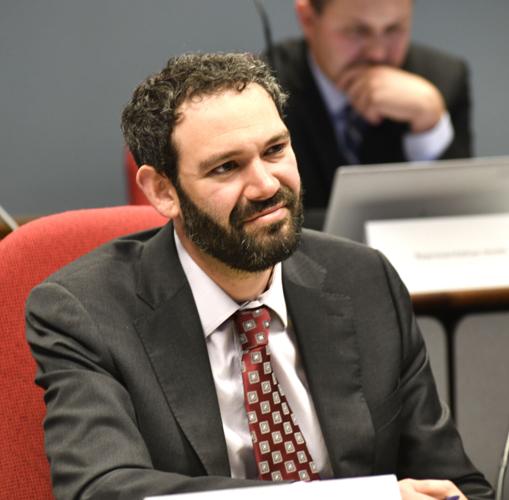
“I think we all want to make sure that internet pornography is not being distributed to children,’’ Rep. Alexander Kolodin said as the measure, Senate Bill 1503, first came to the floor.
But he said SB1503, as approved by the Senate, goes beyond that. He said it would require adults who want to view those materials to register with documents that could wind up in the hands of the government.
“That’s a constitutional problem,’’ said Kolodin, a Scottsdale Republican.
Giving government that power
The issue for Kolodin, and a handful of other Republicans who found the plan unacceptable, goes beyond the legal questions.
“I know it’s not like a fun thing to say as a politician,’’ he told Capitol Media Services. “I do not trust the government even a little bit. Why would I want to give the government that kind of power?’’

Rep. Alexander Kolodin
He pointed to the power that would be in the hands of officials who know who has signed up to download what some define as pornography.
“It’s a way for the government to try to blackmail people,’’ Kolodin said. “It’s a way for the government to try to scare off people from what materials they consume.’’
As for the bill’s goals, “Yes, it is socially desirable to reduce pornography viewership, I suppose,’’ he said.
“But the government doesn’t get to say ‘This speech is socially undesirable, consume less of it,’ ‘’ said the attorney and first-term lawmaker. “That is emphatically not our role.’’
The opposition by Kolodin and a few other Republicans, coupled with the unanimous vote against SB1503 by Democrats, doomed that version to defeat.
Requiring parental action
Now, a third version awaits a final House vote. This one seeks to take the government out of it entirely.
Instead, it essentially would put the burden on parents to take affirmative action, contacting their internet service providers and requiring that those companies block sites determined to have materials the legislation deems offensive.
That, however, raises its own issues.
What would have to be blocked would come down to a three-part test of the materials:
Whether they appeal to the “prurient, shameful or morbid interest of minors;’’
Whether they are “patently offensive’’ to what adults determine is suitable for minors;
And whether they lack “serious, literary, artistic, political or scientific value for minors’’ when taken as a whole.
It’s even more complicated than that. Only when a “substantial portion’’ of a website’s materials meet all three tests would the content provider have to consult the blacklist to see if a customer asked that the site be blocked. The legislation defines “substantial’’ as 33 1/3%.
Marilyn Rodriguez, lobbying for the American Civil Liberties Union of Arizona, told lawmakers they are wrong if they think that will keep minors from accessing what they think is unacceptable.
“There are several websites, including Google, Reddit and Twitter, that allow access to sensitive content but whose total sensitive information falls beneath the 33% threshold,’’ so they wouldn’t be affected, she said.
Adults’ access blocked, too?
There are other issues.
Setting up a blacklist to protect children also would block access to those materials to any adult in that household or anyone using that phone or tablet.
Also, SB1503 is worded so that a spouse could limit what their partner could see: The provider would not be required to determine if there is a minor child in the house.
Rep. Alma Hernandez, D-Tucson, said she doesn’t think children should be looking at pornography, but the measure lacks any sort of enforcement mechanism.
“So, just to clarify, the only way we would really find out if this was happening is if the parent were to look through their tablets or their phones?’’ Hernandez asked.
Rogers acknowledged the point, saying her legislation provides “first steps’’ to regulating those who publish such materials “and gives recourse to those who happen upon it.’’
That “recourse,’’ however, would require parents to hire an attorney to file a civil suit. And they would have to show “damages resulting from a minor’s access’’ to those materials.
Ultimately, there are legal issues with the whole idea. Rodriguez told lawmakers they are not considering how such a law would affect the First Amendment rights of adults.
“Courts have repeatedly struck down attempts to prohibit minors from accessing adult content when they burden speech more than necessary to achieve that goal,’’ she testified.
At least part of that rests on the question of whether there are alternatives, Rodriguez said.
She cited a 2004 U.S. Supreme Court ruling that struck down a similar federal law. There, the justices wrote, “blocking and filtering software is an alternative that is less restrictive than the (law), and, in addition, likely more effective as a means of restricting children’s access to materials harmful to them.’’
After being initially shot down, a new version of State Bill 1503, is being considered by Arizona lawmakers. Video courtesy of Arizona Capitol Television.

