


PHOENIX — Arizona’s Senate president is trying to undo tax incentives designed to lure Hollywood producers to Arizona — incentives backed by half the senators of his own party.
In a new legal brief, President Warren Petersen, a Gilbert Republican, contends the 2022 law that sets aside up to $125 million a year in “refundable tax credits’’ runs afoul of the Arizona Constitution. He says the way the law is structured makes those credits effectively a gift of public funds.
Petersen is even telling a judge that, despite the Legislature’s broad authority to set tax policy, the court has the power to overrule it when deciding lawmakers have gone too far.
He’s not the first to make that argument. Petersen’s filing is in line with a lawsuit filed earlier this year by the Goldwater Institute asking a judge to overturn the law.
But it is unusual because it amounts to the Senate president, acting in his official capacity, trying to void legislation sponsored by a fellow Republican, in this case David Gowan.
Gowan, a Sierra Vista Republican, convinced half of his GOP Senate colleagues to support the film credits measure, and got then-Gov. Doug Ducey to allow it to become law, albeit without his signature.
Petersen did not respond to a request for comment on the filing. Nor did he or his press aide answer questions of whether the filing, made on his behalf by a private law firm, was done with public money.

Petersen
Proponents said the 2022 law was designed to breathe new life into what was once a more thriving film industry in Arizona, dating back at least as far the 1930s when John Ford saw Monument Valley and decided to film Stagecoach here with John Wayne.
The studios at Old Tucson were long the site for various Westerns, ranging from The Lone Ranger to Three Amigos, before much of the facility was destroyed in a 1994 fire.
More recently, productions that are supposed to portray events in Arizona were being filmed elsewhere. For instance, Only The Brave, the 2017 film about the deaths of the Granite Mountain Hotshots from Prescott, was filmed primarily in New Mexico.
To provide a financial lure, Arizona lawmakers approved tax credits that apply against what a production company otherwise owes the state.
The problem, according to the Goldwater Institute lawsuit filed earlier this year, is that these are “refundable’’ credits. Put another way, if the amount of credits exceeds the tax owed, the production company actually gets a check from the state.
Challengers claim this violates a provision in the Arizona Constitution that makes it illegal to provide a gift of state funds unless taxpayers get something of equal benefit in return.

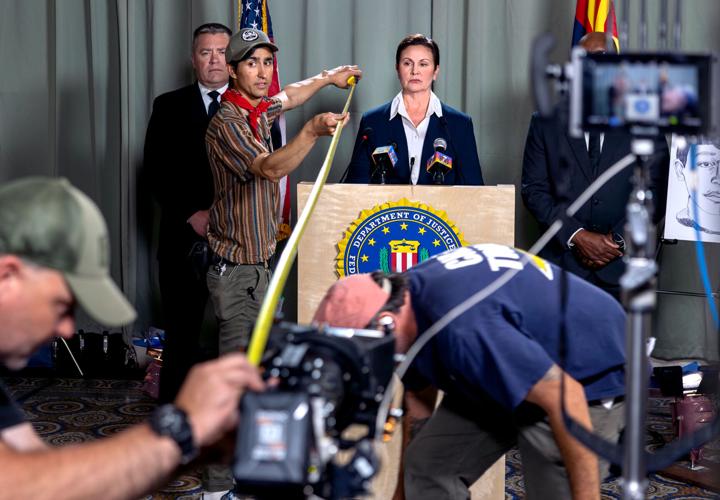
Tucson’s Flat Dog Films has applied to receive state tax credits for its film “Choir Practice,” which wrapped up filming in Tucson in late May. The Tucson producers have a handshake deal for national distribution.
Proponents of the 2022 law contend these are not gifts or grants, arguing that the state will get benefits in the form of sales taxes spent by production companies and their employees as well as income taxes from the workers who are hired. But the lawsuit says Arizona courts have ruled that only direct benefits count, not anticipated future tax collections.
The Arizona Commerce Authority also is telling the judge, Maricopa County Superior Court Judge Michael Herrod, that it is up to the Legislature, not the courts, to determine tax policy.
Petersen, in his legal filing in his capacity as Senate president, told the judge to ignore those arguments.
It is true, he said, that the Legislature can “enact any law its discretion may dictate.’’
“But even that expansive authority is modulated by the Constitution’s structural constraints on the elected branches,’’ Petersen said. “If a legislative enactment veers outside one of those guardrails, it is the courts’ core constitutional authority and duty to ensure that the Arizona Constitution is given full force and effect.’’
That is true with the constitution’s Gift Clause, he said, which spells out that the state cannot provide any donation, grant or subsidy to any individual, association or corporation.
He said it’s one thing to forgive taxes owed. But what’s at issue here, he said, is a credit that is independent of a company’s actual liability. “It is, as a matter of law and common sense, a ‘subsidy’ within the meaning of the Gift Clause,’’ Petersen said.
He also suggested those who crafted the film credits law, and others like it, were too cute in how they described them.
“Because the lexicon of ‘tax credits’ is more mellifluous to many voters’ ears than the terminology of ‘handouts,’ interest groups and their allies devising new subsidies often are tempted to seek the cloak of the tax code in the hope that opponents of a generous social welfare state will not find out what we are doing,’’ Petersen said. “But cosmetic political nomenclature cannot alter the inescapable fiscal and practical reality that refundable credits represent direct, redistributive expenditures of government funds, (i.e., revenues collected from other citizens) to the claimant taxpayer.’’
This isn’t the first time the merits, if not the legality, of these tax credits have been questioned.
The state enacted a similar program in 2005 and expanded it in 2007.
A report said the credits generated 317 full-time jobs in the industry in 2008. Another 413 were created indirectly from spending by filmmakers in the state.
All totaled, according to the report, that generated about $2.3 million in additional state and local taxes.
But it turned out Arizona gave out more than $8.6 million in credits to get that gain. A similar report for 2007 showed a $1.7 million loss to the state.
Lawmakers repealed the program in 2015.
Gowan, however, insisted that the new credits are different than the prior program. He said they require those seeking the credits to show, subject to a state audit, that they have spent the money in Arizona.

