


PHOENIX — State senators voted Thursday to abolish the unpaid holiday honoring now-dishonored labor leader César Chávez — but not before rejecting a bid by Democrats to rename it to honor the farmworkers movement, and shutting down all debate over that proposal.
Despite that, most of the Democrats in the Republican-controlled Senate agreed to support the measure, House Bill 2072. Each agreed that, to honor the women who said they were victims of sexual abuse by Chávez, it is no longer appropriate to honor him. They agreed to provide the votes necessary to make the change effective prior to Tuesday, the date of his birth, and the date the unpaid holiday has been observed.
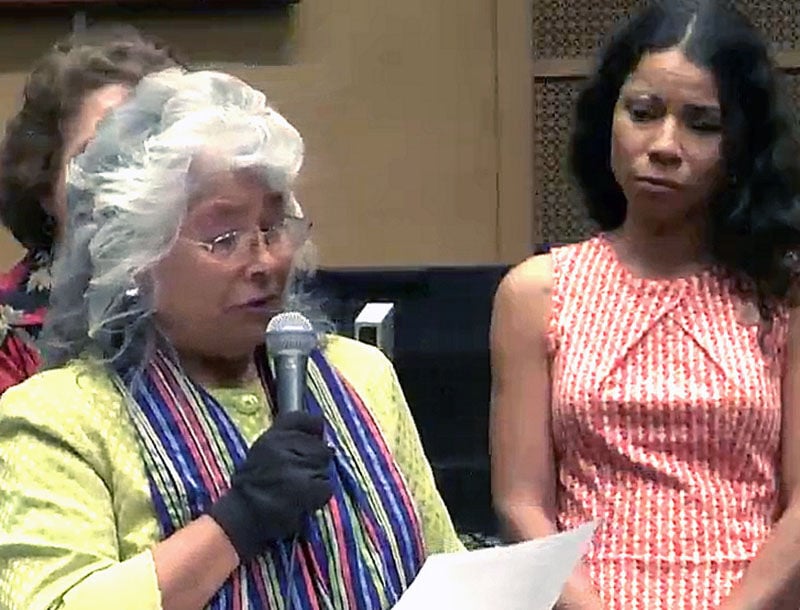
But Tucson Democratic Sen. Sally Ann Gonzales, who tearfully told colleagues about working in the fields as a child, said she could not support a measure that only did outright repeal.
Sen. Catherine Miranda tried to amend the measure to rename March 31 as Farmworker Day. But Republicans, on a party-line vote, rejected the proposal by the Laveen Democrat.
Gonzales sought to proffer an alternative to not just rename the day but also to encourage residents to pay tribute to past and present farmworkers "for their extraordinary contributions to the labor and civil rights movements in this state and throughout the United States.''
But she never got to offer her amendment, much less get a vote on it: Republicans used a procedural maneuver to keep it from even being debated.
'I am the kid that worked in the fields'
That left Gonzales with the only option being to tell her story and the story of her family as she explained why she would not support the outright repeal.
She said parents were working pre-dawn to post-sunset, leaving no one home to take care of the children.
"So kids had to go to the schools and work,'' Gonzales told colleagues. She said if they were too little to work, they were still there, in the fields, unprotected from the cold in the morning and the heat of the day, as well as from the snakes in the fields, the same as everyone else.
"I am the kid that worked in the fields,'' she said.
Gonzales also recalled how her mother, Maria, was the only one for whom the family could afford to buy gloves to protect her from the sharp edges of the cotton plants. Putting her mother's gloves on during her speech Thursday, Gonzales explained that the fingers were cut out "so she could grasp the cotton from the plant.''
Farmworkers also faced other issues, she said, including crop dusters spraying cancer-causing herbicides in adjacent fields and the failure of farmers to provide bathrooms, which meant women "had to go to find a bush to go behind.''
Sen. Rosanna Gabaldon shared her own stories, of her father-in-law who worked the fields in California for years until an uncle came and took him away, and of her grandfather who was taken at gunpoint, put on a bus and driven to Pennsylvania "to pick strawberries against his will.''
Yet Gabaldon, a Green Valley Democrat, said all Republicans could think about was repealing a holiday that, while it bore the name of César Chávez, was really about the whole farmworkers' movement.
"What we're doing is we're wiping away my father-in-law, my grandfather, all of my family, all of my cousins' families, and all the people that are out there,'' she said.
'There are a host of occupations'
Senate Majority Leader John Kavanagh argued there was no need and no precedent to honor farmworkers. He said no other labor group has such a holiday, paid or otherwise.
"I'm sure there are members that would support farmworkers,'' said the Fountain Hills Republican. "But what about police officers, firemen, teachers, plumbers? There are a host of occupations.''
About the closest any Republican came to saying such a holiday might be justified was Sen. Tim Dunn, who represents the Yuma area where most of the state's crops — and much of the winter crops for the entire nation — are grown. He said he is willing to work with others to see if such a proposal might be considered, but not until next year.
The rush to wipe any trace of Chávez out of the statutes started with a New York Times report earlier this month that two women said Chávez, at that time already a recognized champion of farmworker rights, sexually abused them when they were children in the 1970s.
Also, Dolores Huerta, who, with Chávez, led the movement to create the United Farmworkers Union, told the New York Times during its investigation that he raped her. Huerta said she stayed silent for 60 years for fear that disclosure would hurt the labor movement.
Phoenix Republican Sen. Shawnna Bolick said the quick action to simply repeal the holiday was needed in light of the revelations.
"If I was the victim of this type of abuse, I would actually want a clean slate and have no affiliation" with the holiday created on the federal level by then-President Barack Obama in 2014, Bolick said. Arizona created the state holiday through legislation in 2020.
Absent quick action before the Tuesday holiday — the House is set to vote on the measure on Monday — Bolick said the repeal will not take effect.
"How does that help honor the victims of the abuse by the current namesake?'' she asked.
But Sen. Mitzi Epstein said none of the need for speed precludes using the opportunity to rename the holiday to recognize farmworkers. The Tempe Democrat said the victims — the ones whom Bolick said she's trying to honor — have said they want the holiday renamed after the movement.
Huerta is among them.
"She is the victim, one of the victims,'' Epstein said. "And she wants it to be renamed for the people who lost their lives and who struggled.''
Arizona history of 'strict anti-worker laws'
Sen. Analise Ortiz, a Phoenix Democrat, said it's particularly important that some sort of holiday be retained here.
"In Arizona, strict anti-worker laws were in place where farmworkers and families were working in hazardous conditions with inadequate tools under the harsh heat of the Arizona sun after other Western states had already enacted health and safety protections for the farming and working class,'' Ortiz said.
One clear example was the short-handled hoe used by farmworkers to go through fields of new plants to cull out weeds.
Farmers said they preferred it because it caused less harm to plants. But it also meant the workers were constantly bent over.
California banned the use of the short-handled hoe in 1975, followed by Texas.
But when Arizona lawmakers refused to follow suit, it took a ruling in 1984 by the Arizona Industrial Commission, which oversees worker safety, to declare it a health hazard.
"Thousands of brave workers had to strike, march, bleed and die for the right to be treated with dignity as human beings as they were providing the most essential of services, which is feeding every single one of us,'' Ortiz told fellow lawmakers.
More to the point, she said, abuses continued.
"They are still happening,'' Ortiz said. "And that's why we must respect the farmworkers by renaming this day, as farmworkers continue to fight dangerous conditions, low wages, blazing hot temperatures, and the continued threat of a tyrannical federal government raiding their workplaces.''
Tempe Democratic Sen. Lauren Kuby said she was skeptical of claims by Republicans that renaming the unpaid holiday for farmworkers was somehow creating a precedent. She listed a host of other days that the Legislature has declared as official, ranging from the National Day of the Cowboy and Arbor Day to holidays honoring Boy Scouts, Girl Scouts and a holiday to remember the 1983 bombing of the Marine barracks in Beirut.
And Sen. Lela Alston, who has served 36 years in the Legislature, lashed out at Republican leadership for how it handled the whole issue. The Phoenix Democrat said it was the first time in her memory that a lawmaker who had prepared an amendment on pending legislation could not get to even present it for a vote.

