


PHOENIX — State lawmakers are moving to make it illegal for banks, credit unions and check-cashing services to do business with people who don't have legal immigration status.
Legislation approved by the Senate and now awaiting House action would bar financial institutions from accepting any "license or identification card issued exclusively to an unauthorized alien or undocumented immigrant.'' That appears aimed at ID cards issued by Mexican consular offices.
It also would make it illegal to accept anything that is normally issued to legal U.S. residents or citizens but "has markings indicating that the license or identification card holder did not present proof of the holder's lawful presence in the United States.'' Flagstaff Republican Sen. Wendy Rogers, who wrote the measure, said that could include certain driver's licenses.
All that could affect everything from opening a bank account to getting a safe-deposit box, obtaining a loan or cashing a check.
Rogers' measure, Senate Bill 1421, also would bar anyone without the required documentation it lists from using any financial institution — including check-cashing companies — to send money to people in other countries.
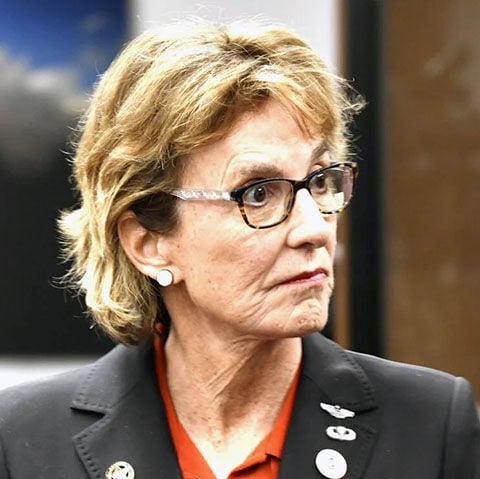
Sen. Wendy Rogers, R-Flagstaff
Rogers made no secret that this bill, like some others she is sponsoring, is designed to reduce the number of people in this country illegally.
"Unauthorized aliens in this country are adversely affecting our economy to where U.S. citizens can't proceed as they should,'' Rogers said during committee debate on the legislation. "And all that money is leaving our country.''
The measure has been uniformly supported by Republican legislators and uniformly opposed by Democrats.
Bankers oppose the measure
The Arizona Bankers Association is also against the bill.
Jay Kaprosy, lobbying for the bankers' group, said financial institutions operate under federal regulations that already spell out what kind of identification they are required to get from their customers.
That drew a sharp response from Rogers.
"Do banks make money on undocumented aliens sending money home?'' she asked.
"We make money banking whoever we are allowed to bank under the law,'' Kaprosy responded. He said banks don't want to be dragged into the political debate about illegal immigration and placed in the position of enforcing the kind of restrictions being advanced.
That didn't satisfy Rogers.
"That's all well and good for you to say you don't want to wade into an immigration fight,'' she said. "This isn't an immigration fight. This is a transfer of funds out of this country.''
'Economically disadvantageous'
Joseph Palomino, director of the Arizona Center for Economic Progress, questioned the financial impact of what Rogers seeks.
His organization bills itself as supporting fairer tax codes to put more money into education, affordable housing and health care.
Palomino questioned whether any of what Rogers is trying to enact is illegal, predicting it is preempted by federal law and would be overturned. But that is just part of the problem, he said.
"This is just economically disadvantageous,'' he told the House Commerce Committee when it debated and approved the bill. All efforts to try to remove migrants from the state and the country are just harming the economy, he said.
Rep. Cesar Aguilar, a Phoenix Democrat, had his own take on that.
"In a state where we are so close to the border, where Mexico and the United States have a trade agreement and bring in so much money from Mexico to the United States and vice versa ... introducing bills like this are an insult to our own state and actually weaken our own state,'' Aguilar said.
He had broader objections, as well.
"The underlying bill targets my community, targets the immigrant community, people who work hard, pay taxes, who put money in their bank accounts,'' Aguilar said.
As to Rogers' claim of exporting dollars from this country, he said many of the targeted people are dealing with the same economic issues as others, meaning "they don't even have money to send back.''
'Racial profiling' dispute
The debate over the legislation turned personal in the Senate Committee on Military Affairs and Border Security.
At several points, Sen. Catherine Miranda, a Laveen Democrat, asked whether what Rogers is asking financial institutions to do — and for the state Department of Insurance and Financial Institutions to police — amounts to "racial profiling.''
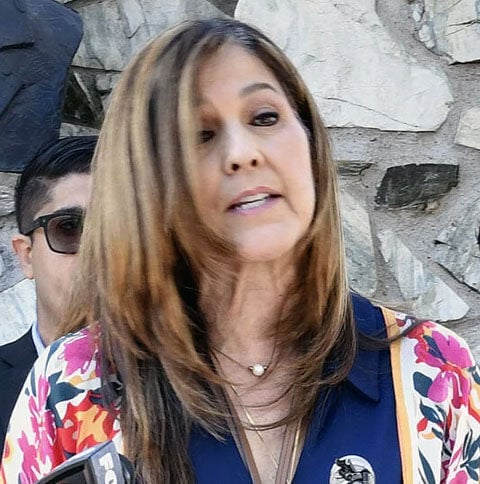
Sen. Catherine Miranda, D-Laveen
"The notion of racial profiling is irrelevant,'' Rogers responded.
Rogers said she sees nothing wrong with going after banks and others "because they're aiding and abetting the outpouring of resources from our country to another country.''
Miranda responded, "How would you know that without profiling them, asking their status?''
"Are you talking, again, racial profiling?'' Rogers inquired.
"That's what it's all about with these bills coming through here, absolutely,'' Miranda said.
At one point, Sierra Vista Republican Sen. David Gowan, who chairs the Senate panel, cautioned Miranda, telling her not to suggest Rogers is racist.
"I won't do that,'' Miranda responded. "Instead, I'll let the record speak for itself.''
She proceeded to read aloud the 2022 findings of the Republican-controlled Senate when, in a bipartisan fashion, it voted 24-3 to censure Rogers for "conduct unbecoming of a senator.'' The specifics included "publicly issuing and promoting social media and video messaging encouraging violence against and punishment of American citizens.''
Days earlier Rogers had spoken at a conference organized by Nick Fuentes, an outspoken white nationalist, where she praised him. That followed by just a week, a speech Rogers made to the America First Political Action Committee, a group of white nationalists, where she said "we need to build more gallows.''
Rogers didn't help her case when, just before the 2022 Senate vote to censure her, she told her followers that "today is the day where we find out if the Communists in the GOP throw the sweet grandmother under the bus for being white.''
Said Miranda during the debate on the banking legislation: "That same elected official has brought us SB 1421. How do we justify legislation she cosponsors that systematically excludes immigrants from banking?''
Rogers responded that there is a constitutional right of freedom of speech.
"No matter how heinous someone's speech is, he or she has the right to say it,'' she told Miranda. "By impugning my character and blurring that as someone who supported free speech and blurring that with this bill that I'm carrying is really a sad overreach of your own.''
Rogers' other immigration-related bills
The measure on banking and money transfers is just one of numerous immigration-related bills Rogers introduced this legislative session.
Other Rogers-crafted measures include:
- SB 1051 requiring hospitals to ask and report the immigration status of patients, though they could not be denied care regardless of the answer;
- SB 1152 suspending eligibility of asylum seekers for state and local benefits until a judge grants it;
- SB 1157 allocating $20 million to reimburse cities, towns and counties to build border fences in high-traffic areas;
- SB 1444 creating a deportation task force of sheriffs to work with federal agencies;
- SB 1474 requiring all law enforcement agencies to train officers in enforcing federal immigration laws;
- And SB 1520 mandating that state agencies must share any data requested by immigration authorities related to undocumented migrants and visa overstays.

