


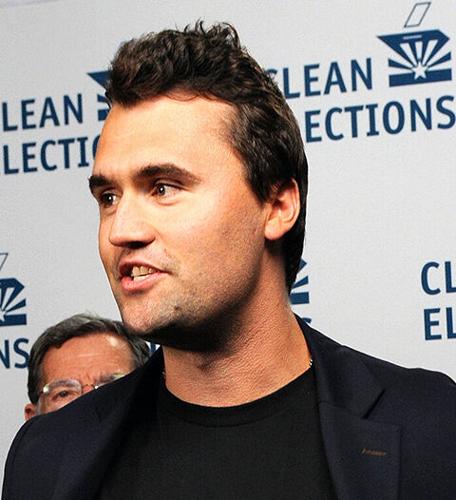
PHOENIX— Arizonans won't be driving on the Charlie Kirk Loop 202.
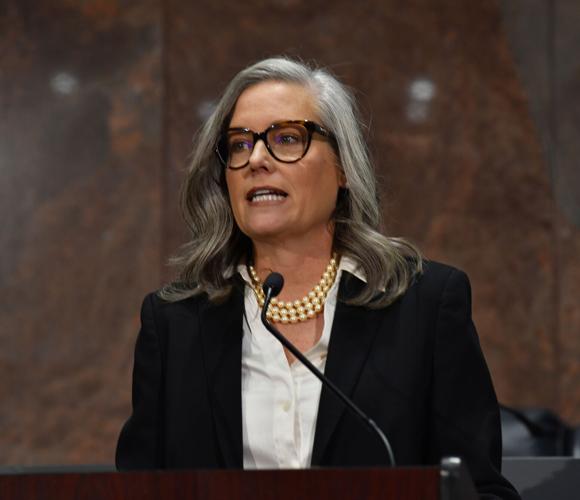
Democratic Gov. Katie Hobbs vetoed legislation Friday to rename the 78-mile freeway in Maricopa County after the slain, controversial leader of Turning Point USA. Hobbs said the proposal crafted by Senate President Warren Petersen, approved on a party-line vote in the Republican-controlled Legislature, is flawed because it is "inserting politics into a function of government that should remain nonpartisan.''
The veto drew an angry reaction, with Petersen saying it is Hobbs who is acting political.
"She broke with a long-standing Arizona tradition of recognizing impact over politics,'' said Petersen, a Gilbert Republican.
He said Kirk deserved the honor. Kirk, who put Turning Point USA's headquarters and its affiliates in Arizona, "built something that reached far beyond Arizona, and he brought that energy right here to our state.''
Petersen said a nonpartisan precedent was set in 2019 when the last 22-mile stretch of Loop 202 was named for former U.S. Rep. Ed Pastor, a Democrat, who had died the year before. Pastor was the state's first Mexican-American member of Congress.
"Arizona has never required political agreement to recognize someone's contribution to public life,'' Petersen said in a written statement Friday. "We've recognized impact, service, and people who've shaped conversations and encouraged others to participate. This veto makes it clear that standard has changed."
But the decision to name that stretch of freeway for Pastor was approved by the Arizona State Board of Geographic and Historic Names, an agency set up under state law to evaluate requests to designate and name roads that are of historic or geographic significance.

Kirk
Petersen's legislation, however, was written to bypass the board. It would have mandated the designation in state law and directed the Arizona Department of Transportation to erect "a reasonable amount of signage throughout Loop 202 that includes the new designation.''
That difference did not escape the governor.
"Any renaming of a highway must follow the current process through the Arizona State Board on Geographic and Historic Names and not be circumvented by the legislature,'' Hobbs wrote.
The governor's action was not a surprise.
It comes exactly three weeks after she nixed legislation that would have allowed the creation of a state license plate bearing Kirk's image to raise money for Turning Point USA, set up as a charity, that is now run by his widow, Erika Kirk.
But that veto, in its own way, was a departure for Hobbs. She had given her approval to every other legislatively approved request for a special license plate. Those plates are particularly attractive to charities. They provide a way for people who support an organization or its goals to advertise it publicly. Potentially more significant, $17 of the extra $25 annual registration fee goes to the organization.

Gov. Katie Hobbs
In her vetoes, Hobbs made no mention of Kirk's record of controversial comments, ranging from criticism of gay and transgender rights and comparing abortion to the Holocaust to his calling the approval of the 1964 Civil Rights Act a "mistake'' he said had been turned into "an anti-white weapon.''
The governor condemned Kirk's assassination last year, when he was shot while speaking at Utah Valley University, as a "tragic and horrifying act of violence.''
"In America, we resolve our political differences at the ballot box,'' she wrote in both vetoes.
Stephen Roe Lewis, governor of the Gila River Indian Community, said Hobbs "made the right decision.''
He said the Loop 202 freeway, while adjacent to the reservation, runs through South Mountain, which he called "a place of deep cultural, spiritual and historic significance to our people.''
"Mr. Kirk's public statements about Native peoples, tribal sovereignty, and our connection to our ancestral lands were deeply offensive,'' Lewis said in a written statement Friday.
"They dismissed our identity and centuries of our history,'' he said. "To associate his name with this corridor would have compounded the harm.''
Lewis did not provide specifics.
But Kirk, in one of his broadcasts, said Europeans "came to a very violent country.'' He also said that, for the most part, "there was nothing here,'' criticizing any moves to acknowledge that the land settled by Europeans previously belonged to someone else.

