



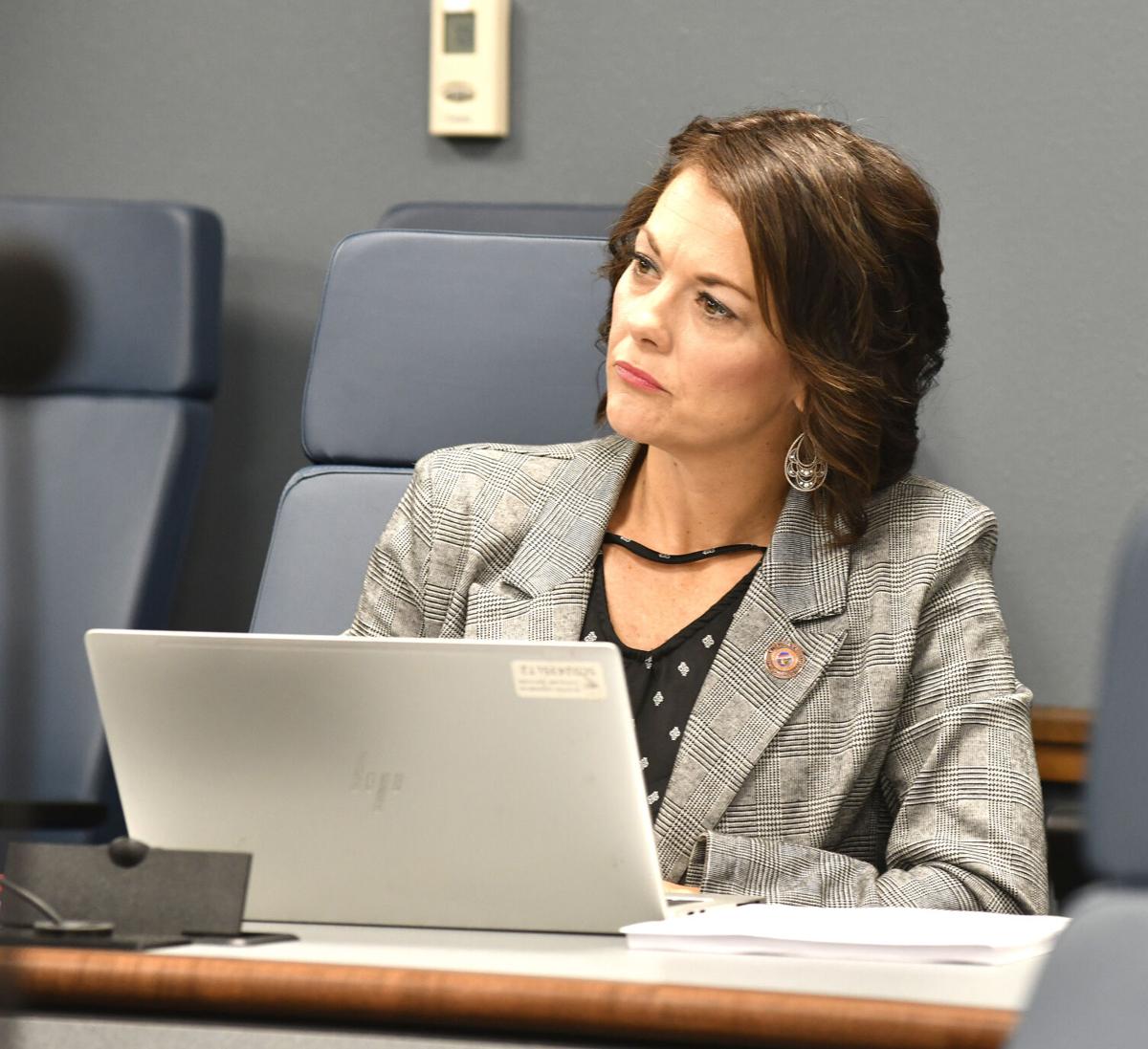
PHOENIX — State lawmakers are moving to make criminals out of doctors and pharmacists who send abortion-inducing drugs to Arizona women — and the women who seek to obtain them that way.
But questions remain whether the legislation is constitutional.
The legislation awaiting the vote of the full Senate would make it a Class 4 felony for health-care providers, pharmacists, manufacturers or suppliers to provide such a drug in Arizona. That carries a presumptive penalty of 2 1/2 years in state prison.
Rep. Rachel Keshel, who is sponsoring the bill, pointed out that state law already makes it illegal for any of those people to arrange to have such drugs delivered. The Tucson Republican said her measure would just put some teeth in the law.
It is modeled after a similar law in Texas.
But the proposal has something not in the Texas law. It also declares it would be a Class 1 misdemeanor for anyone who "orders, solicits, requests, receives or attempts to receive'' an abortion-inducing drug, whether by mail, courier or any other delivery service.
That would make Arizonans who buy the drug subject to six months in county jail.
The targeted drug is Mifepristone. Generally used in combination with another drug, is is considered effective in terminating pregnancies up to about 10 weeks.
Nearly half of the more than 13,000 abortions in Arizona in 2024 — the most recent data available — were performed with Mifepristone.
The legal issue is the ability to obtain the drug without an in-person visit to a doctor. That generally involves the use of telemedicine, having virtual consultations, whether by video or text, and having the drug sent to the person's home.
"Arizona law already prohibits the mailing and delivery of abortion-inducing drugs,'' Keshel told colleagues during debate on the measure.
"What is missing in the statute is clear enforcement mechanisms,'' she said. "This bill, HB 2364, basically just closes that gap.''
Keshel said the prohibition, and the penalty she wants to add, are justified.
"It is obviously taken to end the life of a preborn child,'' she said. "And I believe that life starts at conception, in the womb.''
Beyond her personal feelings, Keshel told colleagues the ability to get the drug through an online consultation has led to abuses.
One case she cited involves a Texas attorney who pleaded guilty to obtaining the abortion drug and then putting it into the drinks of his pregnant wife. He was sentenced to 180 days in jail.
Another case involves allegations an Ohio man who ordered abortion drugs using his estranged wife's information and then gave them to his pregnant girlfriend. He was later indicted.
"So we need to take this very seriously,'' Keshel said.
The legislation drew support from Dr. Erica Kreller, a board-certified obstetrician and gynecologist in private practice. She told lawmakers she has treated women who have suffered complications after obtaining the abortion drug in the mail.
"Many of them had taken the pill beyond the recommended 10 weeks, either because they didn't know how pregnant they were or didn't understand the increasing risks of taking it at a later gestational age,'' Kreller said.
But Rep. Stephanie Stahl Hamilton said all this runs up against Prop. 139. Approved by voters in 2024 by a 3-2 margin, it provides a fundamental right of women to terminate a pregnancy up until fetal viability, generally considered to be between 22 and 24 weeks.
"Arizona voters made their intent clear when they protected their right to reproductive freedom in our state constitution,'' said the Tucson Democrat.
"This bill not only would punish Arizonans for seeking legal medical care and threaten doctors and pharmacists with criminal simply for helping patients, it goes even further by turning patients into potential criminals,'' Stahl Hamilton said. "No Arizonan should face prosecution for making a personal medical decision in consultation with their health-care provider.''
Sen. Lauren Kuby, a Tempe Democrat, said if there was any doubt about the scope of Proposition 139, that was resolved just last month when Maricopa County Superior Court Judge Greg Como struck down a number of pre-existing laws regulating abortion. One that the judge found unconstitutional was a ban on telemedicine.
"Telemedicine abortion is safe and effective, based on accepted clinical standard of practice and evidence-based medicine,'' the judge wrote. He said that, by taking a detailed history of a patient, a doctor can determine if telemedicine is inappropriate and the patient should be referred to someone for an in-person visit.
Katarina White, testifying at the Legislature on behalf of Arizona Right to Life, told lawmakers that Proposition 139 is legally irrelevant to this issue. She argued that federal law prohibits mailing abortion pills.
That, however, may not be true.
A 2022 opinion by Christopher Schroeder, an assistant U.S. attorney general, acknowledged there is an 1873 law, known as the Comstock Act, which declares anything designed to produce an abortion, including drugs, is "nonmailable matter.''
But he said that does not apply in any situation where the sender does not know that the recipient will use the drugs illegally.
Schroeder noted that Mifepristone remains legal under federal law.
It also has been legal for doctors to prescibe in Arizona, even before Judge Como's ruling voiding the telemedicine ban.
"Perhaps you know more than the courts,'' Kuby responded to White. And she disputed claims of danger from allowing abortion pills, prescribed by a doctor, even remotely, to be delivered.
"It's not about safety,'' Kuby said. "It's about control, controlling women and their health-care decisions.''
Phoenix Democratic Sen. Analise Ortiz told Republican lawmakers, "Arizona voters passed Proposition 139 with overwhelming support — including in every single one of your legislative districts. The right to access abortion was more popular on the ballot than legislative Republicans.''
The measure, which has cleared the Republican-controlled House and a Senate committee, still needs approval of the full Republican-led Senate before going to Democratic Gov. Katie Hobbs, who has a record of vetoing measures that would restrict abortion rights.

