



What was expected to be any other school day for Amanda Cunha turned into a life-changing moment.
Then a 17-year-old junior at Le Jardin Academy in Honolulu, Cunha “was driving my dad’s old car that I was driving for about a year” to school and noticed a change in her central vision in her left eye. Suddenly, she struggled to see the center of the road.
“It was really crazy because I didn’t think it was anything serious,” Cunha said. “I thought it was from eye drops that I had taken for allergies. I didn’t panic, but I was kind of nervous and like, ‘What is happening?’ It was scary and an interesting moment in my life. ... At first, my family and doctors had no idea what it was for months.”
In the fall semester of her senior year at Le Jardin Academy, she was diagnosed with Leber’s Hereditary Optic Neuropathy (LHON), a genetically inherited disease that causes vision loss, and became legally blind.
The rare genetic disorder, inherited only from the mother, mostly occurs with younger adults and has affected one in 50,000 people worldwide. The condition worsened over months until she was officially diagnosed in November 2021.
“That pretty much changed the entire course of my life,” Cunha said.
Cunha, who’s now the team captain for the University of Arizona adaptive golf team, “was playing adaptive golf before I was actually playing adaptive golf.”
Cunha described her vision as a “kaleidoscope in the center of my vision.”
“Outside of that, it’s probably a lot of TV static, swirls and an oil spill,” Cunha added.

Amanda Cunha was one of the top junior golfers in Hawaii and fell in love with the sport when she was 5 years old.
Before Cunha fell in love with golf at 5 years old, she was born in Kazakhstan and adopted by her parents, Larry and Lila Cunha, in Hawaii. The couple also adopted Cunha’s younger brother, William, who’s from China. It is believed Cunha’s biological mother was a college student in Kazakhstan.
“I don’t know much about my bio family,” Cunha said. “Unfortunately, a lot of adopted kids don’t know a lot about their medical history. My genetic condition was unknown to my entire family.”
At 7 years old, Cunha joined the junior program at Casey Nakama Golf Development Center in Waimanalo, Hawaii, the hometown of former Arizona football star and newest Carolina Panther Tetairoa McMillan. The Casey Nakama Golf Development Center also produced LPGA star Michelle Wie West, who Cunha “always looked up to,” she said.
“It all helped me become the golfer I am today,” Cunha said. “I only got my hat signed by her, but it was such a cool moment as a little girl.”
Cunha reconnected with her golf idol following a practice round at the U.S. Women’s Open at Pebble Beach in 2023 and said, “that was a really cool moment.”
Like most kids in Hawaii, Cunha grew up going to the beach and even did karate, but “golf took up a big part of my life.”
Her love for golf brought her back to the game despite losing her vision. Cunha didn’t let a life-altering setback hinder her golf game. As a senior in high school, Larry Cunha took her to driving ranges in Hawaii to practice. He would guide her, line her up with the ball and describe where she was aiming. Driving range sessions eventually turned into rounds.
“I would have my moments where I tripped on a cart path and curbs and my dad would be like, ‘Alright, you can take a rest,’” Cunha said. “But I was able to get really comfortable being on the golf course again.”

Arizona adaptive golfer Amanda Cunha lost central vision in May 2021 and was diagnosed with Leber's Hereditary Optic Neuropathy (LHON). (Photo courtesy of Arizona Adaptive Athletics.)
The biggest hurdle “was trust issues with my dad, because he was my caddie,” said Cunha.
“He’s the person lining me up and telling me where to hit my ball,” she said. “That was the biggest issue in our relationship and it affected it off the course, as well. But I learned to trust him in where I’m hitting my ball.”
When her senior year at Le Jardin Academy was coming to a close and Cunha was looking at college options, “the main thing I was looking for was academic accommodations I would receive as a student, but when I saw the (UA Disability Resource Center) offered adaptive athletics, we checked it out,” she said.
Once she saw the UA adaptive golf program, she contacted Arizona adaptive athletics director Peter Hughes about joining the team. Cunha received $10,000 from the UA and an additional $10,000 from another scholarship fund for blind students. Cunha teamed up with Project Par’s Justin Kent, a golf swing instructor at Randolph Dell Urich Golf Course in Tucson.
“Developing my game at the University of Arizona has been so helpful,” Cunha said. “I’ve been able to reach some of the best scores I’ve ever hit in my life.”
During her time at Arizona, she befriended Tucson native and fellow adaptive golfer Bailey Bish, who won the third-ever U.S. Adaptive Open at Sand Creek Station in Newton, Kansas, last year. Cunha’s career-best round was a 71 at Sand Creek Station Golf Course.
“That was probably one of the greatest highlights of my career,” Cunha said.
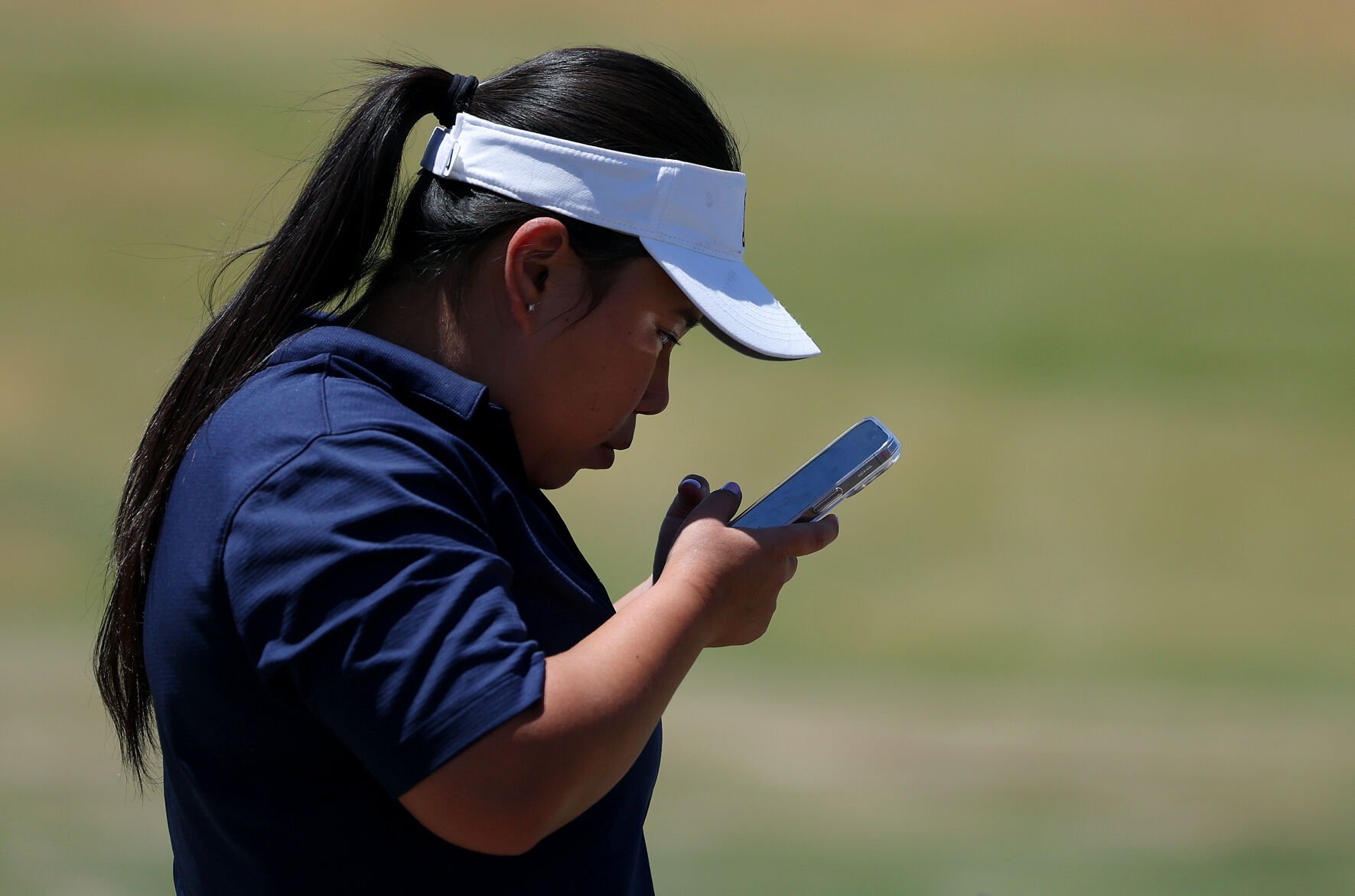
University of Arizona adaptive golf captain Amanda Cunha, who is visually impaired, uses big text on her phone to be able to read messages.
Two years before Bish’s breakthrough moment, Cunha was one of 96 golfers to compete in the U.S. Adaptive Open at Pinehurst Resort and Country Club, the same course she competed at for the North & South Junior Championship as one of the top high school golfers in Hawaii. Cunha returned to Pinehurst two years after she was diagnosed with Leber’s Hereditary Optic Neuropathy and was a medalist for the women’s vision impairment category.
“People love her and they think she’s great,” Arizona adaptive golf head coach Dennis Schmelzel said of Cunha. “We get to know the members of these clubs and she’s fantastic with these people. It’s the total package. She does a great job as an ambassador for the program.”
Schmelzel’s daughter, LPGA golfer Sarah Schmelzel, met Cunha last year at Starr Pass, Arizona’s home course, for a practice round. Schmelzel rode in the cart with Cunha and caddied for the UA adaptive golfer for 18 holes.
“That was a cool experience,” Sarah Schmelzel. “I’ve never done anything like that before. I don’t know what her vision is like, right? So I’m saying, ‘OK, can you see this? Can you see that? Can you see where that tree is? Can you see that bunker?’ I was pointing her in the right direction and I never really had to think of these things on the golf course.
“It was eye-opening for me, the positivity and energy she had to try and get so much better even though she has this extra obstacle that she has to overcome — on top of golf already being hard.”
In addition to her power with a driver, Schmelzel noted Cunha’s putting prowess as one of the best parts of her game.
“She’s a really good putter,” Schmelzel said. “She just walks up and brushes them in, which is so cool to see. There’s no second thought for her.”
Cunha is “a great golfer and an even better person,” Schmelzel said.
“She’s such an awesome light to be around,” Schmelzel added. “One of the coolest things about her is that she’s constantly trying to learn and trying to get better. She is such a great example of how we should all be acting in our lives.
“We make mountains out of molehills every single day and here’s this person who’s had to overcome so much and is not letting it get in her way. I just think it’s a superpower of hers, that she’s always trying to get better as a golfer, a student-athlete and a person.”
Dennis Schmelzel named Cunha team captain last August. Since Schmelzel lives in Phoenix, Cunha has shouldered the responsibility of scheduling practices at Starr Pass.

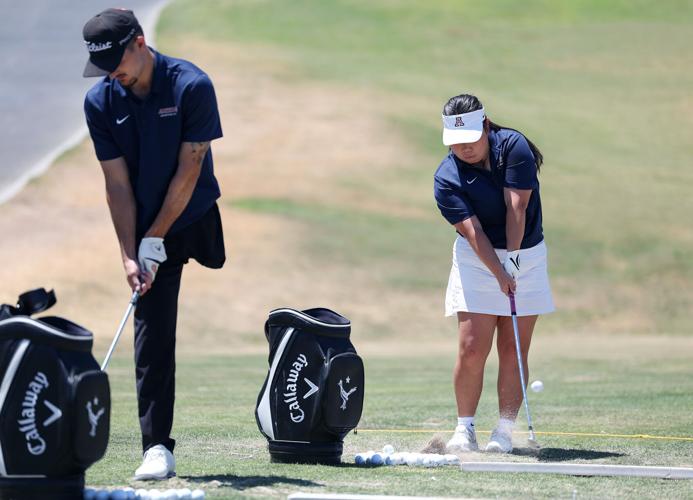
Arizona adaptive golf player Amanda Cunha, right, hits the ball along side her teammate, Anthony Maldonado, during practice at Starr Pass Golf Club, 3645 W. Starr Pass Blvd., on May 2, 2025.
“She has done a masterful job as a golfer and a leader,” Schmelzel said. “Once she became the captain, she really started to blossom and she loved the responsibilities. ... She has a great, positive attitude. No matter what is thrown her way, she’s going to overcome it. She has a lot of energy and she has interacted well with other players at tournaments.”
Added Schmelzel: “You give her a task, she’s going to get it done. There’s no hesitation. She’s a different kind of kid in this world. She complains about nothing — nothing! Just a tremendous and positive attitude and she deserved the right to be captain.”
Cunha is one of 10 recipients of the first-ever “Royal and Ancient (R&A) Golf Club Scholarship.” Over 200 people worldwide applied for the scholarship.
The scholarship is “designed to identify, support and develop the next generation of golf’s leaders through financial support and unique connections to The Royal and Ancient Golf Club of St. Andrews” in Scotland, according to its website.
“It’s a feather in her cap,” Dennis Schmelzel said.
In the last week of August, Cunha will travel to Scotland and stay at The Royal and Ancient Golf Club of St. Andrews — also known as the birthplace of golf — for a week. Even though she’ll miss the first week of the fall semester of her senior year at the UA, “I will gladly miss one week of school to be at St. Andrews,” she said.

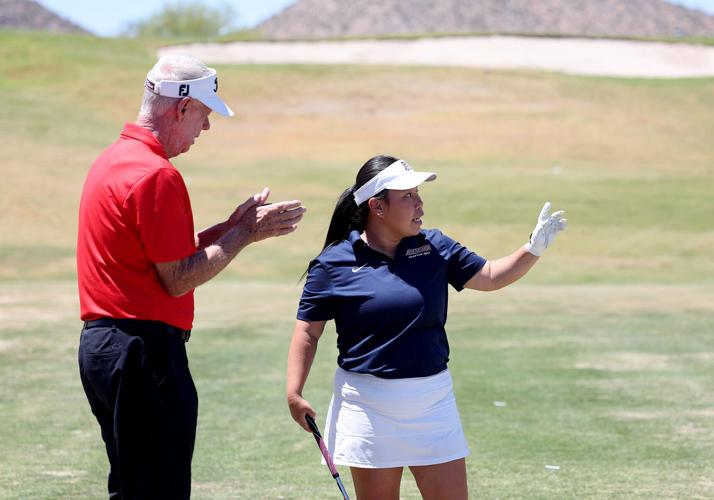
Amanda Cunha, right, talks with Arizona adaptive golf coach, Dennis Schmelzel, during practice on May 2, 2025.
Cunha is holding a clinic in St. Andrews for 10-15 golfers and will attend a leadership conference. She is also expected to play the course once or twice while she’s there.
“I’m so starstruck that I even get to go,” Cunha said. “I get to host a golf clinic at the home of golf, which is awesome. We’re going to have kids with disabilities from schools nearby.”
England native Andrew Jessop, a club member at The Royal and Ancient Golf Club of St. Andrews, will work with Cunha for the week. The two will work in tandem to promote adaptive golf at the mecca for the sport. Cunha is majoring in communications at the UA and is hoping to be one of the biggest advocates for adaptive golf, which is more prominent in Europe than the U.S.

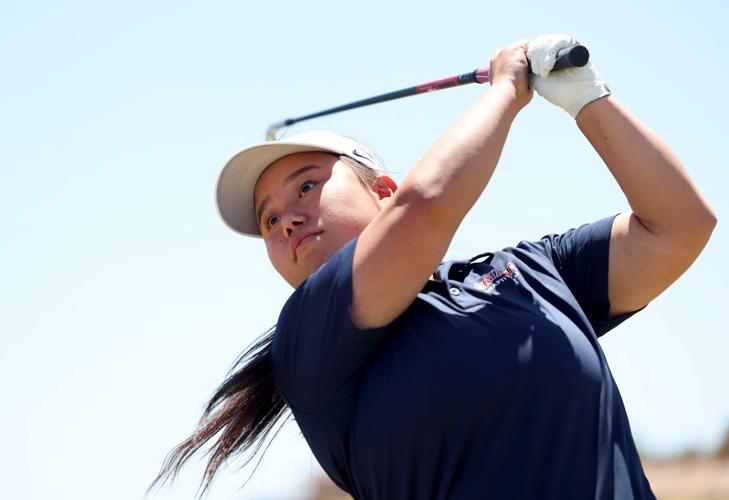
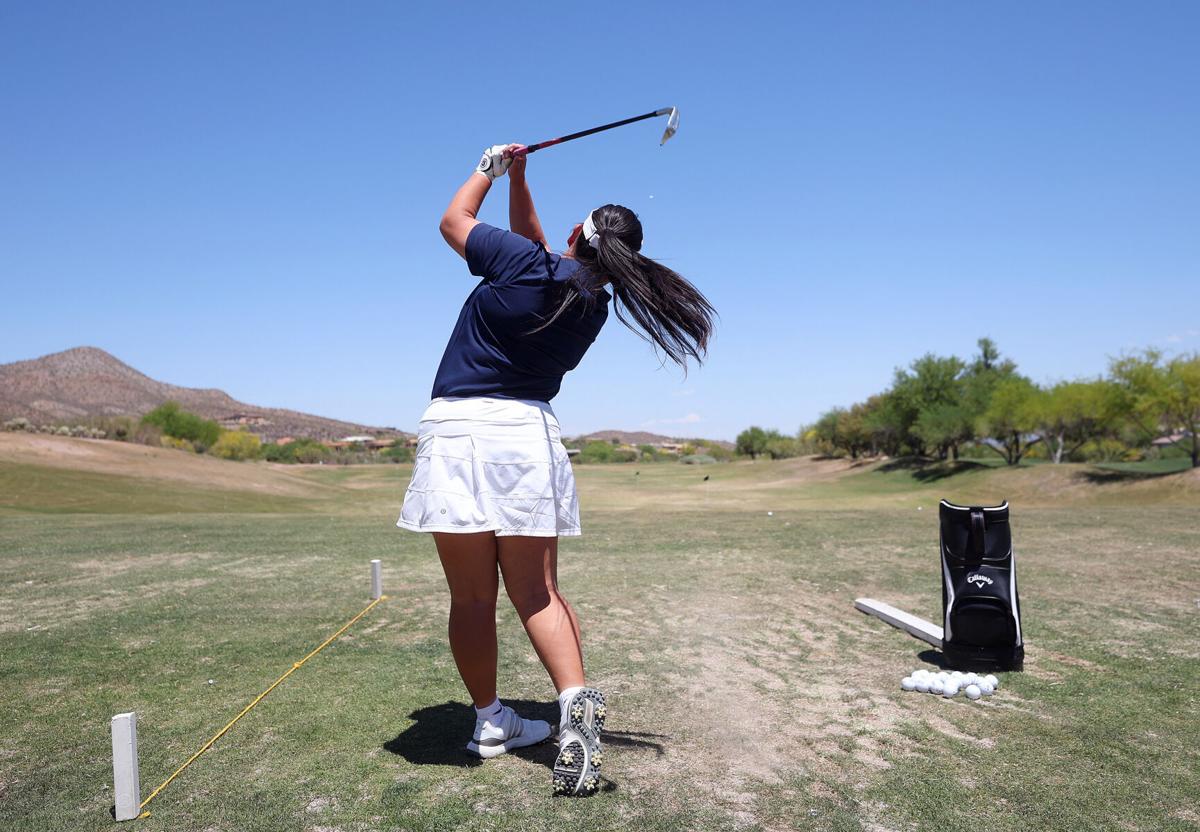
Amanda Cunha, who is visually impaired, watches her ball soar during practice on May 2, 2025. Cunha is on the University of Arizona adaptive golf team.
“Adaptive golf is one of those things that no one is doing right now, especially what I want to do,” Cunha said. “I don’t really have a person to look up to in terms of how to grow it. Having someone who has all of these connections and is a member at (St. Andrews) is the best because I’m able to gain his insight and gain the backing of the (The Royal and Ancient Golf Club of St. Andrews).
“I definitely want to work with USGA and (The Royal and Ancient Golf Club of St. Andrews) in terms of growing (adaptive golf) into more of a main-stage presence. It has grown over the last five years, but I see a chance for it to be more mainstream.”
Cunha hopes her story will inspire other visually impaired golfers or other golfers with disabilities to continue pursuing the sport.
“I hope aspiring golfers can see that resilience and determination can take them places,” Cunha said. “For me, even though I was nervous golfing again, I want them to see that putting in the work — even if it’s just one thing each day, baby steps — will pay off later on down the line. For me, it was about taking it easy and taking it one step at a time.”

