


Good luck finding spare time when Arizona’s offense is on the field this season.
It’s fast, up-tempo and rhythmic. Under first-year offensive coordinator and former quarterback Seth Doege, Arizona’s offense is all gas, no brakes and it spreads the wealth with receivers, running backs and tight ends.
However, a new offensive scheme comes with growing pains, and learning the pace of Arizona’s offense has surprised the Wildcats’ offensive leaders. After Arizona’s first spring practice last week, quarterback Noah Fifita “thought we played fast today and Coach Doege was disappointed in our urgency and energy.”

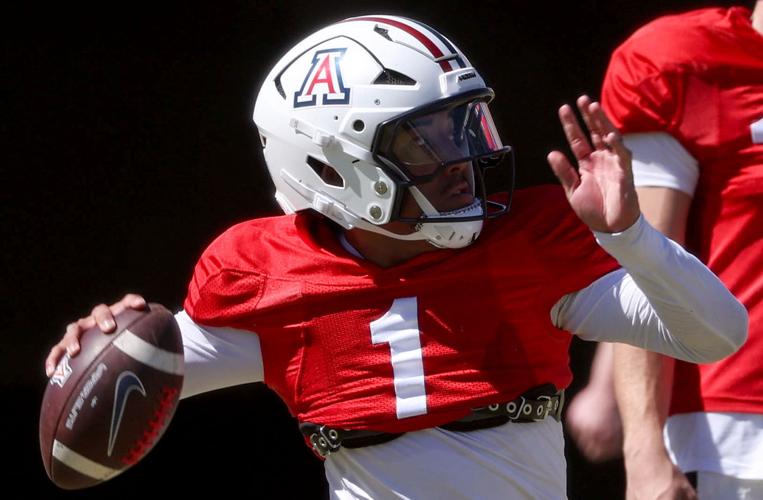
Arizona quarterback Noah Fifita throws the ball during spring football practice at Dick Tomey Field, March 25.
“After the first day, they felt like we were going fast and in my eyes, that wasn’t the standard,” Doege said. “The standard could be faster. We’re trying to push it to extreme limits. If we can and we can execute it, then I think we can be really dangerous. Beating defenses to lining up, them not being able to sub and late in the game, their lung capacity isn’t the same as ours because that’s what we do every day.”
Arizona’s no-huddle system requires players to look at the sidelines to watch coaches sending in signals and listening to Fifita, who is able to hear Doege in his helmet (coach-to-player communication system) until the 15-second mark of the play clock.
“The biggest thing is to get the signal and then translate it to figuring out what you have to do and then being able to do that while you’re fatigued,” said Arizona running back Kedrick Reescano.
When the pieces come together and Doege’s offense functions the way it’s supposed to, Reescano equated it to the “Mighty Morphin Power Rangers” combining their strengths — or “zords” — to create the “Megazord.”
“Same thing with a team,” Reescano said. “We all control this one thing to make it look super fluent.”
The biggest objective for Arizona’s offense this spring “is becoming a unit,” Doege said.
“A unit that can go out there and win the Big 12 championship,” Doege said. “With so many new guys and installing a new system, everybody is starting from scratch. There’s a major process of becoming one and doing it together. There are so many things that go into that. Part of it is learning what we do and getting lined up fast and operating fast and the effort we expect, the coaching points and executing what we expect. Owning (mistakes) and accountability — owning it and fixing it.”
Doege said Arizona has 90% of the offensive playbook installed — “and with a lot of flavor.” Even though Doege hails from an Air Raid background from his quarterback days at Texas Tech under Mike Leach, his offense at Marshall had more rushing yards than passing yards and leaned into the talents of Marshall’s personnel.
Playing to Arizona’s talents and maximizing Fifita’s strengths, which will likely include more designed runs and bootlegs, is Doege’s plan in his first season orchestrating Arizona’s offense.

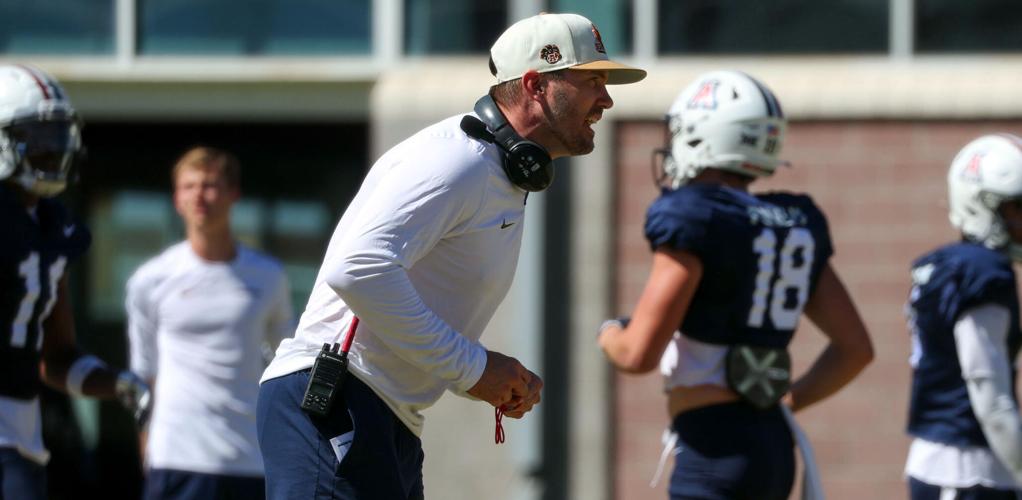
Arizona offensive coordinator Seth Doege talks to his players during practice drills at a spring football session on March 25, 2025.
Doege spoke to local media following Arizona’s fourth practice of the spring. Here are some of the items he discussed:
What are the benefits of playing an up-tempo, no-huddle offense?
A: “It’s a huge advantage, especially late in the game, but it’s only an advantage if you execute it. We talk about this all the time, tempo can be a weapon, but it’s only a weapon if we’re doing it the right way, lining up fast, if we’re intentional with the details, if we’re disciplined in our assignment and how we’re executing it. If we’re not, then we’re just playing fast to go three-and-out as fast as possible; obviously that’s a disadvantage. There’s parts to that that do give you an advantage, but at the end of the day, if we’re not executing at a high level, then tempo doesn’t give you the advantage we expect it to late in the game.”
What are some key points conveyed to the offensive line as they learn the new system?
A: “The hardest part for the O-Linemen is having to find ways to finish practice because we are playing in an up-tempo offense. They’re not used to that, whether they transferred here or played here last year. I think offensive line is the hardest job in college football because there are so many fundamental details that you have to master. ... Doing all of that really fast is really hard. That’s probably the most challenging thing for the offensive line so far — that I’ve asked them to do what they haven’t done in the past — is execute tempo. Even when we’re not playing with tempo, we still gotta line up fast and press the pedal.”
Redshirt junior Grayson Stovall and Hawaii transfer Ka’ena Decambra, among others, have taken reps at center this spring. What are you looking for in a center?
A: “To me, the center is just an extension of the quarterback. We ask a lot of that guy and I try to take some of it off the quarterback and put it on the center from an (identification) standpoint, so he’s gotta be very intelligent and process different types of (defensive) fronts and different types of alignments. ... He’s gotta have a ton of communication skills, because he’s making that whole thing go. Take it for what it’s worth, but he’s also gotta have a little dog in him. I feel like the best centers I’ve been around had a little edge to them. Whether they were short, big, fast, strong, explosive, it didn’t matter. At the end of the day, they had a ton of heart. ... I put a lot of stock into the center because that guy does a lot for us. He’s the first one to touch the ball and chases the ball every play. He’s the first one to get lined up and get us going. It’s a major piece for what we do.”
How was it learning the coach-to-player communication in helmets last season at Marshall, and how will the system benefit Arizona’s up-tempo offense?
A: “It was unique at first but I’ve really come to love it. Since we’re operating no-huddle and playing with pace, playing with tempo, it allows me to see the picture. When it ends up being a longer play-call, I can help the quarterback what the protection is and remind him on tip or a reminder. ... Sometimes I can see it quicker than he can see it and maybe we flip the protection or I can get us into a better play just because they’re aligned fast and I can still talk to him. It only works if we align fast, because we get cut off. Part of the process of playing with tempo and aligning fast allows me to communicate as much information as I can to Noah or (Braedyn Locke) or whoever is in there, so it allows them to have the best chance of success.”
How has it been learning from Arizona head coach Brent Brennan, who comes from a wide receiver background?
A: “The first unit meeting I had, I challenged the receivers. ... I’ve been at places where there was really, really good receiver play — at times elite receiver play — and this offense really goes. I’ve been at places where you didn’t have that and the offense struggles tremendously in the pass game. For us to do what we want to do, that receiver play has to be executed at a high level. I feel like we can get them there because of (wide receivers coach Bobby Wade) and Coach Brennan. ... For me, as a coordinator and a guy that’s installing an offense that puts a lot of premium on receiver play, it’s good to know those guys see it through the same lens. ... That receiver group, we need them to be really good for us to go and they know that, because we do it every day. I believe in those guys and I believe in Coach Wade, and I love that our coach believes in the standard, as well.”

