



The early returns suggest Arizona is not as good a football team this year as last.
If true, it’s not surprising. The 2023 Wildcats were just the fourth team in program history to win 10 or more games. Many of the key players on that squad — and most of the coaching staff — are no longer in Tucson.
It’s still early, though. Arizona has played just a quarter of its season. Last year’s club was 3-3 at the halfway point before reeling off a seven-game winning streak. This team has time to improve. This week’s bye is ideally situated to start that process.
The concern coming out of Friday’s loss at Kansas State wasn’t so much that the wrong Wildcats came out on top; it was how one-sided the result was. Arizona’s three losses last year came by a combined 16 points, including two that went to overtime. KSU beat Arizona by 24 points, and it easily could have been more.
There’s plenty of blame to go around; all three phases had critical breakdowns in the Little Apple.

But it’s the offense’s struggles that have left UA fans frustrated and worried.
That unit is trending the wrong way. Arizona scored 61 points in Week 1, then 22 (20 by the offense), then seven.
The 2023 Wildcats never scored fewer than 21 points. The ’22 squad’s lowest output was 17 (in Week 2).
What’s changed? What’s missing?
The underlying statistics support what your eyes are telling you: Arizona’s passing attack isn’t clicking in the same way under Brent Brennan and Dino Babers as it did under Jedd Fisch.
In this week’s “Cats Stats,” we’ll dig into some of those numbers and explain what they indicate about a pass offense that lacks consistency, timing and rhythm.
Time to throw
Two aspects of Arizona’s passing offense changed dramatically after Noah Fifita replaced Jayden de Laura last season: Fifita turned the ball over way less and got the ball out of his hand way faster.

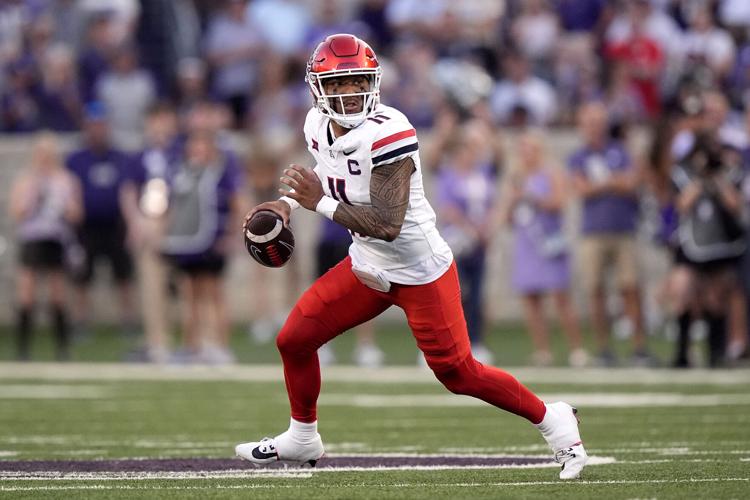
Arizona quarterback Noah Fifita looks to pass during the first half of the UA’s 31-7 loss at Kansas State Friday in Manhattan, Kansas.
In one of those areas, Fifita more or less has remained his usual self. He has thrown an interception in each of the first three games, but it’s not as if he’s become a turnover machine.
However, Fifita is holding onto the ball a lot longer. His average time to throw (TTT), per Pro Football Focus, is 3.16 seconds. That’s the second-highest figure in the Big 12.
Last year, Fifita’s TTT was 2.55 seconds — the fourth-lowest figure in the Pac-12. De Laura’s was 3.21 — tied for the highest.
Four Big 12 quarterbacks have a TTT over three seconds. The other three are dual-threat QBs: Baylor’s Dequan Finn (3.18), UCF’s KJ Jefferson (3.15) and Kansas State’s Avery Johnson (3.14). That isn’t Fifita’s game.
Fifita has the highest TTT in the Big 12 on dropbacks where he ends up scrambling, at 6.6 seconds. His TTT on scrambles last year was 4.95 seconds.
All of this suggests that Fifita isn’t seeing the field clearly and/or doesn’t have the outlets to unload the ball quickly.
It could be that Fifita is still getting used to a new offense. Or that his protection isn’t as sound. Or that something is awry structurally.
Most likely, it’s all of the above.
Pass-rush pressure
Through three games, per PFF, Fifita has been pressured on 33% of his dropbacks. That’s up from 27.8% last year.
Defenses are blitzing Fifita at a greater rate — 50.9% vs. 43.5% last year.
Fifita has not been as efficient when under pressure.
Fifita has completed 11 of 29 passes (37.9%) for 210 yards with one touchdown and one interception when pressured this season. Last year he was a 55.7% passer (44 of 79) under pressure and posted a 7-2 TD-INT ratio.
Fifita has done a much better job of avoiding sacks this year, lowering his pressure-to-sack rate from 17.5% to 8.6%. That could be attributable to him throwing the ball away more. He already has more throwaways this year (eight) than last year (seven).

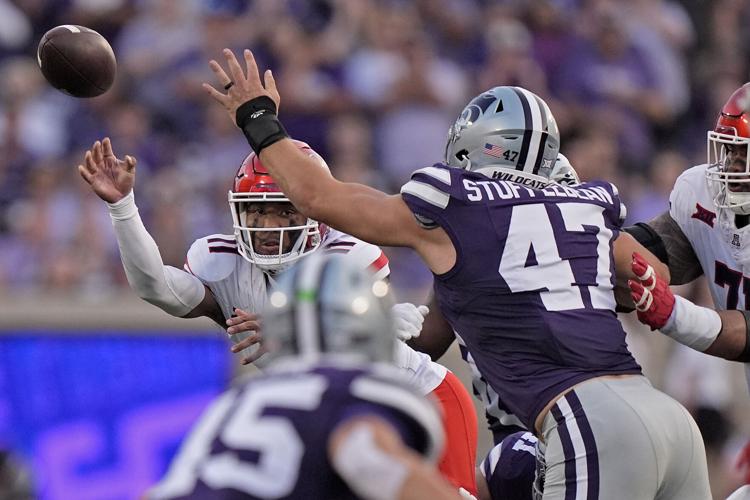
Arizona quarterback Noah Fifita passes around Kansas State defensive end Cody Stufflebean (47) during the first half KSU’s 31-7 win over the UA Friday in Manhattan, Kansas.
Arizona’s upheaval upfront is not something to be underestimated. The Wildcats had to shuffle their offensive line in Week 2 because of injuries. Only one player, left guard Wendell Moe Jr., started in the same spot as the opener.
Arizona was able to restore the opening-week offensive line in Week 3. But it’s doubtful that left tackle Rhino Tapa’atoutai was 100% coming back from a lower-leg injury. He also was making just his second career start.
The UA O-line wasn’t intact for most of training camp either. Offensive lines need time to coalesce. The bye week should help in that regard.
Passing depth
Fifita’s average depth of target (ADOT) is 9.5 yards, up from 7.8 last season. That could be the reason his completion percentage has dropped from 71.9% to 63.6%.
PFF’s data shows that Fifita is not utilizing the middle of the field nearly as much. Last year, 17.6% of Fifita’s pass attempts were thrown behind the line of scrimmage and between the numbers; 26% were thrown between 0 and 9 yards between the numbers; and 8.7% were thrown between 10 and 19 yards between the numbers.
This year, all of those rates are down: 14.1%, 20.2% and 5.1%, respectively.
Overall, Fifita has thrown a higher percentage of passes with 20-plus air yards than last year (17.2% vs. 13.4%) and a lower percentage behind the line of scrimmage (19.2% vs. 24.2%).
Throwing more bubble screens and pop passes would seem to be an easy solution. But those plays require effective blocking to work. Arizona’s blocking on bubble screens has been substandard so far this season.
Target distribution
Last year, Arizona basically had two No. 1 receivers. Tetairoa McMillan had a team-high 130 targets, while Jacob Cowing had 121.
This year, it’s T-Mac and everyone else.
McMillan has 33 targets through three games. The next-closest Wildcat is fellow wideout Montana Lemonious-Craig with 10.
Arizona’s tight ends have combined for 10 targets, or 3.33 per game. Tanner McLachlan had 55 last year, or 4.2 per game.

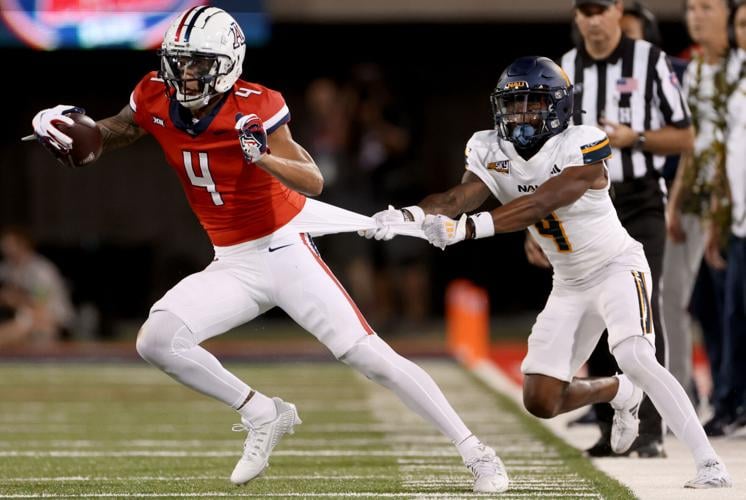
Northern Arizona cornerback DJ VanHook, right, tries to slow down Arizona wide receiver Tetairoa McMillan in the third quarter of their Sept. 7 matchup at Arizona Stadium. For the game, NAU did just that, keeping McMillan to just two catches and 11 yards receiving despite the 22-10 UA victory.
Cowing lined up in the slot on 331 of 472 pass snaps. Eighty-eight of his targets had an ADOT of 9 yards or less.
Getting slot receivers and tight ends more involved should boost Fifita’s efficiency. But those players have to be put in a position to succeed.
Fifita also needs to continue to build trust and rapport with pass catchers not named Tetairoa McMillan. Doing so would benefit both of them and the Wildcats as a whole.

