


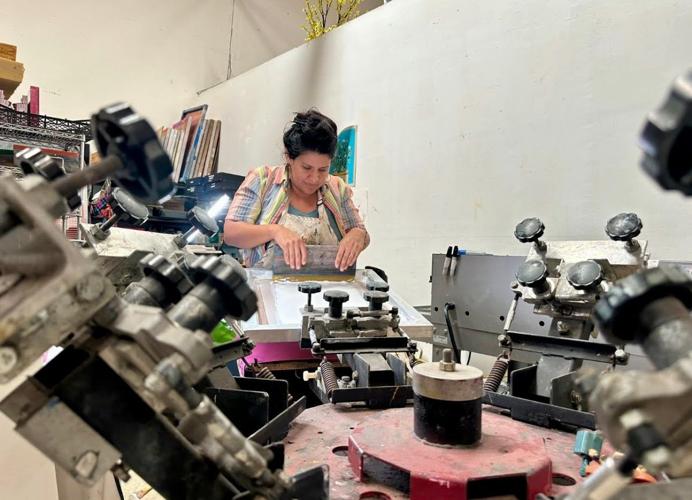

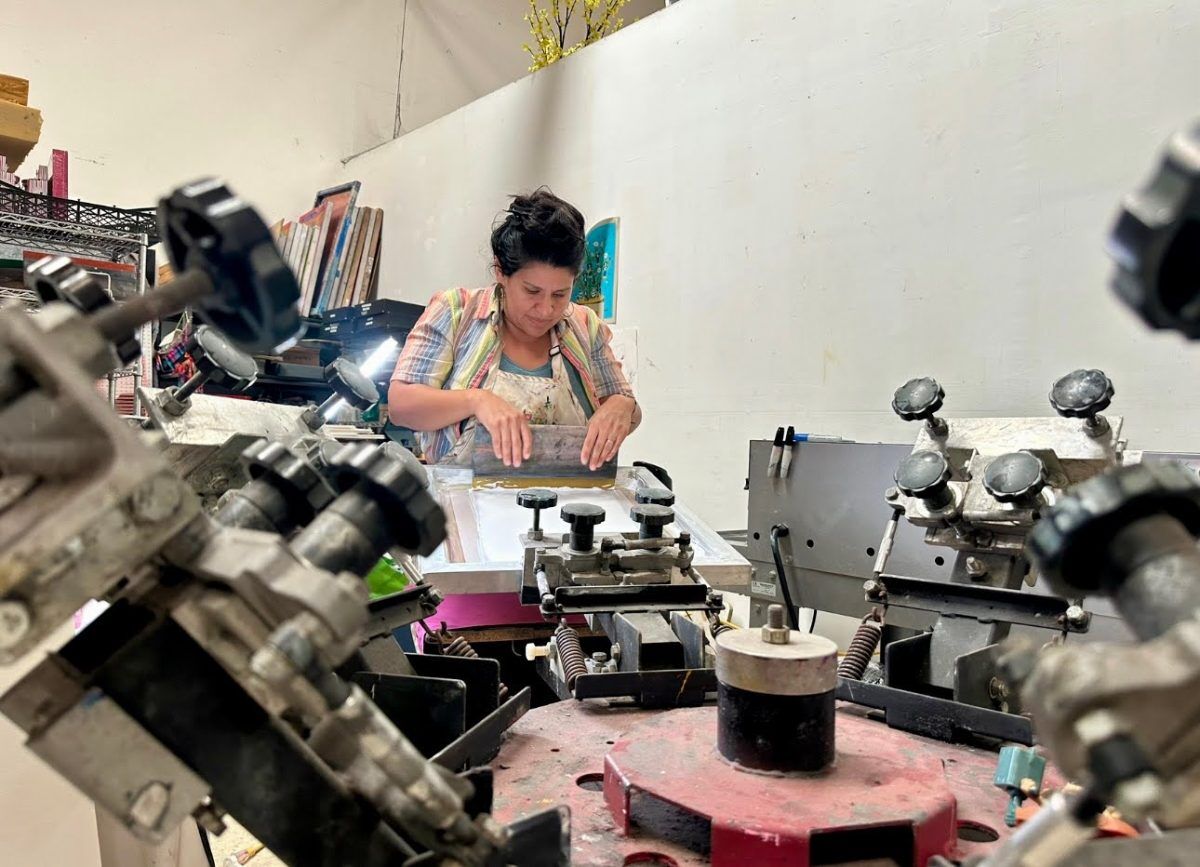
Finding sustainable funding as an artist in Tucson is a challenge, said local artist Alex Jimenez.
Jimenez, a lifelong Tucsonan, sees the city’s art scene as a relaxed and supportive community compared to competitive places like Los Angeles and New York, where artists often feel more isolated.
“I find people are very supportive, even if you’re in competing markets with the same style,” she said. “What I see as the main reason why a lot of people aren’t able to fully sustain an art practice is because you need stable income, and it’s really hard to do that as an artist.”
A new city project is looking to change that.
The Somos Uno initiative was started last year by the City of Tucson to help protect and preserve local arts and culture, according to the project website.
The website says it “aims to lay the foundation for future history, heritage, arts, and culture endeavors, fostering creative engagement programs.” A strategic plan is expected to be released in early 2025.
“There is no stable funding source for arts,” Jimenez said. “It’s always kind of like, I believe it’s always up for negotiation, and it’s been hard to convince lawmakers that it’s essential.”

Peniel Macias designed the wrap for the utility box on the northeast corner of East Congress Street and North Sixth Avenue called “Prickly Pair Commute.”
It’s an understatement to say that Tucson is a city with an abundance of visual art.
With dozens of galleries around the city, over 200 art-related organizations and murals spread across the Old Pueblo, Tucson has an incredibly rich history with art, said former Tucson Museum of Art curator Julie Sasse. It’s built this momentum for centuries.
“It’s almost sacrilegious to think about saying this is when the artists came, because the Indigenous people were making art way before white people showed up,” Sasse said. “But where it starts to become recorded as art, it really was the late 1800s and the early 1900s.”
Sasse said the development of the railroad brought in artists from the Atlantic coast, first to paint murals at the train stops and eventually to make a name for themselves somewhere new.
“You know, we keep thinking nothing started till the 1960s here, and that’s not true. The Women’s Club came in 1900, and that was a group that was all over the country. They were also in Phoenix, and they were the ones who started both the Phoenix Art Museum in its early stages and also the Tucson Museum of Art,” Sasse said.
Many of these artists from the 1920s and 1930s planted the seeds for what would become some of Tucson’s finest art institutions, from the Tucson Fine Arts Association to different University of Arizona art departments, she said.
“We’ve got such an inferiority complex, but we were doing some pretty good stuff back then compared to other cities of our size,” she said.
Since the early-to-mid 1900s, the city’s art scene has continued to evolve with the creation of the Center for Creative Photography, the UA Fine Arts Program, the Tucson Museum of Contemporary Art and dozens of other organizations.
“I think the biggest thing is, we didn’t have a good PR person like they did in Santa Fe. There’s myriads of books about Santa Fe and Albuquerque and New Mexico artists, but Arizona? Not so much,” Sasse said.
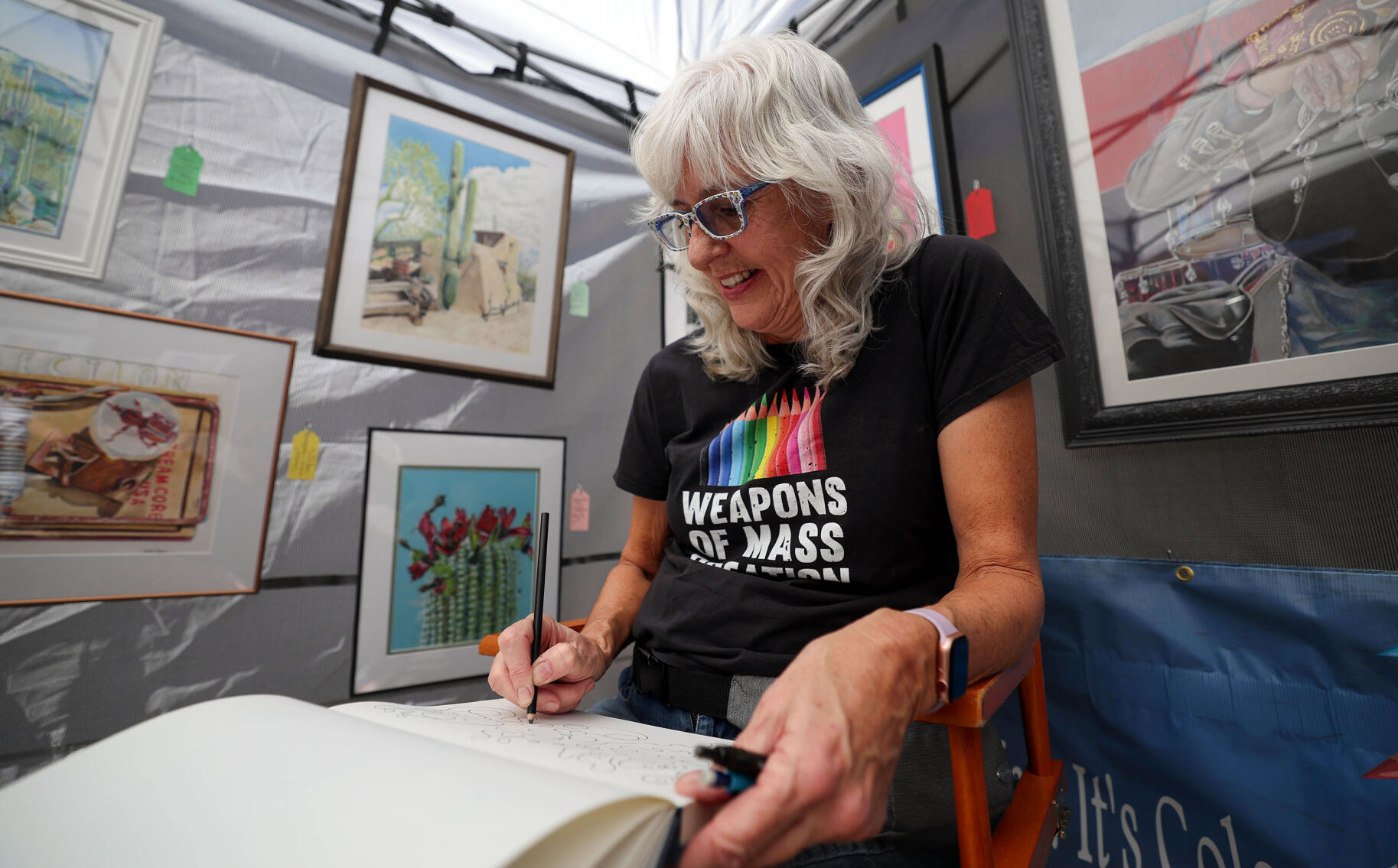
Amber Pierson uses colored pencil to create works of art during the 43rd Annual Fall Artisans Market at the Tucson Museum of Art on Nov. 22.
With the creation of these institutions and the increase of visual arts seen across the city, Tucson has developed a pronounced reputation in the creative world, yet it can’t quite be compared to any other city, said Visit Tucson President and CEO Felipe Garcia.
“I think that we have been able to recently develop our own proper image identity, and that has been kind of different and unique. With how we compare to others though, it’s challenging, because there’s many factors when we look at the economic side,” Garcia said.
It’s hard to compare Tucson’s art, heritage and culture budget with other cities’ because some invest in things that we don’t, he said.
“I remember we were comparing Tucson against another city in the U.S. based on the line item allocated on the arts, heritage and culture, and this community I remember was like investing 10 times more than Tucson,” Garcia said. “But then when we started digging into this other community, what was included in those investments were their local suit, their convention center, things that we don’t include in our arts, culture and heritage (analysis).”
The Arts Foundation for Tucson and Southern Arizona and the Arizona Commission on the Arts are two of the main organizations local artists and art institutions can go to seek funding, Jimenez said. She said that in recent years, the two organizations have enhanced their application process to make it more accessible and less intimidating, especially for first-time applicants.
“Everyone is trying to make their applications more accessible to bilingual people, so we get more diversity of people funded, but also people who aren’t good at writing. They’re doing more video applications too,” Jimenez said. “So that’s been a change I’ve seen over the past five to 10 years.”
The application process is fairly straightforward, said Gabriela Muñoz, director of grants and programs at the Arts Foundation for Tucson and Southern Arizona. She said the Arts Foundation tries to make the expectations of applicants as transparent as possible online, laying out the instructions as well as the criteria applicants will be assessed on.
“We invest a lot of hours in connecting with artists, answering questions, supporting them, because we are invested in funding them through the Arts Foundation,” she said. “But above and beyond that, we’re really interested in augmenting their capacity to receive funding, not just from us, but from other funders.”
The Arts Foundation distributed $3.2 million to “672 artists and arts organizations via 16 diverse grant programs” within the last four years, according to the website.

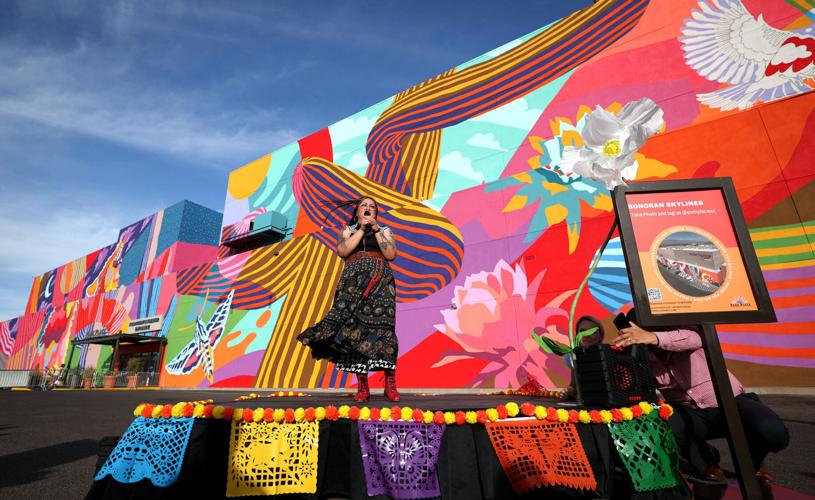
Jessica Gonzales addresses the crowd at Park Place Mall during a ribbon cutting ceremony for her new mural "Sonoran Skylines," at 5870 E. Broadway on Nov. 2.
According to the Somos Uno State of Culture Executive Summary, Albuquerque, Chicago and San Antonio are the most comparable cities in the country to Tucson when it comes to arts and culture, but they all have varying differences in arts funding.
San Antonio and Chicago utilize a transient occupancy or hotel-motel tax to fund arts and culture. However, unlike Tucson, a much larger percentage is earmarked. Albuquerque has an unusually large budget of over $50 million because it directly manages and staffs several major cultural facilities as well as a system of 19 libraries for the county.
The same study shows that Tucson’s core arts and cultural industries annually contribute $4.1 billion to the city’s economy with 52,184 jobs. That money doesn’t always seem to be returned to its contributors, but Jimenez hopes the Somos Uno project will alter that.
“I’m really interested in what the city can do on their end to address certain things like use of space. The city has lots of property and a lot of rec centers that have rooms and lots of art equipment, actually,” Jimenez said. “The city gives incentives to developers all the time because they see development as being an economic gain for Tucson, but artists are also an economic gain because of what we contribute to our local economy and how we attract people.”
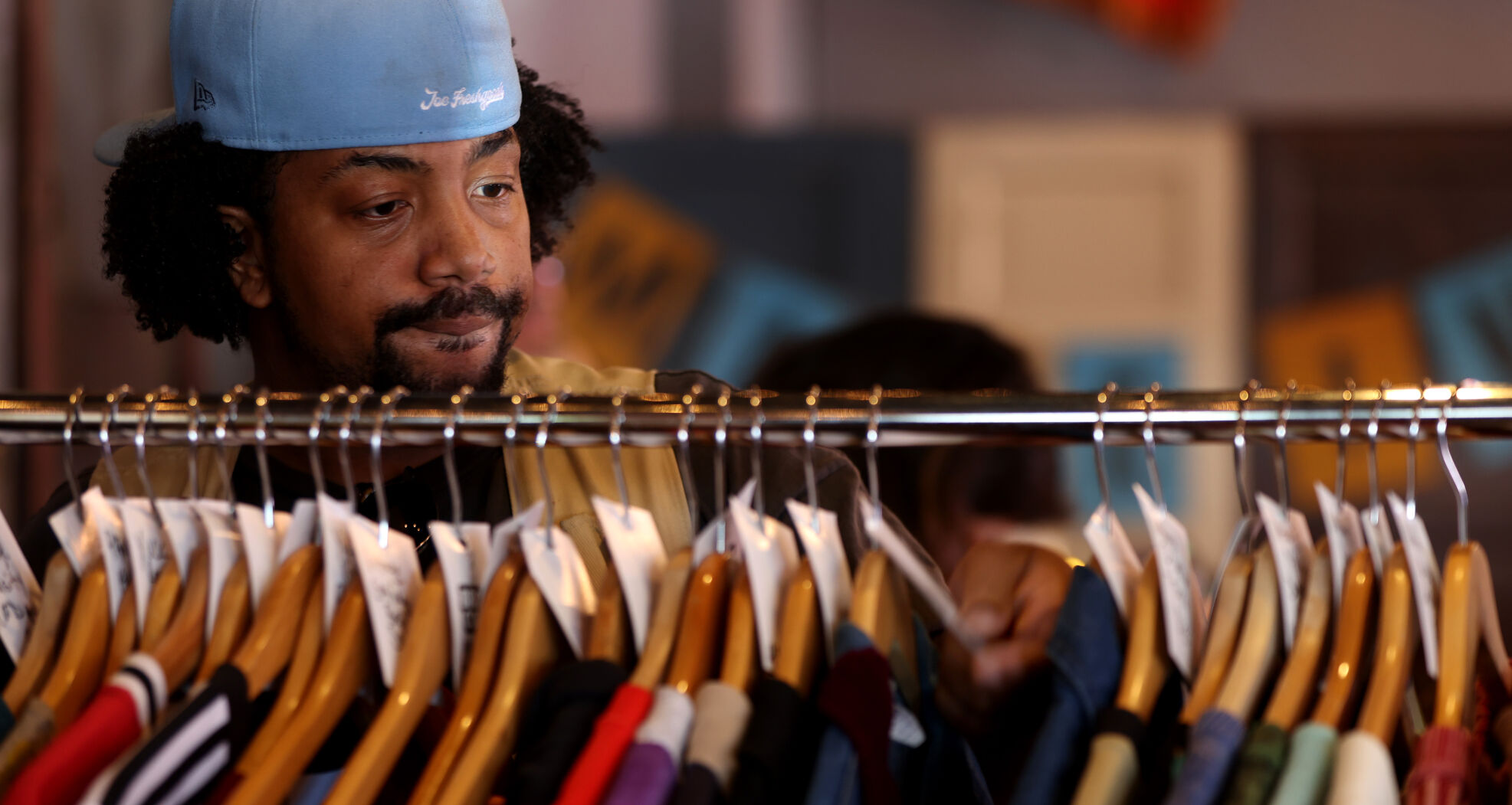
Black Broccoli owner Nick Arcade straightens up his stock on a rack of his redesigned vintage clothing at Ducky’s Banana Bread Bonanza at the Fourth Avenue Coalition Space on Sept. 21.
There are currently two projects in the works to help generate better funding for the arts: the Somos Uno initiative and a ballot tax initiative that will be available to vote on early next year.
“Funding, of course, is always crucial, but some ways to get support for either artist space or rental space for events, the city and others can help subsidize or offset,” said Garcia, the Visit Tucson CEO.
Proposition 414, the Safe and Vibrant City, is based on an estimated $80 million annual tax revenue projection for the next 10 years. The proposed ballot measure invests in five vital areas, according to the community investment plan. These include:
- Affordable housing and shelter (17.50%)
- Neighborhood and community resilience (16.75%)
- Enhanced emergency response (22.75%)
- Technology investments (12.25%)
- Capital investment for first responders (30.75%)
Part of the Neighborhood and Community Resilience section offers $1 million per year to Somos Uno investments. The tax initiative will be up for vote in March of 2025, but Somos Uno will continue with or without the additional funding.
“This project was really living inside the mayor’s brain and was something that she had been thinking about since she was a council member at Ward 1, and she was a council member there for 12 years,” said Genesis Cubillas, Mayor Regina Romero’s policy advisor. “So once she became mayor in 2019, this was one of her priorities on making sure that we would strategize around our heritage, history, culture and arts.”
Tucson’s culinary scene has already put the city on a global map as the first United States UNESCO City of Gastronomy. Once the final plan is out, Romero will attempt to add arts and culture as a tourist draw as well, Cubillas said.
“The overall purpose of this plan is to really give the City of Tucson a road map on how we take care of our cultural assets, how we continue to be mindful of our history and also how to put the city of Tucson on the map when it comes to the cultures and arts,” she said. “It’ll give us sort of a pathway on how we continue to fund the arts and expand, which is something that has been very important to a lot of community partners, organizations and individuals.”
When it comes to the visual arts, Cubillas said this project will allow better access to funding for artists and businesses.
“I think it’ll just give us more opportunity to not just dream of doing these things, but also give us an opportunity to do them,” Cubillas said.
The final Somos Uno plan will be available soon. Visit somosuno.tucsonaz.gov for more information.

