



The Minnesota company that owns two "megadairies" in the Willcox Basin will take 2,000 acres of farmland out of production and set up an $11 million fund to help neighbors whose wells have dried up due to unregulated agricultural pumping, in a new agreement signed with Arizona Attorney General Kris Mayes.
The agreement with Mayes' office, announced Thursday, represents the first step to reduce groundwater pumping in the basin, where groundwater levels have fallen in some places by as much as 5 to 10 feet a year in recent years.

Mayes
The agreement comes in the form of a legal settlement between Mayes' office and Riverview LLP, a Morris, Minnnesota-based dairy farming operation that's generally considered the biggest groundwater user in the 1,911-square-mile Willcox Basin in the far corner of southeast Arizona. The settlement follows an investigation the Attorney General's Office was conducting, based on its allegations that Riverview's pumping is creating a public nuisance, which the dairy company has denied.

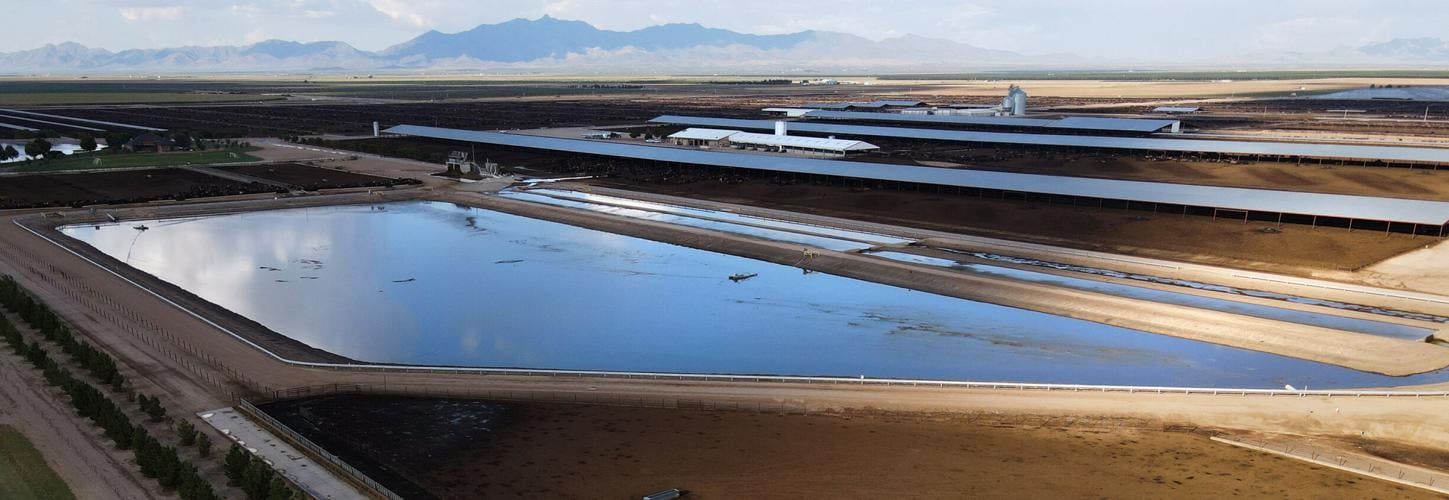
Water basins at Riverview's Coronado Dairy in Willcox, which pumps groundwater for its operations.
The settlement is the first of its kind in Arizona and across the country, Mayes said in a news release. Mayes has sued the Saudi-based Fondomonte's alfalfa operations in western Arizona on similar allegations of creating a public nuisance but hasn't sued Riverview.
The agreement was praised by Kathleen Ferris, an Arizona State University water researcher and a former Arizona Department of Water Resources director, as an important first step toward putting the brakes on chronic overpumping of the basin's aquifer. Overpumping has persisted since the 1950s and dried up more than 100 residential wells over the past decade or so.
Ferris said she hopes the agreement will spur future actions, particularly as Arizona's water agency prepares to impose longer-term conservation measures in the basin through its recently created Active Management Area there.
“This settlement sets a new precedent in Arizona — one where businesses commit to being good neighbors to the communities they operate in and make meaningful efforts to reduce pumping of our most precious resource — groundwater,” Mayes said in the news release. “As a daughter of rural Arizona, I can’t imagine anything more important than paving a new way forward to conserve groundwater and protect a future for the rural communities like Willcox and the Sulphur Springs Valley that define Arizona.
"And I would like to thank Riverview for coming to the table and making this settlement possible. I hope it is a precedent that other corporations will look to as an example," she said.
The agreement follows widespread scrutiny and increasing complaints from residents about Riverview's heavy groundwater pumping to grow corn, alfalfa and other feed crops to feed its dairy cattle. Complaints have steadily intensified since the early 2020s as reports of falling wells and dry wells increased.
In 2021, Arizona Daily Star reporter Tony Davis and Tucson-based freelancer Debbie Weingarten published a major investigation into Riverview's operations in both southeast Arizona and rural Minnesota, first in the regional magazine High Country News, then focusing in the Star on Riverview's Arizona operations.
In December 2024, the Arizona Department of Water Resources legally designated the Willcox Basin as an Active Management Area, which bans new irrigation except on lands that have been irrigated in at least two of the previous five years. The designation also sets the stage for increasing conservation restrictions, once the department adopts a management plan for the basin.
Riverview agreed to the following, according to Mayes' announcement:
- Over the next 15 years, the company will fallow a total of 2,000 acres of irrigated farmland or turn it over to a different land use, such as grazing, wildlife habitat or other uses not involving row crops.
- Riverview has agreed to deposit $11 million into two funds to pay residents of the Sulphur Springs Valley inside the basin to replace or deepen drying wells and for emergency or short-term water supply measures such as hauling water, buying water tanks, financing local community water systems and building water "stations" providing public supplies.
The funds will be split 50-50, with one fund serving people living within 1.5 miles of a Riverview-owned well and another helping those living outside those areas. The money will be provided over 20 years, and funds can be allocated sooner if there are "outstanding claim requests" from people needing access to water, the Attorney General's Office said.
- The money from the fund serving residents closer to the Riverview wells will be available for affected residents, schools, and special districts, water companies, or municipalities that provide domestic water services.
That fund will be directly administered by the dairy company. But the fund serving residents farther from the Riverview wells will be administered by a non-profit group not named in the agreement. It will be advised by a five-member review panel appointed by the activist Sulphur Spring alliance, the non-profit Babbitt Center for Land and Water Policy, the ASU Sustainability Institute and the University of Arizona's Water Resources Research Center.
- Riverview is banned from selling or otherwise transferring ownership of the land taken out of production without maintaining the existing ban on growing crops and without continuing existing commitments to fallowing the land.
It agrees to continue its "best management practices" on the land it keeps farming, including the use of center pivots, precision water application systems, pivot control "and other superior devices." Center pivots save water by applying it uniformly and precisely, reducing waste.
The company said in a written statement Thursday: “Riverview values stewardship of the land and water — a healthy environment is essential to everything we do. That’s why we have invested and innovated over the past decade to ensure our farms in Cochise County are equipped with the best available technology to conserve water, as well as voluntarily fallowed farmland. Riverview also recognizes the water challenges facing the Sulphur Springs Valley, and we want to be part of the solution."
For at least the past six years, Riverview's pumping has been under intense scrutiny and criticism from residents living inside the Willcox Basin and environmentalists, academics and other observes living outside it.
Since buying Coronado Dairy in the Kansas Settlement area southeast of Willcox from a local owner in 2014, Riverview's operations have mushroomed, expanding into the Douglas Basin to the south of the Willcox Basin even as the company bought more and more acreage inside the Willcox Basin.
It started a second dairy near Turkey Creek at the Willcox Basin's southern end in 2020 and 2021, and complaints about its pumping began to multiply from residents complaining of drying wells.
In 2021, Davis and Weingarten's article found that despite Riverview's assertions that it had reduced water use on its lands since buying them from the Coronado Dairy owners, neighboring farmers and other landowners, the rate of decline of groundwater wells in the area had increased since Riverview's arrival.
They also found that by September 2021, Riverview had bought more than 50,000 acres in the Willcox Basin since 2014 for a total price tag of more than $180 million. The company by then had drilled a total of 80 new wells since 2014, most at least 1,000 feet deep.
At the time the article was published, the entire Willcox's Basin's rate of water level declines had increased from 2 to 4 feet annually from 2010 to 2015 to 3 to 5 feet per year since then. The sharpest declines in the basin were found in the Kansas Settlement area, where Riverview's Coronado Dairy lies.
The company's land-buying has continued since then, Cochise County records show.
In 2023, ADWR released a report finding that the wells it monitored across the Willcox Basin had declined an average of 56 feet, or more than 5 feet a year, between 2010 and 2020. The basin also has had the fastest rate of land subsidence in Arizona in that time, which occurs when excessive pumping causes an aquifer's underlying soils to collapse — a process that state officials have said can't be reversed even once the overpumping stops
The Arizona Geological Survey has found the Willcox Basin has also accumulated the largest amount of earth fissuring due to subsidence of any groundwater basin in the state — about 50 square miles, ADWR reported in 2023.
Said ASU's Ferris, "We all know that the Willcox AMA is in serious trouble in terms of depletion. All the studies show that really, the only way to address that depletion is to reduce groundwater pumping.
"We all know that Riverview is the basin's biggest pumper. I think it’s really important for someone who is responsible for a lot of the decline in groundwater levels to help pay for the problem," Ferris said.
While this agreement will not by itself have a major impact on the basin's groundwater deficit, it will be a step forward, Ferris said.
"You always hear people say, 'Oh, we can’t set a precedent, because then everyone will always want us to do it.' But I think it sets a precedent," Ferris said of the agreement.

