



Can a thumb empower? Can a forefinger keep you safe? Can an app stop an attack?
Public Safety officials at the University of Arizona are banking on the answer being ‘yes.’
The SafeCat app has been rolled out ahead of the upcoming school year. It can be downloaded by Apple and Android users in their selective app stores. Anyone can join, whether a part of the Wildcat community or not.
“I don’t think that students can really thrive if they don’t feel safe,” said Amanda Kraus, vice president of student affairs at the UA. “And that safety is bigger than, you know, a response to an emergency.”
Instead, the proactive app connects students to a number of services at the push of a button that can help them avoid, prevent and get out of suspicious, scary or sticky situations.
Have you got a long, dark walk across campus? Activate the “Friend Walk” feature. It will allow app users to share their location with a friend who can monitor the user’s location, progress and confirm a safe arrival home.
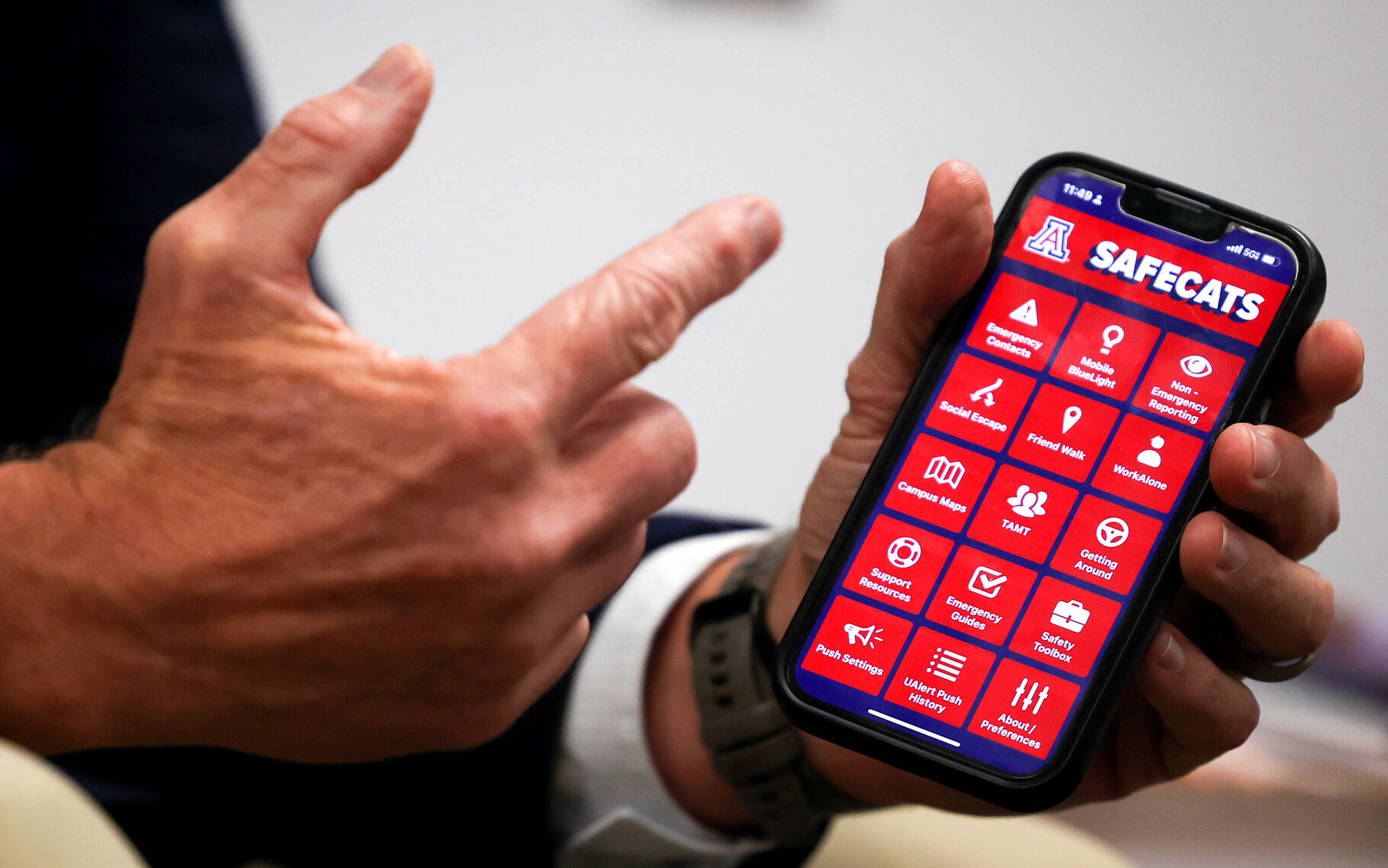
Steven Patterson, the UA's chief safety officer, demonstrates SAFECAT, the school's new campus safety app.
Other features, like the Mobile Blue Light/Text to 911, can be used in emergencies to silently request help, share a user’s location or text directly to 911.
The application will help students better understand the resources available on campus when it comes to safety and wellness, said Steve Patterson, the UA’s chief safety officer.
“We’re at a time where there’s a lot of technology out there and we really should be making sure that we’re using some of that technology for public safety,” Patterson said. “So, now we’re providing those services in an easier format for the members of our community to utilize. Just tap and you’ll have access to whatever it is to make you feel safe,” wherever you are, whether that’s in a laboratory alone, in a library at night or on a first date.
The “Work Alone” feature allows users to schedule check-ins at designated intervals. If the user does not respond to the check-in, their emergency contacts will be notified.
Patterson said the feature students were most excited about was the “Social Escape” feature, which enables users to discreetly get out of uncomfortable dates, parties, situations by sending a pre-programmed call or text as a social cue to leave.
Students gave the idea a standing ovation, which surprised Patterson and his colleagues.
“I’m excited to see them excited,” he said. Getting student feedback will be a major part of the roll-out, and his team will be meeting frequently to discuss and address student safety needs.

Steven Patterson, chief safety officer at the University of Arizona, and Amanda Kraus, vice president of student affairs, discuss the school's new SafeCats app, which was introduced as a tool to help boost campus safety as classes resume later this month.
Parents are also encouraged to download the SafeCat app and utilize the functions with their students, as emergency contacts, or to gather information in real-time from the university.
“I know parents and families may be anxious. They may be worried about sending their kids to a big campus, …this can really give parents, families, as well as students that additional peace of mind,” Kraus said.
A major benefit, Patterson said, is there’s no longer a need to juggle three or four different applications at once to accomplish what SafeCat can do at the push of a single icon.
Mental health services, which are often difficult for students to address, are also incorporated into the application, raising a different caveat to public safety and campus life.
Students can make appointments, arrange to speak to someone and get connected to 24/7 hotlines.
They can track Cat Tran transportation instead of waiting outside in the 100-degree heat, check parking garage vacancies and get important U-notifications sent via the app.
In the upcoming weeks, posters, banners and advertisements will be seen across campus encouraging students to download the SafeCat app and to familiarize themselves with the available services and features in an effort to reduce crime and increase public safety in their new homes.
“I think when you’re a member of the U of A community, other people are invested in your safety and your success, and that’s really reflected in this app,” Kraus said.

