

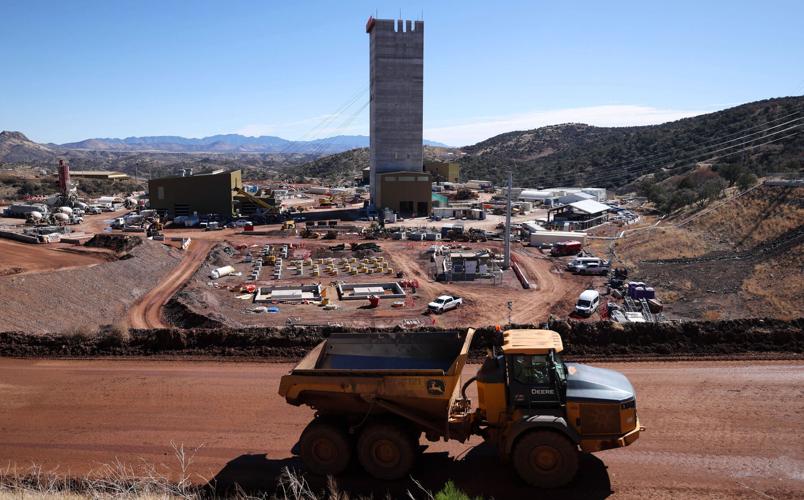

PATAGONIA MOUNTAINS — Construction cranes reach into a blue sky as 46-ton dump trucks rumble past with loads of rocks and dirt on a recent Wednesday at the South32 Hermosa Project.
A pair of 20-story headframe towers perch above 25-foot-wide vertical shafts that are being excavated at a rate of 7 feet a day and now extend roughly a quarter of a mile beneath the surface.
The larger of the two headframes already ranks as the tallest structure in Santa Cruz County, and it is destined to grow by another 50 feet or so with the addition of a “penthouse” containing the giant winches that will be used to lower equipment and lift ore from underground.
The critical minerals mine about 75 miles southeast of Tucson only received its final state air quality permit a few weeks ago, and it won’t receive full federal approval until later this year, but you wouldn’t know it from a tour of the site on Feb. 18.
Standing on a metal platform overlooking the mine, South32 Hermosa President Pat Risner pointed to where workers are building a zinc processing facility and preparing to extract bulk samples of battery-grade manganese from beneath a nearby hill for further testing.

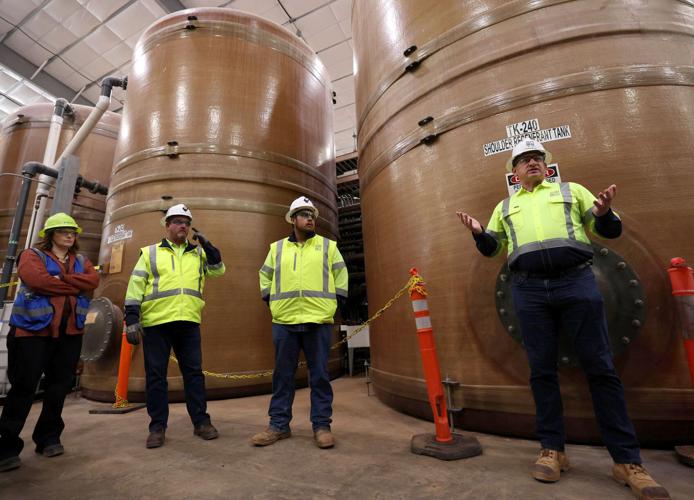
William Whitlock, middle left, Juan Villegas, middle right, and Pat Risner, right, speak to touring journalists inside the water treatment plant at the South32 Hermosa mine in the Patagonia Mountains on Feb. 18.
The project will also yield silver and lead as byproducts, and the site shows promise as a potential source for copper and rare earth elements as well, Risner said. “This is evolving into a critical minerals district.”
Other construction work now underway includes a 17-mile transmission line that will eventually power the mine and a high-tech office complex about 30 miles away in Nogales from which employees will monitor and remotely control Hermosa’s underground fleet of robotic, battery-electric mining equipment.
Risner said the more than $2.5 billion mine is about 50% complete, with construction levels expected to peak in the coming months, as the temporary workforce tops out at around 1,000 people.
Meanwhile, he said, the permanent staff of about 300 employees for South32’s operation in Southern Arizona is on track to roughly double by the time zinc production is slated to start next year.
This is what it looks like to develop what the Australia-based multinational giant calls a “next-generation mine” almost entirely on private property. Though federal regulators do get to shape how the project is designed and what sort of impacts it will have on neighboring public land, the mine is getting built regardless.
Final statement
On March 6, the U.S. Forest Service will release its final environmental impact statement for the Hermosa Project, a document more than 1,100 pages long that analyzes the mine’s potential impacts to the surrounding Coronado National Forest.
Publication of the EIS will trigger the start of an objection period, typically lasting 60 days and only open to those who submitted substantive public comments earlier in the review process. That is expected to be followed in July by an official record of decision from the Forest Service, another 60-day objection period and then a final notice to proceed sometime in September, Risner said.
The process will not result in an up-or-down decision on the mine itself, only the parts of the project South32 hopes to build on federal land or that could directly impact the forest. They include the transmission line, a second tailings pile on adjacent forest land, and a new 8-mile access road that would skirt the town of Patagonia by connecting the site to Arizona Highway 82 near the turn-off for Patagonia Lake State Park.
The situation is “a little unusual,” Risner said, because allowing the mine infrastructure on forest land will actually result in a more environmentally sustainable project. He said the “no-action alternative,” prohibiting any development in the forest, would mean more mine traffic on existing roads and the use of onsite natural-gas-fired generators to power the operation instead of imported electricity from renewable sources on the grid.

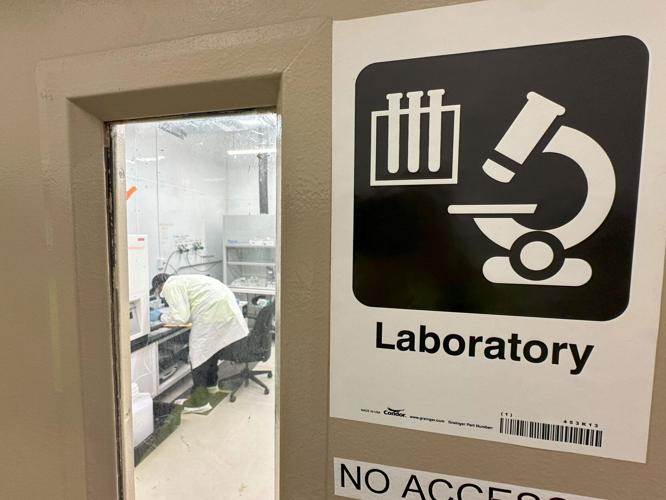
A technician tests samples inside the water treatment plant at the South32 Hermosa critical minerals mine in the Patagonia Mountains.
According to Risner, the only major change between the draft environmental impact statement released last May and the final one is how the mine intends to return treated water from the mining operation to the local watershed. Instead of building infiltration basins to put the water back into the underground aquifer, the project now plans to directly discharge from its onsite water treatment plant into Harshaw Creek and two other ephemeral streams in nearby Goldbaum and Mowry canyons.
The mine is already sending treated water down Harshaw Creek, raising concerns from some nearby residents and conservation groups about possible industrial contamination and the mobilization of naturally occurring toxic metals downstream.
In November, a compliance sampling report the mine submitted to the Arizona Department of Environmental Quality showed a release into the creek in early October that contained the heavy metal antimony at a level above the limit allowed by its state Aquifer Protection Program permit.
ADEQ determined the isolated discharge did not warrant any sort of public health advisory, but the agency did require an investigation and corrective action by South32. The mine has since shut down two onsite groundwater wells that were producing elevated levels of antimony and is in the process of upgrading its water treatment plant.

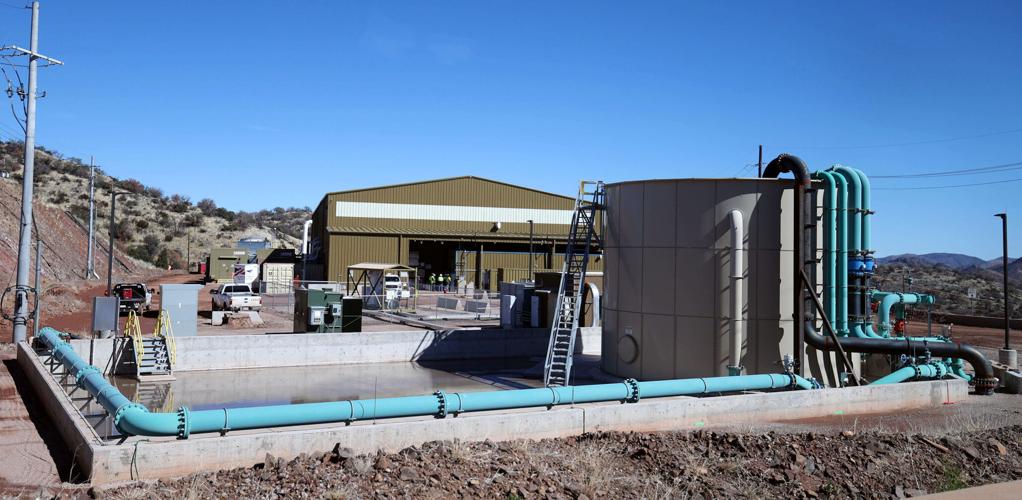
The treatment plant built to clean contaminants from water collected from tailings and pumped from the underground mining area at the South32 Hermosa mine in the Patagonia Mountains.
In a separate action on Feb. 9, ADEQ issued the final air quality permit for the mine, after completing revisions ordered by the U.S. Environmental Protection Agency to beef up emissions monitoring and clarify some provisions of the permit.
Also in the coming days, the U.S. Fish and Wildlife Service is expected to complete its Endangered Species Act consultation for the mining project, which is being built in a sky-island mountain range on the U.S.-Mexico border that provides habitat for jaguar, ocelot, Northern Mexican gartersnake, Mexican spotted owl, yellowed-billed cuckoo and other rare and protected species.
A mandatory federal review of historic and cultural sites in the project area by the Forest Service and Arizona’s State Historic Preservation Office was completed in late January.
Moving FAST
Building on private land isn’t the only thing bolstering South32’s development in the Patagonia Mountains. The project also has been accelerated by an Obama-era initiative aimed at streamlining the federal permitting process for what is considered critical infrastructure.
In 2023, Hermosa became the first mine to be accepted into the so-called FAST-41 program. As a result, the project is on track to have all of its necessary permits and approvals in hand by early September after just three years of multiagency review, while other proposed mines in the region continue to languish in the traditional permitting process after a decade or more.
“That’s gone quite well for us,” Risner said.

The view from an observation platform shows construction activity at the South32 Hermosa critical minerals mine in the Patagonia Mountains on Feb. 18.
The momentum has been dizzying for some activists trying to stop the mine or at least safeguard nearby communities and natural resources from potential harm.
In a Feb. 4 presentation to the Santa Cruz County Board of Supervisors on last year’s antimony release, retired hydrogeology consultant Chris Gardner said he moved to Patagonia “knowing full well the mine was coming,” but he was counting on government regulators to do what was necessary to “protect human health and the environment.”
Now he’s not so sure.
He said the Community Benefits and Protections Agreement that local officials are currently negotiating with South32 may represent their last chance to ensure the safety of their air, soil and drinking water by demanding enhanced monitoring and infrastructure improvements.
“It’s going to be the only way we get protections here,” said Gardner, who used to consult for Superfund sites and now serves as a scientific advisor to local residents. “The law is not on our side.”

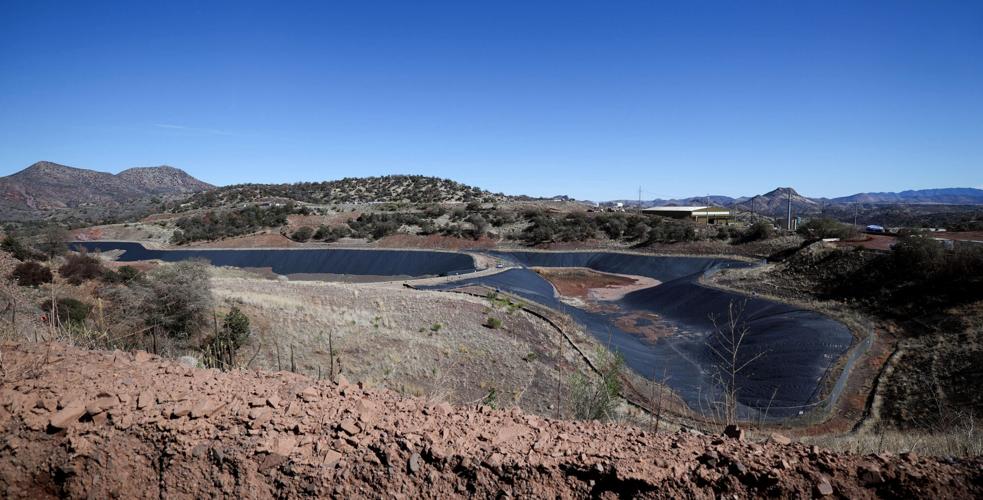
The lined, dry-stack tailings site at the South32 Hermosa mine in the Patagonia Mountains, as it looked on Feb. 18.
While Risner doesn’t share Gardner’s view of the law, he said he does agree about the importance of what he called the “good neighbor agreement” that Hermosa hopes to enter into by year’s end with Santa Cruz County, the City of Nogales and the Town of Patagonia.
The wide-ranging pact will be legally binding and spell out Hermosa’s commitments to upgrade and expand community services, workforce development and local infrastructure, while providing supplemental environmental monitoring and remediation beyond what is required by state and federal regulators.
It is important to get that framework right from the start, he said, but the agreement also has to be adaptable to meet the changing needs of communities over the course of a mining project that could last for the next 60 years or more.
“It’s designed to be a living document. We make decisions by consensus,” Risner said. “This isn’t the last chance.”

