

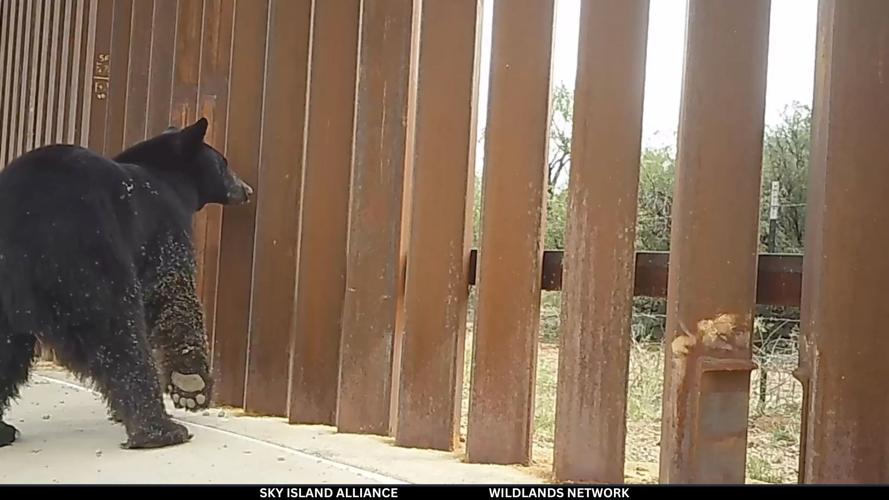

An American black bear paces for hours along a 30-foot wall of rust-colored steel but never finds a way through in video footage captured at the U.S.-Mexico border in Arizona.
Bears are one of several animal species whose movements have been blocked altogether by the tall, bollard-style barriers built since 2006, according to the first comprehensive study on how the border wall impacts wildlife.
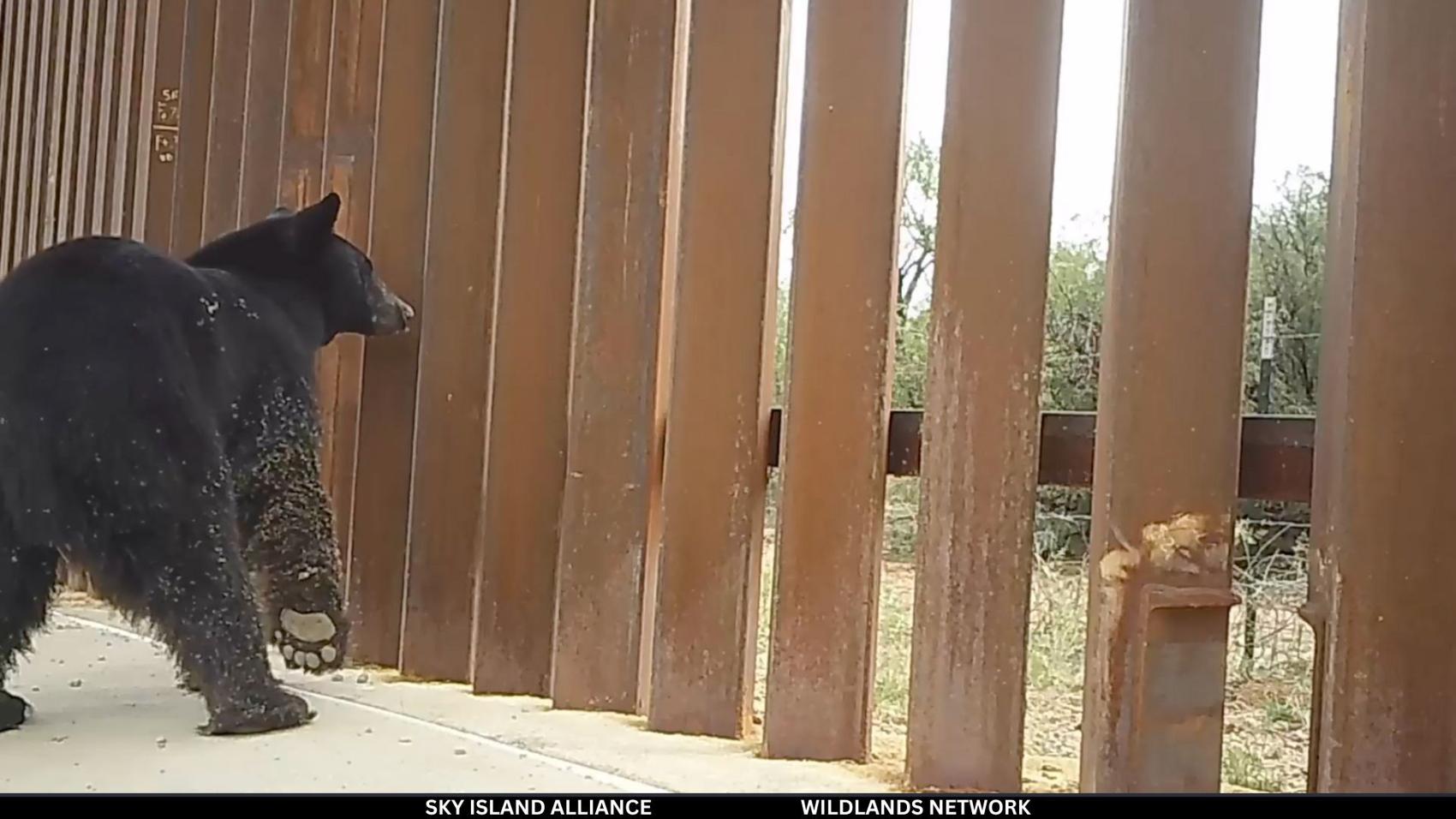
An American black bear paces in front of the border wall in trail-camera footage captured in Arizona as part of a new study on how barriers impact wildlife movement.
Researchers from the Tucson-based Sky Island Alliance and the Salt Lake City-based Wildlands Network used 36 motion-activated trail cameras to track 20 native species interacting with different kinds of barriers along 100 miles of the border in Arizona.
The two-year study found that tall, bollard-style barriers reduced overall wildlife crossings by 86% and left bears, deer, mountain lions, badgers and wild turkeys with no way across, because they can’t seem to squeeze through the 4-inch openings between the vertical steel beams.
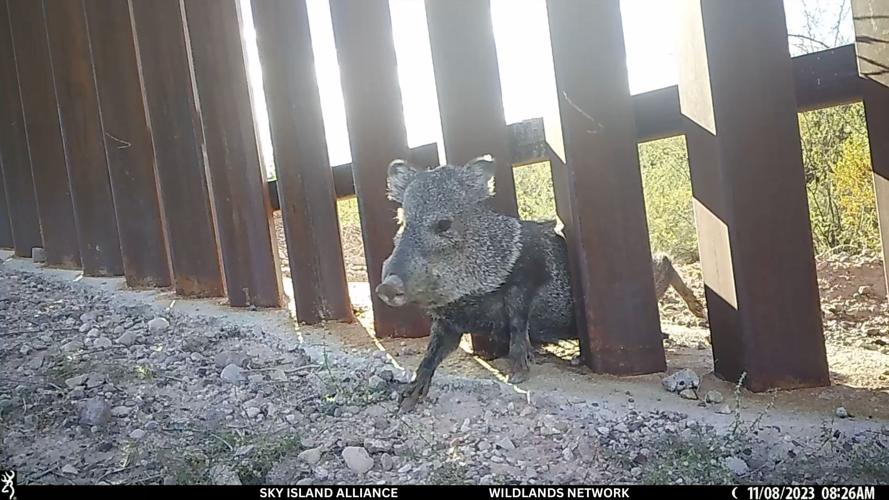
Crossing rates improved significantly at small wildlife openings installed in some sections of the wall, but the ground-level gaps the size of a standard piece of printer paper are scarce and don’t allow passage for all borderland species.
No bears, deer or wild turkeys were recorded crossing the bollard barriers, even where wildlife openings were present.
“Clearly, more and larger openings must be installed to help wildlife move across the landscape to access food, water, shelter and mates,” said Eamon Harrity, wildlife program manager for Sky Island Alliance and lead author of the study. “We are likely to see more border wall construction in the future, and even small increases in the spaces between the border wall posts would be a lifeline for species that have been stopped in their tracks and left in distress.”
Reason to roam
The findings are based on almost 13,000 videos collected between August of 2022 and July of 2024 at scattered locations from the Patagonia Mountains east of Nogales to San Bernardino National Wildlife Refuge near Douglas.
That 100-mile stretch of border includes roughly 70 miles of bollard wall — some of it built during the Trump administration — and 30 miles of waist-high vehicle barriers and barbed-wire cattle fencing.

A javelina squeezes through a special wildlife opening in the border wall in Arizona. New research shows the scarce openings help with wildlife movement, but more of them are needed.
Unsurprisingly, perhaps, researchers documented animals crossing the border with relative ease in those areas with no high walls.
The first-of-its-kind report was published on Nov. 20 in the peer-reviewed journal Frontiers in Ecology and Evolution. Co-authors included Meagan Bethel and Emily Burns from Sky Island Alliance and Michael Dax, Aaron Facka and Myles Traphagen from Wildlands Network.
The researchers placed their trail cameras at 33 locations in Arizona and three in Mexico, and collected the memory cards every 4 to 8 weeks.
Seven of the cameras were pointed at sections of bollard-style wall, and 18 were positioned at low vehicle barriers or barbed-wire fences.
Another 11 cameras were specifically trained on the small wildlife openings, all of which are clustered around the San Bernardino refuge and the San Pedro Riparian National Conservation Area southeast of Sierra Vista, with 60 miles of continuous border wall between them.
Those wildlife openings allowed almost 17 times more crossings by javelinas, mountain lions and coyotes, the study showed.

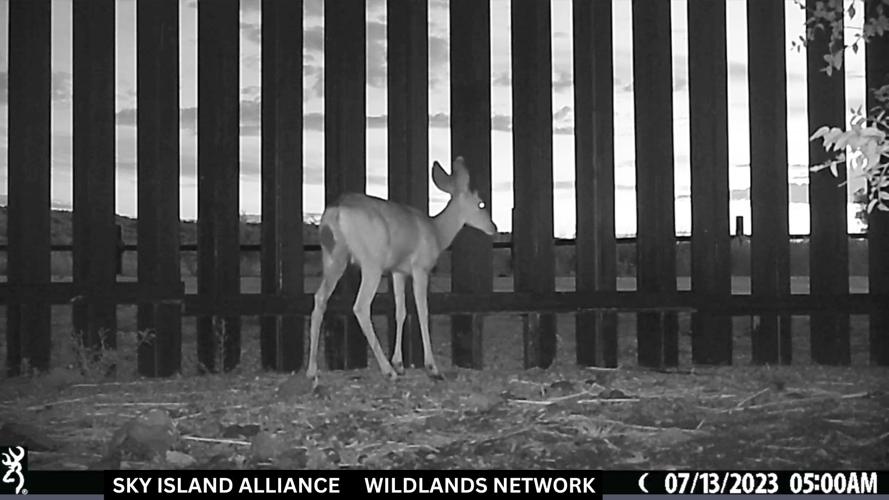
According to a new study on wildlife movement along the border in Arizona, mule deer like this one are one of several animal species that can't get through the tall, bollard-style barriers built since 2006.
The new research seems to confirm something that wildlife advocates have been warning about for years: Sealing off the border with walls designed to stop people also blocks the movement of animals whose long-term survival might depend on their ability to migrate, expand into new territory or mate with neighboring populations.
In the case of the black bear, an impenetrable border wall could threaten the genetic viability of populations in northern Mexico, where the species is listed as federally endangered, by cutting off their ability to mix with bears from southeastern Arizona.

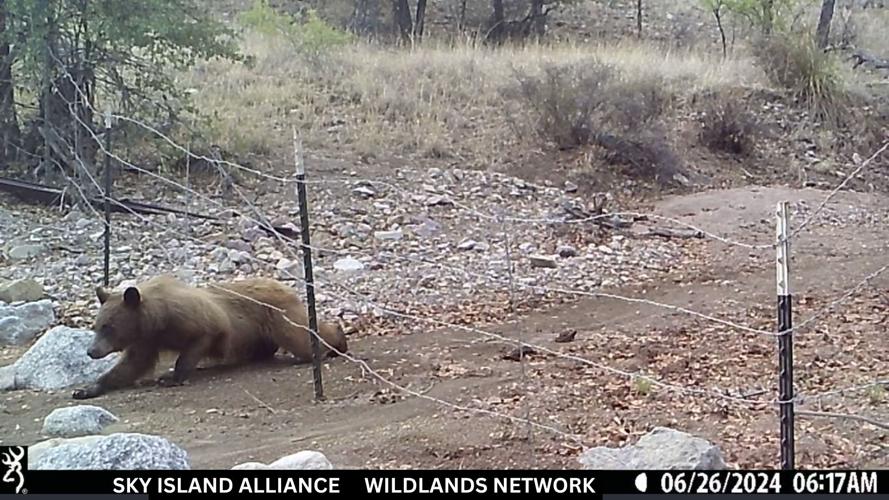
Trail camera footage shows an American black bear squeezing under a barbed-wire cattle fence that marks the U.S.-Mexico border east of Nogales. A new study shows that bears have no way to cross the tall, bollard-style border walls that have been put up in Arizona since 2006.
“In a rapidly changing climate, animals need more space, not less, to survive,” said study co-author Traphagen, who serves as borderlands program coordinator for Wildlands Network. “Doing whatever we can to allow wildlife more freedom to move is not just sound science to preserve biodiversity, it’s also a moral imperative.”
According to the study team, more than 60% of the border in Arizona is now covered by bollard-style barriers, which range in height from 18 to 30 feet.
Animal crossing
The U.S. Fish and Wildlife Service did not immediately respond to a request for comment about the findings. The Interior Department agency is responsible for enforcing federal wildlife laws, protecting endangered species and working with foreign governments on international conservation efforts.
Spokesman Mark Hart said Arizona Game and Fish Department officials were still reviewing the study and not prepared to comment on it.
Ultimately, though, Hart said federal agencies are in charge of the border and any barriers that are put there. Game and Fish does consult on wildlife issues there when asked — as it did in the Sasabe area in 2022 — but that’s about it.
From a regulatory standpoint, “we don’t really have a role,” Hart said.
Along with their findings, the researchers released some of the more impressive trail-camera footage they captured.
In one clip, a mountain lion uses a wildlife opening to cross through the barrier, followed closely by three spotted cubs still small enough to fit between the bollards. In another, a mule deer buck leaps gracefully over a barbed-wire cattle fence marking a different stretch of the border.

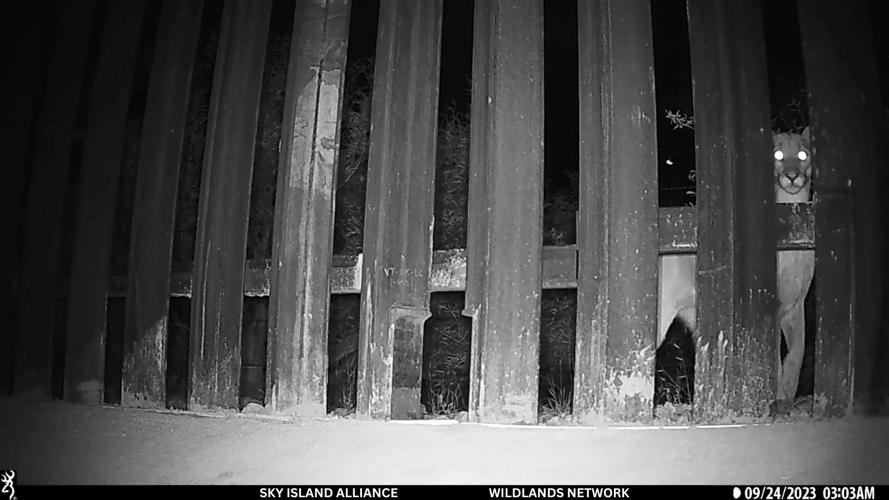
A trail camera set up by researchers catches a mountain lion looking through the border wall in Arizona. Their study showed that adult mountain lions can't fit between the steel bollards but are able to cross through special ground-level wildlife openings like the one at the center of the image.
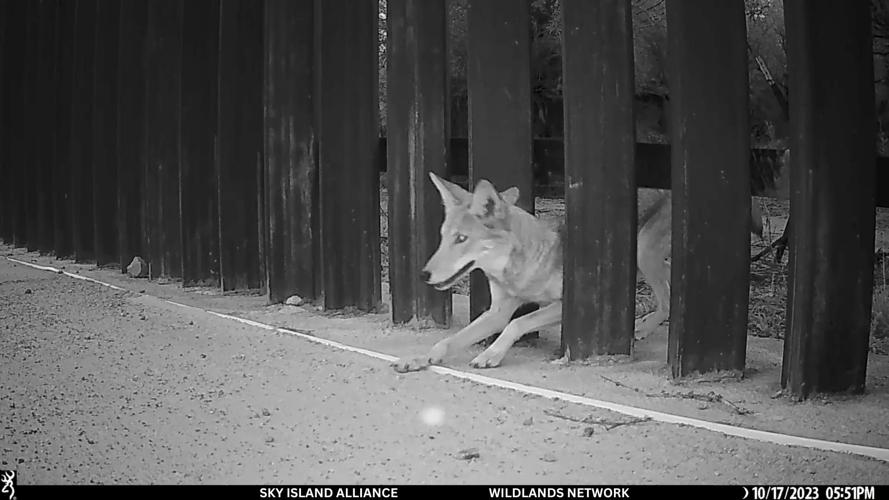
The trail cameras also captured a coyote carrying a deer leg in its mouth that’s too wide to fit through the wildlife opening in the bollards. After a struggle, the coyote manages to squeeze through with its meal, which it then drops right in front of the camera so it can cough up a mouthful of deer fur.
All told, the border study documented one bird species (the aforementioned wild turkey) and 19 mammal species, including badger, bobcat, coati, gray fox, opossum, porcupine, raccoon, ringtail, two different types of deer, two different types of jackrabbit and three different types of skunk.
Coyotes were the most common species caught on camera, followed by javelinas and white-tailed deer. According to the study, one of those javelinas got itself wedged between the bollards and eventually died of exposure.

A coyote crosses through the border wall in Arizona in trail-camera footage from a new study on how barriers impact wildlife movement.
No video was collected of rare, federally protected borderland wildlife such as desert tortoise, ferruginous pygmy owl, jaguar, pronghorn and ocelot. Researchers said more study is needed to assess the impacts of border barriers on those specific species.
The cameras also failed to capture footage of a single person crossing the border, even where the boundary is blocked only by a vehicle barrier or a barbed-wire fence.

