

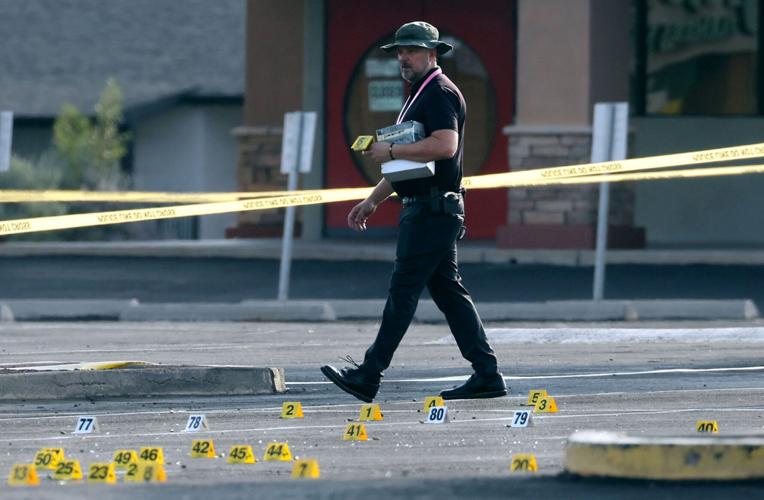


The details of the crime shocked Tucson and the country.
The victim and his wife were passing through Tucson on a bus-trip layover.
It was downtown on a beautiful Saturday morning.
And of course, there was the weapon used in the attack: A hatchet.

Arizona Daily Star columnist Tim Steller
When Tucson resident Daniel Michael allegedly attacked Jacob Couch April 5, leading to his death 12 days later, it struck a nerve here and elsewhere. It alarmed some local people and ashamed others. It appeared on Fox News, the New York Post and People magazine.
It said something about Tucson that Tucson doesn’t like to say about itself: That this funky city in a beautiful natural setting can be a dangerous place where sudden violence may break out anywhere or time.
That’s the opposite of the message that we’re trying to send the world. In fact, in a head-spinning series of events for me, I read a flattering real-estate piece about Tucson in the online New York Times on Wednesday, April 16. Then, on the 17th, shortly after a prayer vigil outside the hospital, Couch died of his injuries. And on Friday April 18, I got home to see blocked-off streets nearby and a helicopter circling overhead, the result of a shooting.
Nobody was killed in that shooting, so there was no news reporting about it, unlike the shooting later that same day, when a pawn-shop employee shot and killed a man who he said had assaulted him. That pawn-shop incident was part of a run of four killings in eight days, between April 13 and April 21, in the middle of which Couch also died.
Tucson Police Chief Chad Kasmar acknowledged in an interview that we’ve had a bad run of violent crimes in April. We have had 23 homicides this year, up from 16 in the same time period last year. But he noted that overall, reports of violent crime are down 15.6% this year compared to last year and are down by 16.1% compared to the five-year average.
“If you’re not selling drugs, using drugs out in public spaces, or involved in trying to rob each other, your probability of being a victim of violent crime in Tucson is low,” Kasmar said.
As to the Couch case, he said, “On this day in this case, there’s still happenstance that happens. If we had 1,600 cops, I can’t say we’re not going to have a similar situation.” The Couches, he emphasized, “didn’t drive that conflict.”
Not a typical violent offender
The man accused of driving the conflict, 25-year-old Daniel Michael, has a long history of minor infractions and mental health evaluations and treatments.
Court records show Michael has criminal arrests going back to when he was 11 years old and was regularly accused as a juvenile of crimes from shoplifting to criminal damage to assault and burglary. When he was 16, a juvenile court judge issued an order declaring that his caretakers were “unable to control, supervise or parent” him.
As an adult, Michael has been convicted of misdemeanors, including criminal damage and theft in Tucson City Court, and has been involved in the county’s mental health system. He was facing another criminal damage charge when arrested for the attack on Couch. Still, he was not one of the violent criminals that the Tucson police keep an eye on.
“When I look at him and look at his history, he’s not someone who would have been on our target as a violent offender,” Kasmar said.
TPD is aware of some local people with violent tendencies. They’ve been targeting people who are prohibited possessors of firearms — many of them with previous convictions for violence — arresting more than 40 per month. For more than a year, they’ve been working not just with local prosecutors but with the U.S. Attorney’s Office, prosecuting 96 prohibited possessors in the federal system, where sentences are stricter.
But the number of shootings is still alarming. Kasmar noted that his department is now tracking the number of incidents in which a bullet pierces the skin of a victim. These are not homicides, but they could have been with slightly different aim or a slower medical response.
“When we’re having between 250 and 300 nonfatal skin-piercing shootings in our town, everybody should be outraged,” Kasmar said.

Jake and Kristen Couch pose for a photo on Christmas 2023. Jake Couch died days after he was attacked in Tucson by a man with a hatchet. Luke Couch said it would bring the family some peace "if some good would come," of his brother's killing.
A run-of-the-mill response
Violence brought Luke Couch to Tucson from the small town in northern Alabama where he and his brother, Jacob, grew up, a town called Arab. Luke came here soon after the April 5 attack, visited his brother in the hospital and, unable to sit still at the motel, went out to investigate the crime himself.
“I went and bought a notebook and a pen and went downtown and did my own investigating,” Couch told me in an interview.
He walked the streets near Broadway and Sixth Avenue downtown and found an eyewitness to the crime as well as surveillance footage, which the owner turned over to police. In his time here, he’s been both heartwarmed by the help many Tucsonans have offered and a little surprised by the run-of-the-mill official response.
Yes, the detective and victim’s advocate have helped and kept them up to date, but he wondered if there would be something from the mayor, for example.
Couch spoke carefully as he said, “If it was me, if I was the mayor of a town, and a tourist that wasn’t even supposed to be in my city for more than two hours and was murdered in such a heinous way on their way back home, I’d think of more of a little human decency.... Just, ‘Hey sorry for your loss.’”
After I spoke with Couch, I had a chance to speak with Mayor Regina Romero and asked her about the killing.
“That was a very, very tragic incident,” she said. “Especially as mayor, I really feel for anyone that loses their life in these types of incidents.”
Familiar circumstances
But what type of incident was this, really? Since it happened, rumors have circulated that Jacob and Kristen Couch were doing drugs on the streetcar-stop bench where Michael is accused of confronting and attacking them.
That is what Michael said, according to the initial criminal complaint on him — that he had confronted them over using drugs. Police say they have no evidence that’s what the couple was doing at the stop.
“He and his wife were traveling through Tucson and ended up staying downtown for a little more than a 24-hour period,” Kasmar said. “Nothing that they were doing warrants a guy pulling out a hatchet and hitting somebody in the neck with it and killing them.”

A recent run of killing this month shows that Tucson can be a dangerous place where sudden violence may break out anywhere or time. Tucson has had 23 homicides this year, up from 16 in the same time period last year.
When I asked if this case belongs among the approximately one-third of homicides that involve unsheltered people, he said, “I’m not ready to say that with that case.”
When somebody is murdered in Tucson, at least one of several factors is usually a key part of the picture. Homelessness, substance abuse, illegal-drug dealing, gangs.
How many of those factors were present in this case is unclear, but the more I hear about it, the more familiar and less distinct it sounds.
‘People need to pay attention’
People often say the mayor and local government are doing nothing to address these problems. You can debate whether what they’re doing is effective, but the idea they’re doing nothing is not true. They spent more than an hour at Tuesday’s council meeting, for example, discussing how to spend money on which programs addressing the fentanyl crisis.
They also discussed a planned boost to the police budget and pay raises for officers and other city employees.
“People who criticize our work — they don’t have a clue how this work works,” Romero said. “Our facts are evident. We are looking at double-digit numbers in terms of violent crime coming down and property crime doming down.”
Indeed, that’s what Tucson police figures say, even if our experience doesn’t feel that way. Even property crime reports are down by about 30 percent year over year and 31 percent over the 5-year average. There’s reason to dispute these numbers: We all know that TPD tends to be so unresponsive to property crimes that people sometimes don’t bother making a report. But of course, that isn’t something that started in the last five years.
I asked Romero about whether her role in promoting the city gets in the way of facing the city’s real problems.
“I don’t shy away from talking about any of the issues we need to talk about,” she said. “People need to pay attention.”
Social dysfunction permeates city
Still, that run of homicides this month sparks valid concern. On April 13, 60-year-old Michael Lee Baker was found dead at Doris Thompson Park. Police accused 19-year-old Daniel Xavier Webster of killing him. Both were unsheltered, Kasmar said.
On April 17, two groups of teens met, apparently for a transaction, near South 12th Avenue and Drexel Road. A 14-year-old is accused of shooting and killing 19-year-old Antonio I. Rivera.
On April 18, the homicide, allegedly in self-defense, occurred at the pawn shop, leaving 39-year-old Michael Alex Monano Mendoza dead.
On April 21, in an incident in which police are being quiet about potential motives, “known parties” met at an apartment near East Drexel Road and South Nogales Highway. Fernando Pablos was killed; Ambar Esthela Morales and Manny Romero Jr. were arrested.
And on Friday night, April 25, another homicide occurred: An as-yet-unidentified victim was killed near the Rillito bike path at North First Avenue. The case apparently involved unsheltered people, possibly drug users.
Amid that sad series, Couch died. While his death was alarming in certain details, especially the apparent randomness, it wasn’t so different from what happens in Tucson all the time. The social dysfunction that permeates Tucson led to another killing. That’s the real problem.
“What happened to my brother, if that’s what it takes for it to get the ball rolling here and for something to get done and for this to not be swept under the rug, and for this to never happen to anyone else’s family again, then there’s some peace, that it wasn’t for nothing, that he wasn’t murdered in vain,” Luke Couch said. “It would bring me and my family some peace knowing that some good would come of it, if that happens.”
IF that happens, emphasis on the if. Let’s make sure it does.

