


They will always make another demand that you submit more, debase yourself further.
That’s what we’re learning from the University of Arizona’s advancing entanglement with the Trump administration.
You eagerly submit to their first demands, then they come back with new ones.
Arizona Daily Star columnist Tim Steller
You happily submit to those, and they try to box you in with a deal you can’t refuse. The “compact” offered this week to the U of A and eight other universities was basically this: “Nice little university you got there. Be a shame if anything happened to it. Want to sign up for our protection package?”
UA President Suresh Garimella, in his first year on the Tucson campus, has landed the unfortunate task of dealing with the Trump administration’s efforts to bring American universities to heel on behalf of conservatives who find them too politically liberal.
It’s been an unenviable task. In key moments, Garimella and his team have been eager to please the Trump administration and the GOP majority in Congress, going further than they asked sometimes, responding fearfully last week to a Republican request dealing with China.
In other words, he hasn’t learned the first lesson of bullies. They will not stop hassling you if you hand over your lunch money today. The aggression will only get worse until you stand up to them.
That, in essence, is how the U of A landed on a nine-member list of mostly elite universities that have been asked to sign onto a compact, under which the selected universities agree to terms in how they operate and get preferential access to federal funding.
It’s a misleading document in that it purports to establish more of a neutral meritocracy on American campuses, but at the same time sets up a special class of universities that receive federal funding and other benefits, not because they’ve earned them but because they are the president’s special pets.
Even that status is precarious. It only lasts until someone on campus veers from this new orthodoxy. Then the hammer comes down again, and the bully’s cycle of demands is renewed.
An embarrassing exercise
When President Trump ordered an end to diversity, equity, inclusion and accessibility programs on campuses, Garimella’s administration complied — a little too eagerly, it seemed to many.
He cut DEIA jobs in the administration, eliminated ethnic cultural centers for students, and his administration even went through websites and academic units, scrubbing the words “diversity” and “inclusion” from their materials.
It was an embarrassing exercise that many students and faculty members rejected. A group of 60 distinguished faculty urged resistance to Trump administration demands, as did the faculty as a whole in a May referendum.

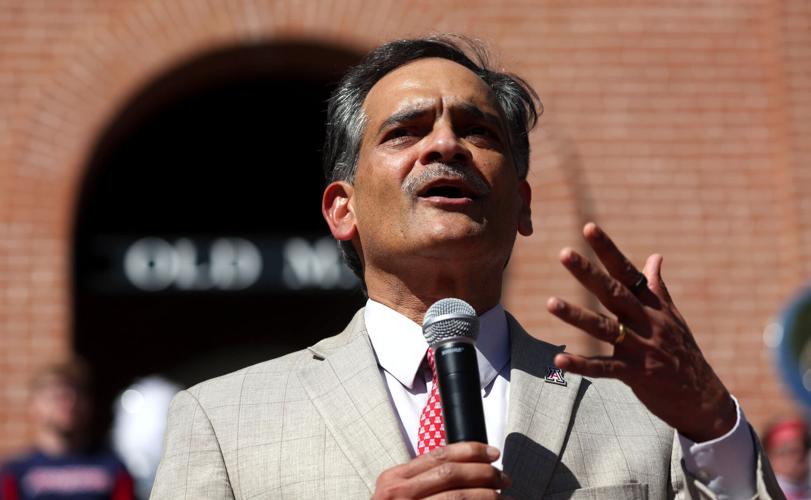
University of Arizona President Suresh Garimella has been eager to meet Trump administration demands. He now must decide if he will stand up to the White House when it comes to committing to a “compact” on how to operate the university in exchange for preferential treatment in federal funding.
Nevertheless, Garimella’s administration went so far as to unilaterally delete the touchy words “diversity” and “inclusion” from a land acknowledgment statement that the UA had carefully negotiated with Arizona tribes. The overcompliance reached that degree of petty conformity.
Garimella defended his actions as necessary to protect federal funding for the university’s students and faculty.
“We are deeply committed to sustaining the work and supporting the success of our students, faculty, and staff, while preserving the long-term financial stability of the university,” Garimella wrote in a response to the professors. “We also have a responsibility to comply with the laws and guidelines that apply to our public university.”
Microcampuses closed
When you start complying with a bully’s demands, though, it almost becomes a reflex, like a flinch from a raised fist.
That was what it looked like when the university responded to a congressional committee, the Select Committee on the Chinese Communist Party, last month. The Republican majority on the committee put out a report Sept. 11 saying the UA and 12 other universities had “failed to act” on the GOP representatives’ concerns that American university programs in China were unwittingly handing over national security secrets.
The UA flinched: Two weeks later, it ordered the university’s four microcampuses in China closed. University spokesman Mitch Zak tried to make closing the campuses sound like an order.
“Acknowledging a congressional directive, the University of Arizona immediately terminated its China-based micro-campus agreements,” he said in a written statement.
Except there was no “congressional directive.” The Republican majority of this select committee cannot order the UA to end its China programs — the Democratic minority did not even agree to the report. Calling it a “directive” was a way to justify backing down from a righteous fight.

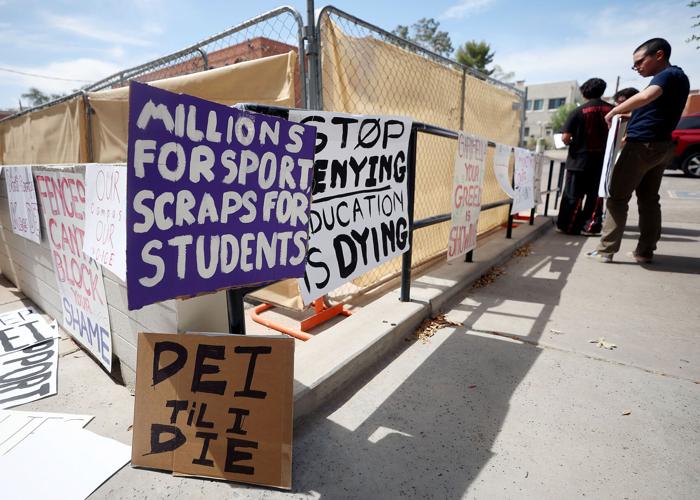
In May, signs posted on campus by students from the Coalition to Protect Students and Workers showed their disappointment in the University of Arizona’s decision to centralize its cultural and resource centers.
The UA decision had harsh impacts on the programs’ 2,200 students, 36 faculty members, four other employees, and the UA’s reputation. It will also cost the financially strapped university money. Worse: It probably was not justified.
Prof. Douglas Ulmer, head of the UA math department, which ran one of the China campuses, said via email: “It was purely a teaching program, no research, no tech transfer.”
“We were teaching material that is offered at hundreds of universities worldwide. The added value for the students was American-style education with active learning, critical thinking, strong communication skills, etc. — all things we should be happy to spread to other countries.”
This is just one example. The director of the environmental sciences program in China, Ken Smith, told the Star “We were not in any way a threat to national security. We were teaching about soil, air, water, waste management, and many other environmental topics — problems all countries around the world encounter.
The UA administration debased itself anyway.
‘Compact’ must be rejected
It should be obvious why the UA received the dubious honor of being one of nine universities to get an offer from the Trump administration to join its compact for special treatment. The proud university has been proven pushovers, weaklings who hand over our lunch money to the bullies every time.
Or, as the White House senior advisor for special projects told the Wall Street Journal: “The White House chose the schools because it believed they are, or could be, ‘good actors.’”
Now, some of the individual terms of the compact are relatively benign. Signatories agree, for example, “to reduce administrative costs as far as reasonably possible and streamline or eliminate academic programs that fail to serve students,” although even that is open to federal abuse.
Other terms amount to eye-rolling submission to Trump’s political and social agenda. Signatories must only recognize binary genders, for example: “Institutions commit to defining and otherwise interpreting ‘male,’ ‘female,’ ‘woman,’ and ‘man’ according to reproductive function and biological processes.”
There are also ham-handed efforts to crack down on the criticism of Israel’s war in Gaza that has been common on university campuses, demanding suppression of protests in a way that would likely violate state law covering free speech on campus.
The key, though, is this: If the federal government decides the university violated any terms of the compact, the UA must pay back all federal funding received that year. In other words, letting a transgender woman student use a female locker room could cost a university hundreds of millions of dollars.
It could hardly be more obvious that Garimella and the university must reject this anti-meritocratic agreement. In fact, it’s a relatively easy way to show a frustrated university and Tucson community that he and his team actually have some spine.
But this is a university administration that has proven itself tempted again and again by collaboration with the Trump administration’s university agenda, ignoring or perhaps supporting the autocratic project it is part of.
Eventually, though, you have to stand up to the bully’s ceaseless demands. If Garimella doesn’t stand up this time, we know which side he’s on.

