




Some signs of progress and optimism are emerging that the Colorado River Basin’s seven states could reach a short-term agreement on water use curbs by Tuesday — although not the 20-year deal that many outside experts say is essential to protect the river from continued depletion.
Two persons — one from each of the river’s Upper and Lower basins — expressed some degree of hope Friday that such a deal is possible.
However, a third source familiar with the talks downplayed that possibility, saying the two basins remain far apart on key issues. A fourth source who has tracked the negotiations as well said there's still a chance of litigation by one side or another, which would be a clear sign that no agreement is reached.
Negotiators for the seven states have been discussing various versions of a short-term plan in which Arizona and the other two Lower Colorado River Basin states, California and Nevada, would agree to start in 2027 to carry out a cut of about 1.25 million acre-feet a year in water use for five years. Mexico, the Lower Basin officials hope, will agree to cut an additional 250,000 acre-feet to bring the total annual savings to 1.5 million acre-feet a year.
Arizona, California and Nevada have already pledged to make such cuts during ongoing negotiations over the river, but have not until now agreed to do that on a specific date, several sources told the Star.

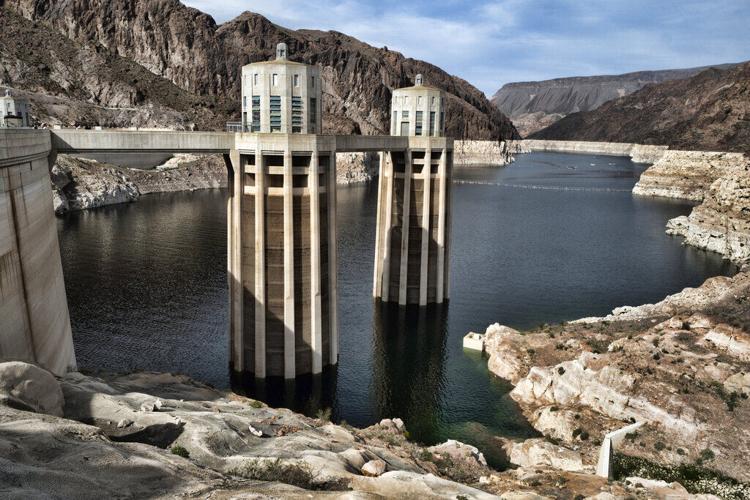
The bathtub ring of light minerals shows the high-water mark of Lake Mead on the Colorado River as seen from Hoover Dam in Arizona. In 2027, Lake Mead is projected to fall low enough — below 1,035 feet — that power production from Hoover Dam would drop by 70% from current levels. Negotiators from the seven river basin states are trying to come up with a deal to cut water use.
In return, the deal being discussed would have the Upper Basin states — Colorado, New Mexico, Utah and Wyoming — agree to set aside 100,000 acre-feet a year for five years in Lake Powell for conservation purposes, to be released when necessary during bad years on the river, sources said. Such an arrangement would be called a “conservation pool.”
Other varieties of this proposal have also been discussed, and it’s not clear which one would actually be in a final short-term agreement.
Tuesday deadline looms
The U.S. Interior Department has said it wants some kind of agreement by Tuesday, Nov. 11, because it’s working to conduct an environmental review of a final deal by next spring and finish work on a final agreement by the end of 2026. The agreement would replace the river’s current operating guidelines that govern how much water is released from its reservoirs. Those guidelines were set in 2007 and expire at the end of 2026.
The agreement now being discussed would come nowhere near to curbing the total overuse of river water by the states and Mexico, which in the past two years has far exceeded 3 million acre-feet a year. But it would give the states some semblance of consensus and buy them time to continue negotiating toward a longer-term deal in which much more severe cuts would be approved.
After weeks of closed-door talks that continued through Wednesday, there had been no signs of progress. As recently as Thursday, a number of officials involved in the negotiations along with outside experts had told the Star they saw little chance of an agreement among the states.
Just this past Wednesday, Arizona Gov. Katie Hobbs blasted Upper Basin states for taking an ”extreme negotiating position” of refusing to commit to any water use cuts.
Several sources in the Lower Basin told the Star this past week that Upper Basin states’ representatives had been unwilling to support virtually any kind of proposal that the Lower Basin states had made to reduce Upper Basin water use.

Visitors take pictures of Lake Mead near Hoover Dam, where the bathtub ring of light minerals shows the high-water mark of the reservoir. Negotiators for the seven Colorado River Basin states are trying to agree on a deal to save water in the face of the depleting river levels.
But then on Thursday, Gene Shawcroft, Utah’s chief Colorado River negotiator, told a Salt Lake City TV station, “we’re making steady progress” toward an agreement.
“These are incredibly complex negotiations, and we’re continuing to work through some challenging issues. The federal government has done a commendable job keeping all seven basin states engaged and at the table,” said Shawcroft, chairman of the Colorado River Authority of Utah. “We’re making steady progress on key issues the federal government has identified, aiming to reach broad agreement by Nov. 11 — even if the finer details come later.”
Asked Friday afternoon to confirm the details the Star had already obtained of such an agreement, Shawcroft said in a text message, “I have no comment at this time.”
But also on Friday afternoon, California’s Colorado River commissioner, J.B. Hamby, told the Star: “I think there’s great opportunity for hope” to reach a seven-state consensus about a short-term agreement over the river.
“California continues to be at the table and work constructively toward a deal. Consensus is in the best interest of everyone and California is committed to working toward that, with the hope that all other states are similarly committed,” Hamby said.
Another source involved in the negotiations, however, told the Star the major issues that separate the basins have not yet been addressed.
“There’s been little progress, and that’s been restricted to issues that don’t matter to us especially to Arizona,” said the source from the Lower Basin, who spoke on condition of anonymity to protect his access to the discussions.
A second source, who also asked that their name not be used so they can preserve access to the discussions, said there’s still a significant chance of litigation over the river, based on how far apart the officials of both basins have been.
Interior could force cuts if no deal reached
Water officials in Arizona, New Mexico, Nevada and Colorado declined to comment on a short-term agreement. Arizona Department of Water Resources Director Tom Buschatzke, for one, will stick to his longstanding policy of not commenting on the ongoing negotiations, an ADWR spokesman said.
Michael Sakas, a spokeswoman for Colorado’s top negotiator on river matters, Becky Mitchell, sent the Star a statement saying, “The Colorado River Basin States are engaged in active, ongoing negotiations. The Upper Basin States, including Colorado, are fully participating and ready to do their part in any agreement. We’ll share updates when there’s substantive progress to report.”
If an agreement isn’t reached soon, Interior Department officials have said repeatedly they will propose their own, unilateral curbs on water use by the seven states — an outcome that all parties involved have said they don’t want. Many participants in the negotiations and several outside experts have questioned how strong the department’s leadership has been on Colorado River issues and whether it will actually carry out that threat.
Friday, a federal source emphasized to the Star once again that it’s likely current Interior Secretary Doug Burgum will propose something unilateral if no agreement is reached.
Burgum will probably order the 1.25 million acre-feet cut to which the Lower Basin states have already committed, the source said. The secretary’s legal authority to order cuts by Upper Basin states is less clear than it is for the Lower Basin, but he clearly has the authority to determine each year how much water Lake Powell is going to release, based on the river’s conditions, which could indirectly determine water use in the Upper Basin, the source said.
“He’ll do something,” the source said of Burgum.
CAP: ‘The short term buys us nothing’
The idea of a short-term agreement has drawn sharp criticism from Ted Cooke, a former top Central Arizona Project official whose nomination last summer by President Donald Trump to be commissioner of Interior’s Bureau of Reclamation was pulled after opposition to him emerged among some key U.S. senators.
Last Sunday, the website Politico ran a story saying there’s a chance negotiators “might be able to throw together some sort of a tentative deal that could get them through the immediate deadline.”
The next day, Cooke posted on LinkedIn that negotiators’ hope for a short-term deal “is worrisome and comes with a healthy dose of déjà vu. The basin cannot afford to settle for anything less than an aggressive and robust plan, whether it is one proposed by the states or by Reclamation.”
A former CAP general manager, Cooke also said, “In my opinion and with plenty of hindsight, both the states and the feds have often settled for less than they should have, leading to an almost constant need to supplement and rework the existing 2007 guidelines.”
The new guidelines should primarily address how much water is available to each basin and/or each basin’s states based on defined limits of water availability, he wrote.
“The plan should be sufficiently robust that it does not need modification anytime soon but should also have the flexibility to be modified when needed, particularly if things get worse,” Cooke said.
Central Arizona Project Board President Terry Goddard told the Star on Friday that he agreed with Cooke, saying in a text message, “The short term buys us nothing.” The CAP supplies Colorado River water to Tucson and Phoenix for drinking and to central Arizona farms.
Some see value in a short-term deal

The imperiled Colorado River flows through the Grand Canyon on the Hualapai reservation in northwestern Arizona.
Three outside water experts, including top University of Arizona and Arizona State University water researchers, said, however, they could see value in a short-term agreement to simply achieve some sort of consensus while the long-term talks continue.
But all three said it would be essential to couple a short-term agreement with a “Plan B” that would require immediate cuts if the river flows continue to deteriorate, as has been forecast by the Bureau of Reclamation’s monthly studies that predict how high the river’s reservoir levels will be up to 24 months from now.
The most recent bureau report, for instance, predicted that Lake Powell could, under the worst-case possible river flows, fall below 3,490 feet in elevation by October 2026 and stay below that level until May 2027. When Powell drops below 3,490, the reservoir levels will be too low for river water to pass through Glen Canyon Dam’s turbines, meaning the dam wouldn’t be able to generate electricity that’s currently sold to 5 million customers in seven states.
Similarly, from May through September 2027, Lake Mead is projected to fall low enough — below 1,035 feet — that power production from Hoover Dam would drop by 70% from current levels.
“My first blush response is that doing this incrementally could be OK, it could be OK to do things in a graduated way, and not have the whole shebang figured out at once,” said Sharon Megdal, director of UA’s Water Resources Research Center.
But, “there has to be some confidence that things will be get figured out,” she added. “We can’t get caught flatfooted if there’s really, really bad precipitation and runoff in the next couple of years. We still have to have a fallback.”
It might be acceptable to have some issues carry over past the end of 2026, “but is that the proverbial kicking the can down the road?” Megdal said.
Sarah Porter, director of ASU’s Kyl Center for Water Policy, said she can see both sides of this issue of whether the states should adopt a short-term policy now or not adopt any agreement now until a long-term deal can be struck.
“A short-term plan doesn’t get us out of this situation we’re in where we are always just on the edge of catastrophe,” Porter said. “But it may provide room for negotiators, in the minds of the people involved, to get a long-term agreement.”
If in the assessment of negotiators, the short-term path would be the most effective way to reach an agreement, “they are the ones at the table doing the negotiating,” Porter said.
Having a short-term agreement “is better than having a) the lawyers get involved or b) having the federal government telling us what to do,” said retired Reclamation official David Wegner, adding that a plan B is also needed because “we cannot depend that there will be adequate snowpack this (next) year.”
Longtime Arizona Daily Star reporter Tony Davis talks about the viability of seawater desalination and wastewater treatment as alternatives to reliance on the Colorado River.

