


Pinal County Sheriff’s Office detectives were there. Homeland Security Investigations agents were there. Then protesters showed up, and so Tucson police did, too.
It was a weird Wednesday in Midvale Park, the subdivision on Tucson’s southwest side. While activists surveilled the area in the afternoon for a reported immigration stop, investigators served a search warrant on a suspected drug trafficker, turning up large loads of fentanyl, cocaine, and meth. Later on, protesters made their way over to this scene from another event nearby.
“When the protesters showed up thinking it was an ICE raid, they didn’t want to listen to reason,” Pinal County Sheriff Ross Teeple said Tuesday. “They tried to block us from leaving with the suspect’s vehicle.”
“It seemed silly,” he said.
And yet from the protesters’ perspective, it wasn’t. Maru Carrasco of the Coalicion de Derechos Humanos said she and others had gone out to check what was going on earlier in the day, when word came in about this raid nearby.
The connection between the two incidents was unclear, and they simply aren’t buying police stories about what’s going on anymore, Carrasco said.

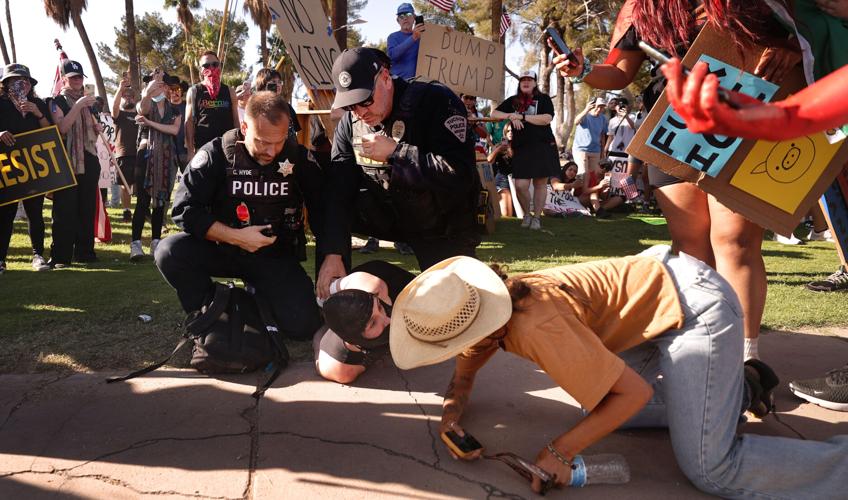
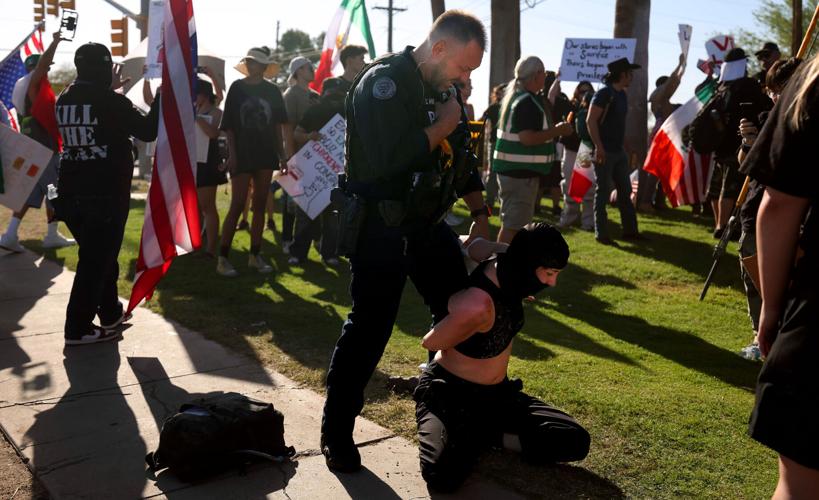
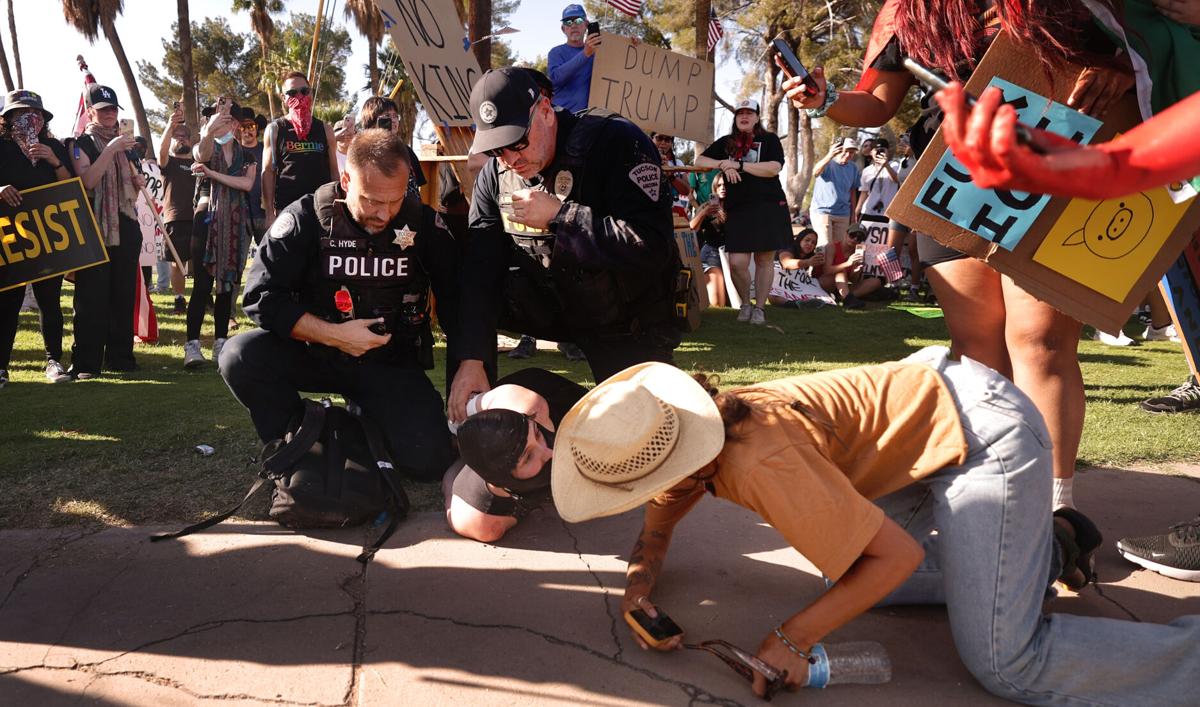
A woman is taken into custody during Saturday's "No Kings" demonstration at Reid Park.
“There have been other (immigration) detentions in other places, and they say the same thing, ‘This is a drug bust,’ so we don’t trust them.
“Everything is a ‘drug bust,’” Carrasco said.
As federal immigration agents try to accelerate their efforts to deport people, local police are getting caught between them and protesters. In the Los Angeles area, this dynamic has led to serious clashes.
But in Tucson, the relationship between local police and protesters has been a tenuously positive one. The course of events will determine whether their separate interests bring them into clashes or sustain relative harmony.
A delicate situation
Tucson Police Chief Chad Kasmar acknowledged the delicate situation his department is in when Bill Buckmaster and I interviewed him Friday on Buckmaster’s radio show.
“We’ve had peaceful protests, we have had peaceful protests that turned violent,” Kasmar said. “Things change by the minute, by the day. Events get canceled. Events get re-initiated.”
“There’s going to be no winning here,” he said. But, he added, “I’m confident in my team’s ability. I’m confident in my own decision-making. I’m confident in my support from mayor and council.”
So far, things have gone tolerably well. One incident, which preceded the Midvale Park episode on Wednesday evening, led to arrests when some protesters moved against security contractors protecting a building housing federal immigration offices.
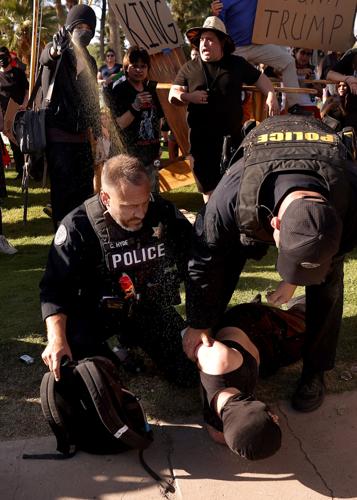
In another incident, which took place during the “No Kings” vehicle protest on Saturday afternoon, police arrested two people in relation to a spray painting incident. One of those arrested is accused of a felony for pepper-spraying officers.
When I spoke with Sgt. Jason Winsky of the Tucson Police Officers Association Tuesday, he thought back over the many protest episodes of the last 15 years, all the way back to the Occupy movement of 2012, and said, “Tucson’s been really lucky.”
“I feel like we’ve kept that Tucson brand, which is, people are upset, they want to get out and protest, but overall things have been calm, and we hope they stay that way.”
Choosing to coordinate
One of the reasons, Winsky said, is that officers try to give protesters significant leeway, shutting down streets as necessary and making other accommodations.
Another reason is that organizers of the biggest protests in Tucson have chosen to coordinate with police. Bennett Burke, of the umbrella group Democracy Unites Us, said the organizers are aiming to attract as many people as possible to their protests. That means minimizing the risks of attending.
“We have found that the protesters who show up at our actions largely appreciate the police being there in case anything pops off that could endanger our protesters,” he said. “Once we organize a protest, we as Democracy Unites Us don’t have the ability to control how things play out.”
While police and most protesters have found common ground most of the time, there is one type of situation that can lead to confrontations. Tucson police don’t participate in immigration enforcement efforts, but they will show up to protect federal agents conducting these operations if necessary. That’s why police showed up in Midvale Park, even though it turned out not to be an immigration operation.

A Tucson police officer is sprayed with a chemical irritant as they take a woman into custody at the "No Kings" protest Saturday at Reid Park.
“We have a legal obligation and some would say a philosophical obligation to assist other law enforcement,” Winsky said.
Kasmar said on the Buckmaster show: “The only reason TPD would be involved in that type of effort was if there was an emergency call for service. We’ve taken an oath, and if that happens, we’ll go out and try to restore peace. I assure you that probably will happen at some point, and I’ll probably have criticism on both sides.”
Indeed, one of the reasons there haven’t been many such flashpoints so far is that immigration agents have moved fast. By the time rapid-responders from Coalicion de Derechos Humanos arrive at scenes of immigration detentions, often the incident is over, Carrasco said.
For now, these activists are largely avoiding standing in the way of federal agents, taking the sort of stand that could lead to a clash with local police. But that could change.
“We cannot stand in the way, not right now,” Carrasco said. “Usually we try to respond and talk to people about their rights.”
“If we want to be in the middle, we need more people,” she said.
And if that happens, Tucson police, too, will be in the middle.
Photos: Protesters clash with TPD and security outside ICE facility. Graphic images.

A security guard uses chemical spray on Karly Low at the barricades as demonstrators clash with law enforcement and private security outside an ICE facility on south Country Club Road, Tucson, Ariz., June 11, 2025. A few hundred protesters stormed the barricades pushing back the guards before Tucson Police arrived.

Tucson Police take a demonstrator into custody after they broke up the last of the protesters blocking Valencia and Country Club following a clash with law enforcement and private security outside an ICE facility Tucson, Ariz., June 11, 2025.

A guard with a chemical ammunition weapon is hit with a balloon filled with paint as demonstrators forced their way through a bike-rack barrier outside an ICE facility on South Country Club Road, Tucson, Ariz., June 11, 2025.

A guard is pushed back by demonstrators shoving a bike rack barrier as a few hundred protesters break through the line outside an ICE facility on South Country Club Road, Tucson, Ariz., June 11, 2025.

A guard sprays a demonstrator with a chemical as he tries to force him back from a barrier outside an ICE facility on South Country Club Road, Tucson, Ariz., June 11, 2025.

Street medics work to flush chemical irritant from a demonstrator involved in a clash with private security outside an ICE facility on South Country Club Road, Tucson, Ariz., June 11, 2025.

A paint-spattered demonstrator faces off over the barriers with private security outside an ICE facility on south Country Club, Tucson, Ariz., June 11, 2025.

A guard bats away a barrier thrown at him by demonstrators outside an ICE facility on South Country Club Road, Tucson, Ariz., June 11, 2025. A few hundred protesters clashed with the guards using fireworks, paint balloons and other objects until Tucson Police arrived.

A demonstrator and a security guard try to kick a smoke bomb into each other’s lines after it was tossed into the fray during a confrontation outside an ICE facility on South Country Club Road on Wednesday.

A guard fires chemical ammunition at some of the few hundred demonstrators forcing back a handful of security outside an ICE facility on South Country Club Road, Tucson, Ariz., June 11, 2025.

A demonstrator sprays paint on the gates of an ICE facility on South Country Club Road as others push the guards back, Tucson, Ariz., June 11, 2025.

A demonstrators hurls a rock at the windows of an ICE facility on south Country Club, Tucson, Ariz., June 11, 2025. A few hundred protestors swarmed outside the building before Tucson Police arrived and they retreated into an hour or so long standoff.

A demonstrator with a chunk of water heater cut into a shield heads to a line of others standing off with Tucson police following a clash with security outside an ICE facility on South Country Club on Wednesday.
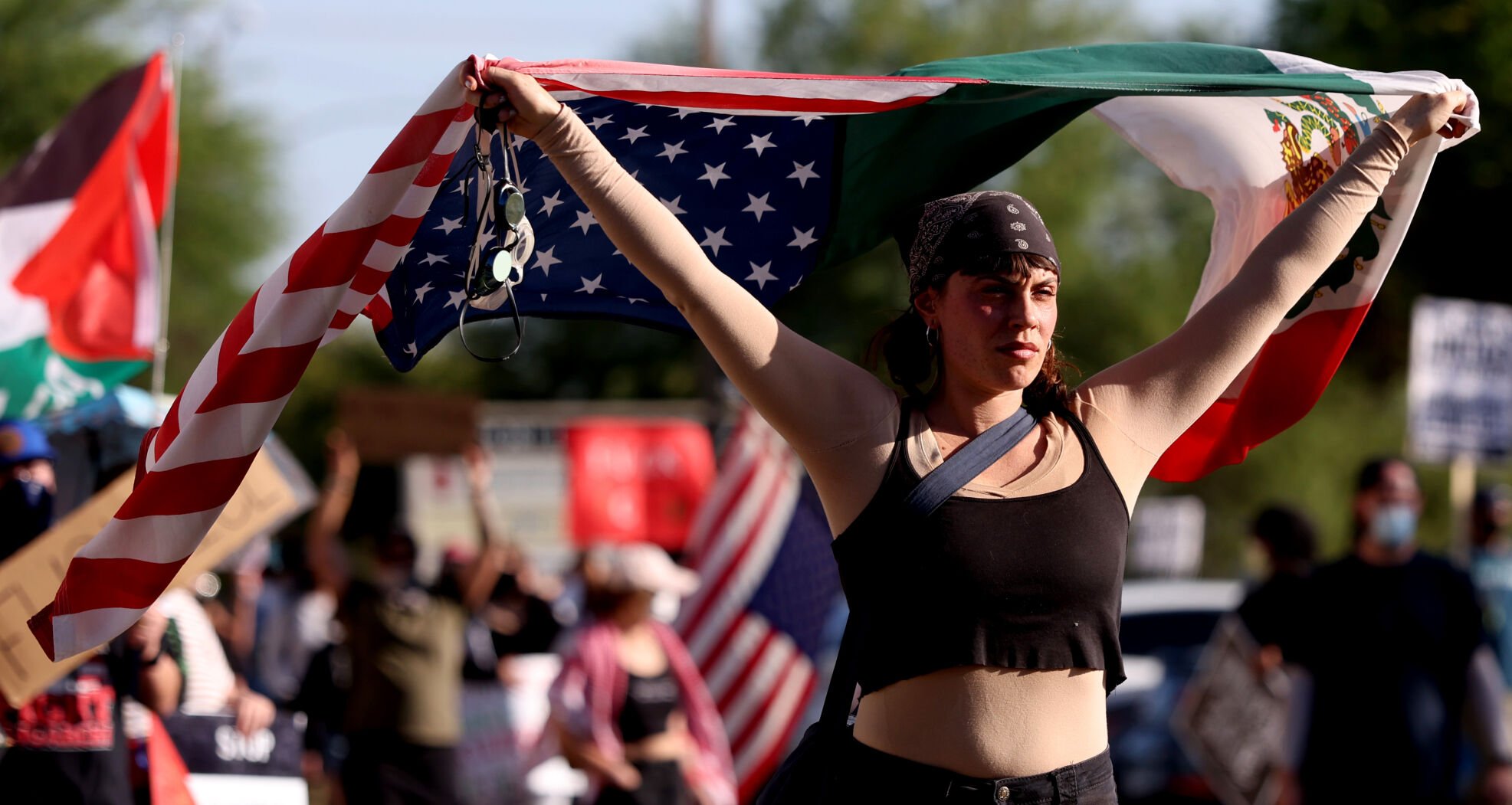
A demonstrator stands defiantly during a stand off with Tucson police after fighting with security outside an ICE facility on South Country Club on Wednesday evening. After an hour or so the protestors retreated to line the intersection of Valencia and Country Club.

A Tucson Police officer shoos away a woman who ventured too close to their lines as they face off outside an ICE facility on South Country Club Road, Tucson, Ariz., June 11, 2025.

A demonstrator uses a skateboard for an impromptu sign as a protest spills into the streets at Valencia and Country Club after battling with security outside a nearby ICE facility, Tucson, Ariz., June 11, 2025.

A pair of demonstrators hold up traffic on eastbound Valencia at Country Club where they retreated with a couple hundred others after a confrontation with security guards at an ICE facility, Tucson, Ariz., June 11, 2025.

Demonstrators shout at Tucson Police as they begin to break up the last of a few hundred protestors during an hours long confrontation ended at Valencia and Country Club, Tucson, Ariz., June 11, 2025.

A guard pulls away a crude shield to threaten the demonstrators with a chemical ammunition weapon outside an ICE facility on south Country Club, Tucson, Ariz., June 11, 2025.

A demonstrator spray paints slogans on the gates an ICE facility on south Country Club as hundreds of protesters swarmed the facility, Tucson, Ariz., June 11, 2025.

A lone demonstrator ventures out of the line a few hundred to taunt the line of Tucson Police outside an ICE facility on south Country Club, Tucson, Ariz., June 11, 2025.

Demonstrators wave at traffic on Valencia from the closed down Country Club during an hours long confrontation at an ICE facility and Tucson Police, Tucson, Ariz., June 11, 2025.

Demonstrators sit in the westbound lanes of Valencia at County Club after a protest spilled into the intersection after a clash with security at a nearby ICE facility, Tucson, Ariz., June 11, 2025.

A demonstrator sits in Country Club Road at Valencia to face an approaching line of Tucson Police after a few hundred swarmed an ICE facility, Tucson, Ariz., June 11, 2025.

A demonstrator drops in surrender as Tucson Police dash to take him into custody during the last stages of an hours-long protest that ended at the intersection of Valencia and Country Club, Tucson, Ariz., June 11, 2025.

A demonstrator is taken into custody as Tucson Police move to break up the last of a posttest at Valencia and Country Club, Tucson, Ariz., June 11, 2025.

A demonstrator sprays bubbles among the few hundred gathered to protest at Valencia and County Club before things got more serious in a clash at an ICE facility, Tucson, Ariz., June 11, 2025.

Demonstrators flash their signs during in an anti-ICE protest building at Valencia and Country Club, Tucson, Ariz., June 11, 2025.

A demonstrator stands in the middle of Valencia as vehicles speed by a protest at an ICE facility that had already shut down traffic on Country Club, Tucson, Ariz., June 11, 2025.

One of the demonstrators, carrying a hybrid US-Mexico flag, gets cell phone video of the anti-ICE protest on all four corners of Valencia and Country Club, Tucson, Ariz., June 11, 2025.

