



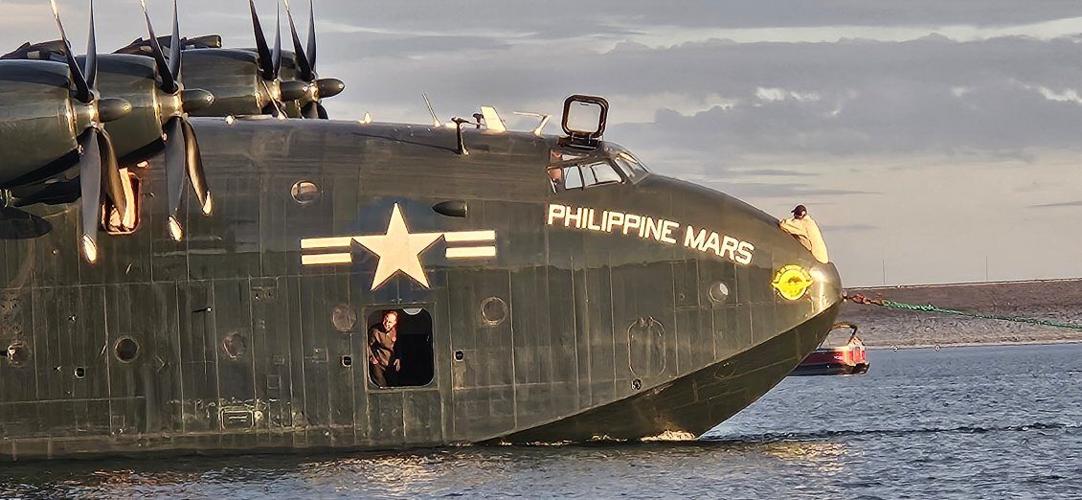


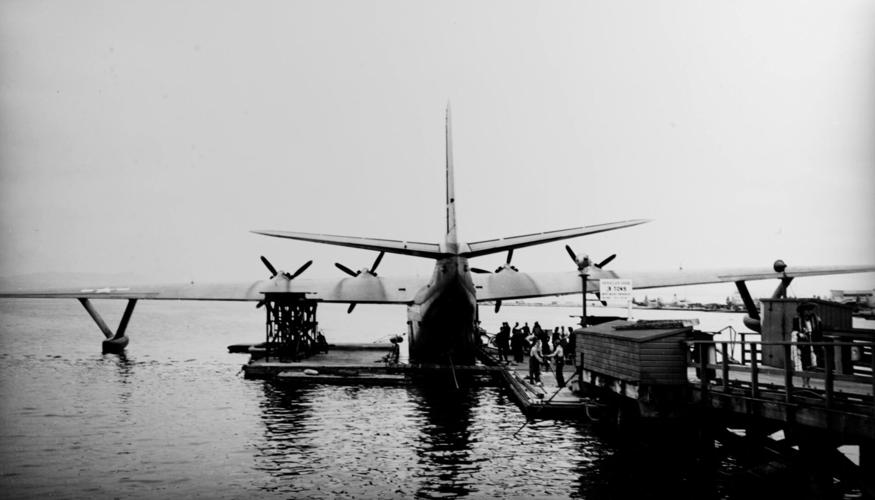



How do you land one of the world’s largest seaplanes in Tucson, a desert city not exactly known for its large expanses of open water?
Piece by piece, apparently.
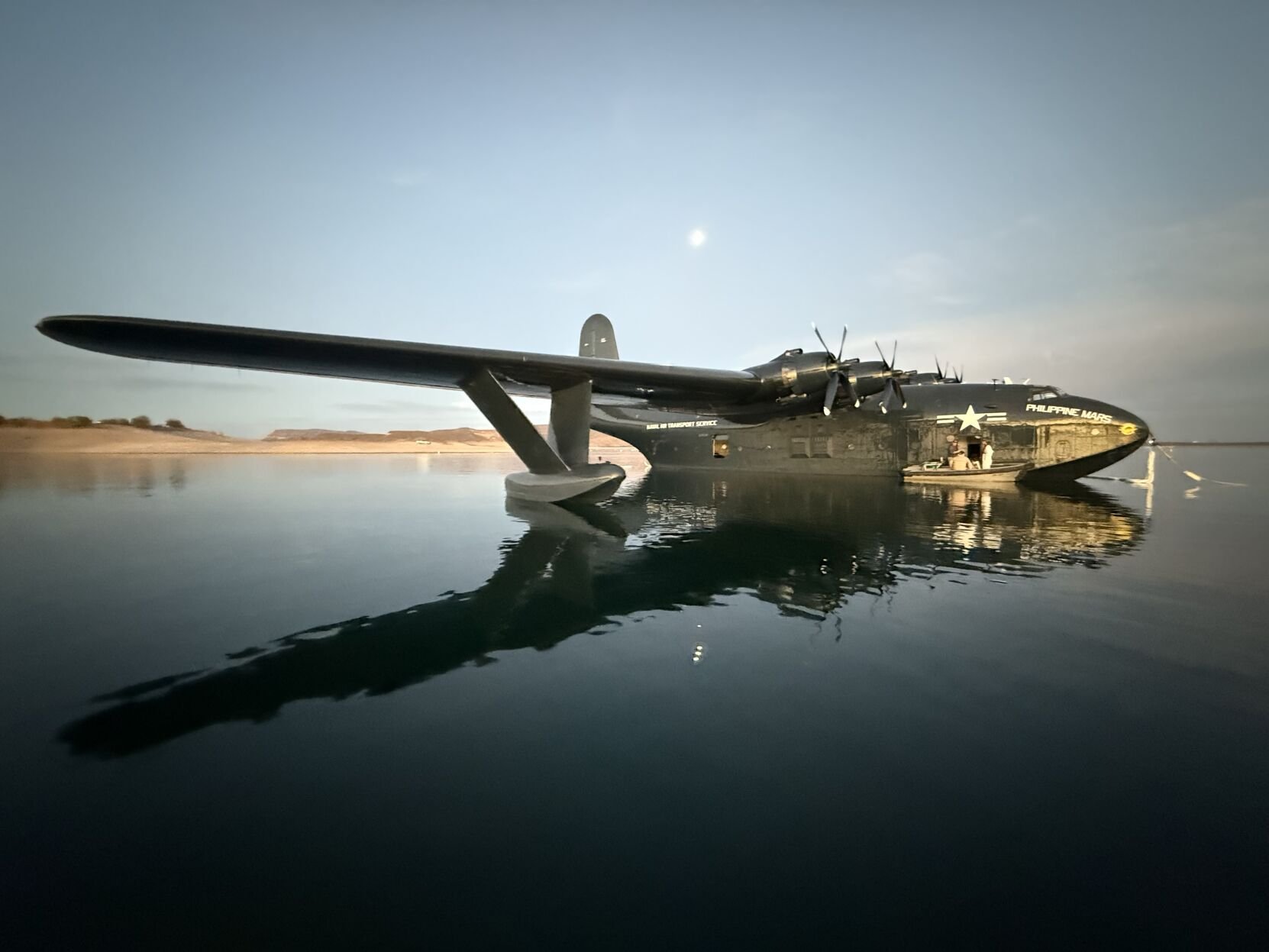
The flying boat Philippine Mars floats on Lake Pleasant, north of Phoenix, after landing there on Feb. 10. The historic aircraft is now being dismantled for shipment to the Pima Air and Space Museum in Tucson, where it will eventually go on display.
The Pima Air and Space Museum‘s newest acquisition began arriving on Thursday night, when four massive engines rolled into Tucson on the back of a flatbed truck.
Over the next several weeks, the rest of the World War II-era flying boat known as the Philippine Mars will be broken down into truck-sized shipments and hauled to the museum on Valencia Road near Interstate 10, where the aircraft will be carefully reassembled for display.
The almost 80-year-old seaplane made its last water landing on Feb. 10 at Lake Pleasant, north of Phoenix, after a two-day journey from its long-time home on Vancouver Island, British Columbia.

Crew members look out as the Philippine Mars flying boat is towed after landing at Lake Pleasant, north of Phoenix, on Feb. 10.
Other vintage military aircraft escorted the Philippine Mars during its ceremonial final flight, which included a landing on San Francisco Bay and an overnight mooring at Alameda, its home base during its U.S. Navy days.
After touching down on Lake Pleasant, the flying boat with no landing gear was towed to shore and up the boat ramp to a nearby parking lot, where it is now being dismantled for the 165-mile drive to Tucson’s southeast side.
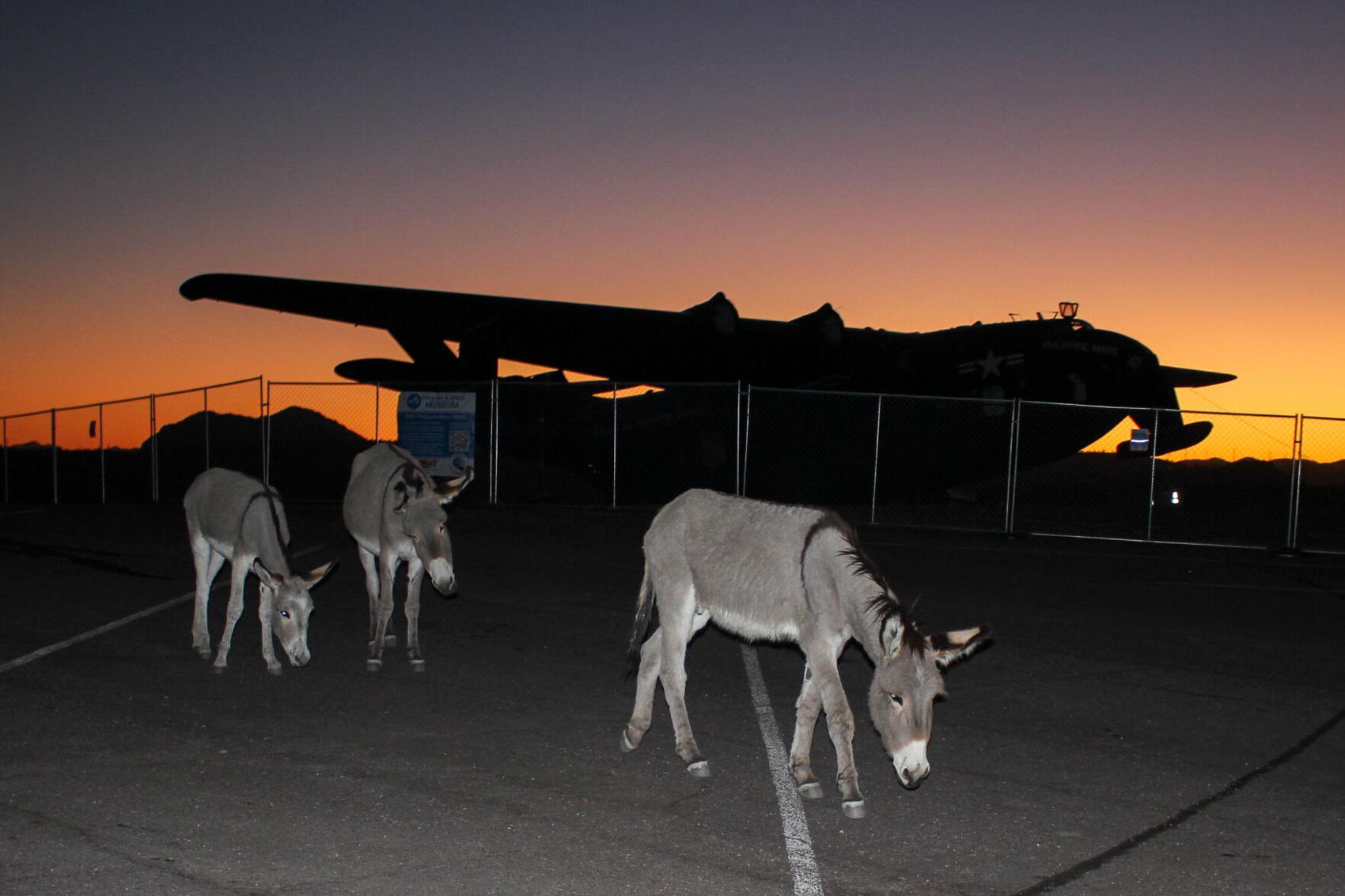
Wild burros walk past the Philippine Mars seaplane on Sunday at Lake Pleasant, north of Phoenix, where the historic seaplane landed for the last time on Feb. 10 and is now being dismantled for shipment to the Pima Air and Space Museum in Tucson.
“We are pleased to have the Philippine Mars join our museum, where we will preserve this World War II-era aircraft for decades to come,” said Scott Marchand, CEO of the Pima Air and Space Museum, in a written statement.
Even in pieces, the flying boat will make for some pretty wide loads. The aircraft is 117 feet long and about 4 stories tall, with a 200-foot wingspan. Even when it’s empty, it weighs more than 75,000 pounds.

Some of the people involved in building the Martin Mars flying boat pose with — and on — the giant seaplane in 1941. As this photo demonstrates, the transport aircraft’s 200-foot wingspan is enough to hold 35 men spaced almost 6 feet apart.
According to the National Museum of the U.S. Navy, the Mars seaplane was developed in 1938 by the Glenn L. Martin Company as a long-range ocean patrol flying boat.
Only seven of the aircraft were built, including the Philippine Mars, which was delivered to the Navy in 1946. It spent 10 years ferrying cargo between California and Hawaii until it was decommissioned in 1956.
A Canadian company bought the aircraft and three of its sister ships in 1959 and converted them into massive water bombers, each with a 7,200-gallon tank that could be refilled in less than 30 seconds simply by skimming along the surface of a lake.

The Philippine Mars flies is trailed by three other Martin Mars seaplanes while operating out of Naval Air Station Alameda, California, circa 1947.
In 2007, the last two Martin Mars in service were purchased for fire-fighting operations by Vancouver-Island-based Coulson Aviation, which eventually retired the aircraft to be put on display — the Philippine in Tucson and the Hawaii II at the British Columbia Aviation Museum.
“Having both of the Martin Mars historically preserved in these museums is our way of honoring the role these aircraft have played in both aviation and firefighting history,” said Coulson CEO Wayne Coulson.

Passenger is helped off the transport seaplane Philippine Mars in July 1946.
The Philippine Mars was originally destined for the collection at the National Naval Aviation Museum in Pensacola, Florida, but that deal fell through in 2016, after the aircraft had already been repainted with its original Navy markings and color scheme.

A Martin Mars transport seaplane taxies in a circle during tests in San Francisco Bay, California, on Sept. 5, 1953.
The Pima Air and Space Museum announced its acquisition of the seaplane last April. Getting it to Arizona wasn’t easy.
The Philippine Mars hadn’t flown since 2007, so considerable work and testing was required just to get it airworthy again.

The U.S. Navy transport seaplane Philippine Mars in port in July 1946.
Two attempts in December to fly the seaplane south to its new home were scrubbed by mechanical problems.
When the Philippine finally made it to Lake Pleasant, it did so with two engines scavenged from the Hawaii II, the only other Martin Mars still in existence.

A hula dance team welcomes the U.S. Navy transport seaplane Philippine Mars and its passengers to Hawaii in July 1946.
Those who gathered at the lake on Feb. 10 to watch it land witnessed a bit of history in the process: the final flight of not just a single seaplane but of an entire line of aircraft, born from global conflict.
No date has been set for when the flying boat will go on display at the Pima Air and Space Museum. Staff members there said they would continue to provide updates on Facebook and Instagram throughout the shipment and reassembly process.
NASA's newly retired airborne telescope is headed to the Pima Air & Space Museum for retirement.

