




Saguaro National Park saw its sixth busiest year in 2024, but don’t expect to hear much about that from anyone working there.
National Park Service staff have been instructed not to publicize last year’s record attendance figures, according to an internal memo shared by an anonymous group of current and former agency employees calling themselves Resistance Rangers.
There will be “no external communications rollout for the 2024 visitation data,” the leaked guidance says. Individual parks can add the information to their websites if that is something they normally do, but the memo says the numbers should not be announced with news releases or posts on social media.

This sceenshot shows an internal National Park Service memo that was shared by the Resistance Rangers, an anonymous group of current and former Park Service employees.
That marks a departure from previous years, when the agency published and promoted reports on visitation trends and the overall economic impact that parks have on their surrounding communities.
The new directive comes as the Trump administration continues to push sweeping reductions to the federal workforce, including at the Interior Department, which oversees the Park Service.
The nation’s parks set a record in 2024 with over 331.8 million total visits, nearly 900,000 more than the previous mark set in 2016. Golden Gate National Recreation Area in San Francisco led the way as the nation’s busiest Park Service site, with almost 17.2 million visits.
Saguaro, meanwhile, logged more than 946,000 visits last year, roughly 133,000 shy of its all-time record set in 2021. The eight busiest years in the history of the 92,000-acre park bracketing Tucson have come over the past nine years alone.
Retired ranger and park superintendent Bill Wade can think of one obvious reason why administration officials might be reluctant to publicize the overwhelming popularity of national parks: They’re actively dismantling the park system right now, he said, and “they don’t want the public to know much about what’s going on.”
Offices targeted
On Feb. 14, Trump’s Office of Personnel Management ordered the mass firing of more than 24,000 federal employees who were still in their trial or probationary periods with agencies across the government.
“The Valentine’s Day massacre, as we’re calling it,” Wade said.
Many of those terminated were notified with a form letter stating that they were being fired for poor performance, despite on-the-job evaluations to the contrary, according to the American Federation of Government Employees, which sued to block the purge.
Among those dismissed were some 1,710 workers from the Interior Department, court documents show.
The following week, Saguaro National Park announced that both of its visitor centers would be closed on Mondays until further notice.
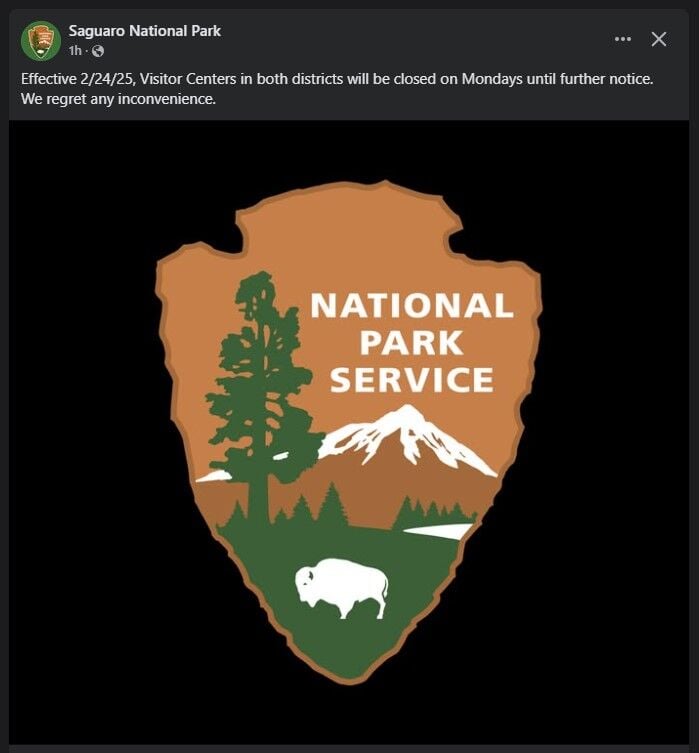
Saguaro National Park announced in a Facebook post on Feb. 20 that its visitor centers will be closed on Mondays “until further notice.”
Yosemite National Park lost its only locksmith, Mount Rainier National Park lost its only plumber and Wrangell–St. Elias National Park and Preserve in Alaska lost the only pilot assigned to a nearly roadless area covering almost 13.2 million acres, Wade said. “How else are you going to patrol that except with an airplane?” he said.
It’s still unclear how many staff members were dismissed from Saguaro National Park. A park spokeswoman referred questions from the Star first to the regional office in Colorado and then to the agency’s headquarters in Washington, D.C., neither of which responded with details about the layoffs.
Wade said he only knows of six probationary employees who were terminated from their jobs at Park Service sites in southern Arizona — two each at Saguaro National Park, Organ Pipe Cactus National Monument and Chiricahua National Monument.
The actual numbers could be higher than that, and Wade suspects more cuts are on the way. He said he has heard talk of a 30% payroll reduction and “additional massive layoffs” looming at Interior.
Several Park Service offices in Arizona are also on the chopping block, he said, as the General Services Administration moves to cancel federal leases on buildings that house agency administrative staff in Phoenix, Flagstaff and Camp Verde.
Rooted in parks
Wade said the last time the Park Service faced major cuts like this was 30 years ago, when the Clinton administration set out to reduce the size of the federal government.
But that effort involved months of planning and largely top-down workforce reductions from the agency’s headquarters and regional offices, with a goal of improving efficiency without impacting park-level services, Wade said. “They went through a very calculated process. They used a scalpel approach, where this bunch is using a broadsword or a chainsaw.”
Though the Trump administration insists it is targeting government “bloat and waste,” he added, “it’s pretty hard to make that case for an agency that turns every dollar it spends into $15 dollars (in economic benefit).”

A sign hangs on the locked door of the Rincon Mountain Visitor Center at Saguaro National Park on Monday.
Wade’s connection to the Park Service runs even deeper than the more than 30 years he worked for the agency. He said he spent his entire childhood at Mesa Verde National Park in Colorado, where his father worked as a ranger.
Today, he serves as executive director of the Association of National Park Rangers, a nonprofit education and advocacy group currently based in Marana, where he lives.
The group was launched in 1977 — and Wade joined in 1978 — to organize conferences and serve as an information network for park rangers across the country.
These days, though, “we’re focusing mostly on employee wellness,” he said. “We’re trying to help employees who have been victims of all of this.”
For example, the association’s leadership voted last month to start providing fired workers with financial assistance from the group’s Ranger Emergency Relief Fund, which was originally established a few years ago to help park employees impacted by floods, wildfires and other natural disasters.

An organ pipe cactus is silhouetted in front of the setting sun at Organ Pipe Cactus National Monument. The federal preserve has lost at least two of its probationary employees to the Trump Administration’s ongoing federal workforce cuts, according to a Marana-based National Park advocacy group.
The nation’s parks were “already under-staffed and under-budgeted” even before the White House went to work on them, Wade said. Now, they face a real crisis, even as visitation continues to grow.
“Obviously, it’s extremely disruptive not only to the people who were terminated but the people who are still working in the parks,” he said. “They are really in turmoil right now, and they’re afraid that it’s going to get worse before it gets better.”
That’s why the association plans to keep advocating for park employees and shining a spotlight on the damage these arbitrary cuts can do, Wade said. “I think the only way this is going to get turned around is if people get angry enough about what’s going on in the parks. It’s got to come from the public.”
Paid in sunsets
Probationary government workers got a reprieve of sorts late last week when a federal judge in California ordered the administration to reinstate those fired at Interior and five other departments.
Park Service officials declined to answer questions about how many former employees in Arizona could be rehired as a result of the ruling. Instead, the agency’s public affairs office in Washington said in a statement that the Interior Department “will comply with the court’s order while the White House works through the appeals process.”
Wade wonders how many of the fired workers will actually return to their old jobs, especially with more budget cuts looming and after the abrupt and insulting way that many of them were dismissed.

Visitors tour Massai Point at Chiricahua National Monument.
Then there are the underlying financial and emotional costs that come with being fired and rehired a month later — everything from broken leases and lost security deposits to the money spent on moving.
“Some of them left their parks and returned to where they came from at their own expense, and now they have to go back, also at their own expense,” Wade said.
But based on the park employees he has talked to and the interviews he has read, he knows that some workers will do whatever it takes to return to their posts.
“The common statement that I’ve heard is, ‘I just lost my dream job,’” Wade said. “You certainly don’t jump into this (work) to make any money. When I was in the Park Service, the saying was, ‘We get paid in sunsets.’”

