


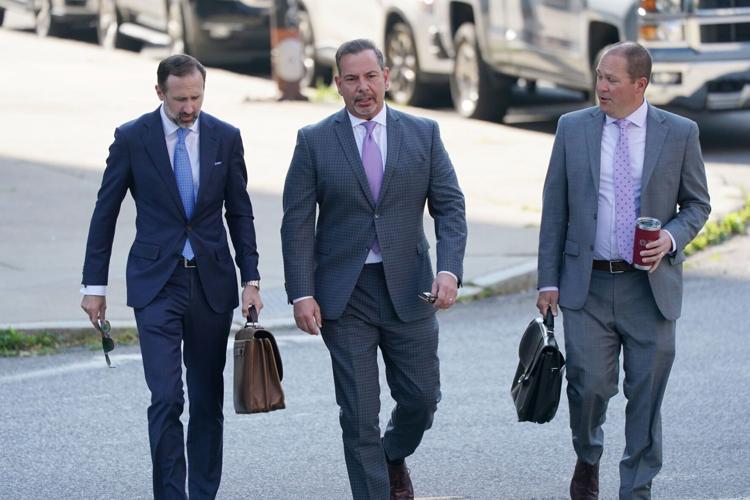
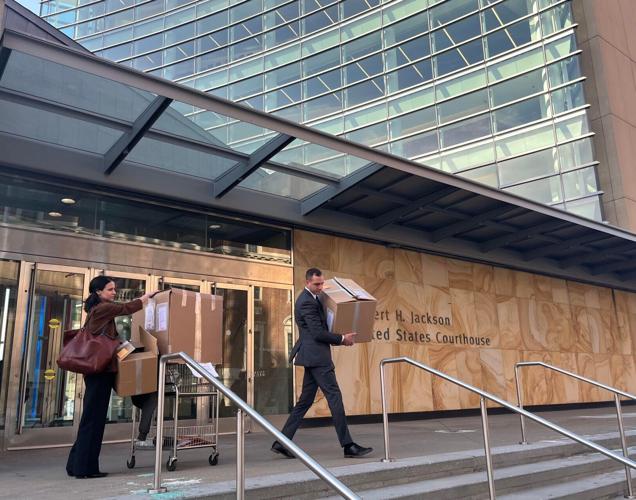
Federal prosecutors rested their case Tuesday after calling the last of 70 witnesses in their bribery trial of former Drug Enforcement Administration agent Joseph Bongiovanni.
Complete coverage: The case of ex-DEA agent Joseph Bongiovanni
“We believe we’ve proven every element of every crime,” said Assistant U.S. Attorney Joseph Tripi of the 15 charges against Bongiovanni.
Many of the charges against Bongiovanni relate to how he allegedly protected the Ron Serio drug-trafficking organization, and other counts involve Peter Gerace Jr., the owner of Pharaoh’s Gentlemen’s Club near the airport, who himself is expected to face trial later this year on charges that include bribery, drug trafficking and sex trafficking.
If convicted, the bribery, conspiracy and obstruction of justice counts could put the 59-year-old Bongiovanni in prison for anywhere between decades and life.
Before putting on their witnesses, Bongiovanni’s lawyers asked U.S. District Judge Lawrence Vilardo to dismiss five of the counts, and they sought to discount the testimony of Gerace’s ex-wife, Katrina Nigro, about handing Bongiovanni two envelopes of cash.
Gerace's ex-wife says she handed Bongiovanni envelopes full of cash at strip club
The defense motions to dismiss the counts, common at this stage of the trial, often reveal what the defense attorneys see as the weakest parts of the prosecution’s case.
Vilardo reserved decision on the defense motions.
Among the first defense witnesses to testify was Bongiovanni’s mother, Maria Bongiovanni, 79, who called the charges against her son and news accounts of them “lies” in an exchange with a prosecutor.
The developments came on the 21st day of testimony in the trial for Bongiovanni, a retired DEA agent facing charges he accepted at least $250,000 in bribes to protect drug dealers whom he allegedly thought were associated with Italian organized crime and to shield them from arrest, as well as provide them with information about investigations and cooperating sources.
Bongiovanni’s defense lawyers see Maria Bongiovanni’s testimony as important, because beyond the expressions of love for her son, she testified about her $750 monthly rent payments to her son plus other cash gifts that she and her late husband gave him.
Prosecutors have pointed to what they called “unexplained” cash deposits to Bongiovanni’s bank accounts. An FBI review of his finances counted approximately $77,000 in cash deposits in his accounts.
No one was looking at Bongiovanni. Then one investigator noticed Ron Serio starting to squirm
But the analysis accounted only for money documented by some form of a record, such as bank records, credit card statements, tax returns and other documents used to analyze his financial standing between 2012 and 2018. So the FBI did not reflect the monthly $750 rent that Bongiovanni’s parents paid their son in cash starting in 2014 to live in his rental property in North Buffalo.
Maria Bongiovanni said she and her husband would put the cash in the china cabinet every month. Her son, who visited their lower-unit apartment almost every day to help bring the laundry to the basement and do other chores, would take the money to help pay the mortgage on the property, she said.
Over five years, the rent payments totaled $54,000 – more than half of what the government called unexplained cash deposits, said Robert Singer, who represents Bongiovanni.
She and her late husband would also insist on paying him when he brought them groceries.
“Joey was at the house all the time helping out,” his mother said.
Bongiovanni would receive cash gifts of $100 to $200 for holidays and birthdays, and received $1,000 or $2,000 for his wedding present from them, she said.
Bongiovanni’s wife, Lindsay Bongiovanni, also testified, answering questions from defense lawyer Parker MacKay about how the couple met when she moved into a North Buffalo apartment he owned, where she lived downstairs from him. She also answered questions about the limited improvements the couple made to a Town of Tonawanda home they eventually bought.
He's not in the courtroom, but Peter Gerace casts a big shadow at Bongiovanni trial
Defense lawyers targeted Nigro’s testimony in seeking to get the bribery count dismissed.
Nigro testified on March 19 that she twice gave Bongiovanni envelopes “thick” with cash in 2015 at Pharaoh’s Gentlemen’s Club in Cheektowaga. She also said she saw Gerace give Bongiovanni a 50th birthday card containing $5,000 in cash.
Nigro, however, said she did not see or know how much cash was in the envelopes she was instructed to give to Bongiovanni.
“She’s the only person who could come in here and say the cash was for bribes – but she didn’t,” MacKay told Vilardo.
Singer said Nigro testified to a federal grand jury about 60 to 80 envelopes given to Bongiovanni by others at the club. So the defense lawyers were puzzled by the dramatic difference in her trial testimony.
So as for the Gerace bribery count, “what we came into this case expecting to hear isn’t what came out in trial,” MacKay said.
Tripi has called the envelopes to Bongiovanni “rewards for a job well done.”
But MacKay said there is “no evidence of any job done before then.”
Tripi said Nigro’s testimony alone is sufficient to bring to jurors to consider. The standards of proof are different in a grand jury, whose job is to decide whether or not a person should be formally charged with a crime.
Tripi said he chose to focus his questions to Nigro on what she was personally involved in.
The defense lawyers also asked the judge to dismiss the charge of conspiracy to distribute controlled substances against Bongiovanni.
Former exotic dancers and patrons have testified about drug use at Pharaoh’s, but there is no evidence Bongiovanni was aware of it, his defense lawyers said. Nobody testified to seeing Bongiovanni use drugs at the club or associate with people who did so.
“There’s never any connection that he knows what’s going on at Pharaoh’s,” MacKay said.
Tripi countered Bongiovanni did not have to be at Pharaoh’s to shield Gerace from an investigation, saying, “it would be silly for an agent protecting a deal to lay eyes on a deal.”
The defense lawyers also asked the judge to dismiss an obstruction of justice count that alleges Bongiovanni erased the data from his DEA-issued cellphone when he retired from the agency. DEA employees who account for the equipment of retiring agents testified earlier in the trial that other agents also “wiped” their cellphones before turning them in without objection. Also, nobody told Bongiovanni not to clear his cellphone of data, his lawyers said.
“He’s doing what the other agents do,” MacKay said.

