



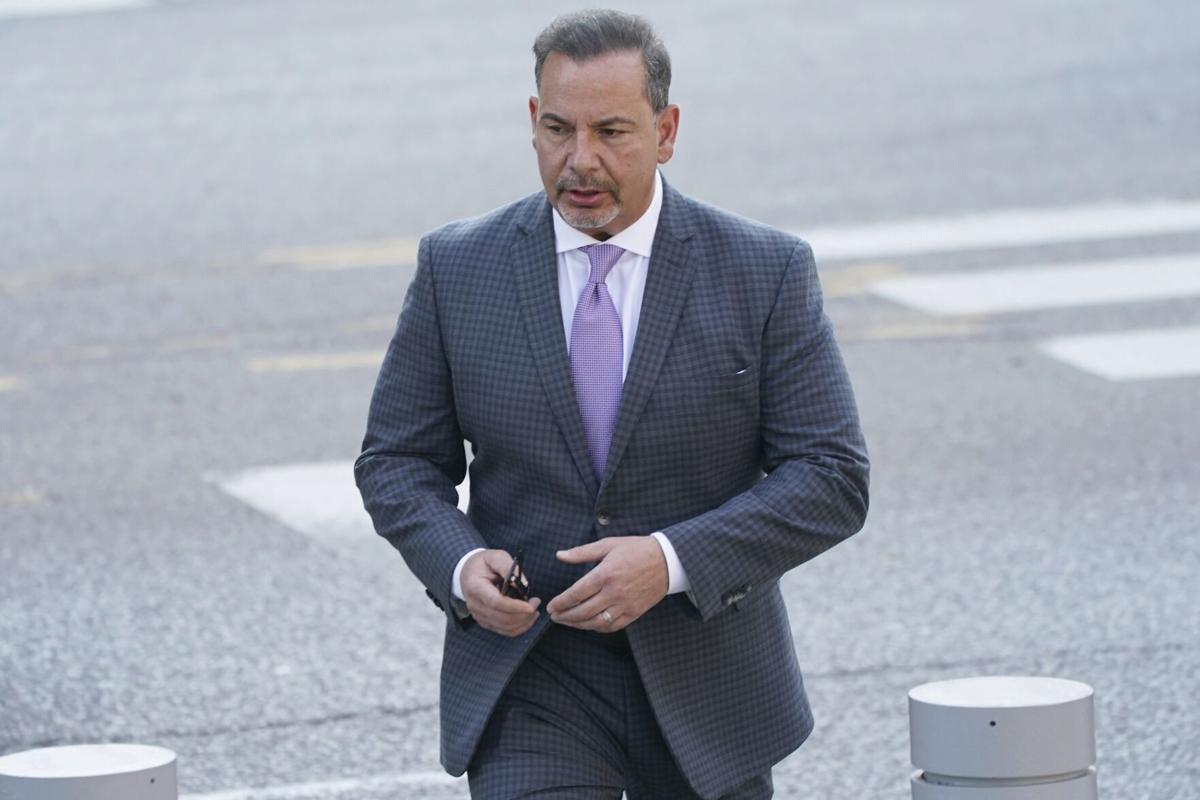
Former Drug Enforcement Administration agent Joseph Bongiovanni’s defense rested Thursday after calling five witnesses – but not the defendant himself – over the past three days in his bribery and corruption trial.
Complete coverage: The case of ex-DEA agent Joseph Bongiovanni
Instead, it was Bongiovanni’s wife, Lindsay, who faced withering questioning Wednesday from a federal prosecutor about the couple’s charitable deductions and unreported rental income.
The tax returns she filed online using tax preparation software included $120,353 in charitable deductions over a three-year period but did not include all of the income from their North Buffalo rental property.
The topic of cash loomed large as Assistant U.S. Attorney Nicholas Cooper cross-examined her, with repeated questions about whether the couple paid cash for their purchases.
Cash has emerged as a focal point in the government’s case, with prosecutors pointing to a forensic accountant’s report showing approximately $73,000 in unexplained cash deposits, money with no identifiable source in Joseph Bongiovanni’s accounts over the block of time the government said he was being bribed.
Cooper asked Lindsay Bongiovanni if her husband spent thousands of dollars on a Las Vegas trip, noting a $3,100 withdrawal from his bank account before the trip.
“If he was spending $3,000 at one time, I’d remember that, Mr. Cooper,” she replied.
“You know cash hurts the defendant in this trial,” Cooper told her.
She continually rebuffed the notion she and her husband spent a lot of cash.
Thomas Devereaux, a certified public accountant hired by the defense team to analyze the couple’s finances between 2012 and 2018, testified Thursday that the Bongiovannis were “using credit to maintain their lifestyle.”
Devereaux said he analyzed thousands of pages of bank and credit card statements among other financial documents and said he calculated an average of about $175 a month in cash that was not accounted for.
What’s more, Joseph Bongiovanni took out loans to pay off other loans, and there were no debts paid off without an identified funding source, Devereaux said.
Lindsay Bongiovanni’s testimony came toward the end of six weeks of testimony in her husband’s trial. The former federal agent faces charges he accepted at least $250,000 in cash bribes between roughly 2009 and 2017 from the Ron Serio drug-trafficking organization to shield its members from arrest, as well as provide them with information about investigations and cooperating sources. Other counts involve alleged bribes from Peter Gerace Jr., the owner of Pharaoh’s Gentlemen’s Club in Cheektowaga, who himself is expected to face trial later this year on charges that include bribery, drug trafficking and sex trafficking.
If convicted, the bribery, conspiracy and obstruction of justice counts could put the 59-year-old Bongiovanni in prison for anywhere between decades and life.
Closing arguments are scheduled for Tuesday, and jurors are expected to begin deliberating Wednesday.
Cooper asked Lindsay Bongiovanni if she had a rooting interest in the outcome of the case and if her bias influenced her answers.
“Mr. Cooper, that’s my husband sitting over there,” she said, referring to the defense table in the courtroom where Bongiovanni sat between two lawyers. “He’s a good man. I’m here to tell the truth.
“Obviously, I love my husband,” she said. “If that means I have a bias, then yes.”
When asked how much she knew of the case against him, she said she knew “everything” about it from what she has read and discussed with her husband.
“We’ve talked about this nightmare, Mr. Cooper,” she said.
Cooper asked her if she blamed the government for the position her husband is in.
“Is there somebody else I should be blaming? You brought the case,” she said.
Seventy-five people testified over 23 days of testimony.
U.S. District Judge Lawrence Vilardo asked Bongiovanni several questions when his lawyers said he would not testify.
His decision not to testify was made after consulting with his lawyers, Bongiovanni told the judge. When the judge asked him if he was satisfied with his lawyers’ counsel, Bongiovanni replied “supremely.”
Spending and tax returns were the main lines of questioning of Lindsay Bongiovanni.
She said she did the family’s taxes – not her husband.
Lindsay Bongiovanni said the couple usually purchased items using their credit cards or Home Depot card, and his $60,693 average monthly credit card balance in 2018 bolstered her assertion.
Federal prosecutors say Joseph Bongiovanni was under financial pressure as a special agent for the DEA, piling up debt while splurging on a Cabo San Lucas destination wedding, buying a classic Buick Electra convertible and the couple spending thousands of dollars on clothing, furniture and jewelry. The unexplained cash deposits, prosecutors have said, enabled him to break even financially over a period of years they contend he received the cash bribes.
The couple had separate bank accounts and credit cards.
‘We don’t bank together,” she said.
She didn’t feel financially strained, she said.
“I paid my bills when I got paid,” she said. “I didn’t feel we were ever financially strapped.”
She also testified she did not report on their taxes the monthly $750 rent that Bongiovanni’s parents paid their son in cash starting in 2014 to live in his rental property in North Buffalo.
“Is there a ‘from my parents’ exemption I don’t see here?” Cooper asked as he showed the tax document to the jury.
“I didn’t think I had to include that,” she said. “It was from his parents that he took care of.”
Bongiovanni’s mother, Maria, testified Tuesday about the $750 monthly rent payments to her son plus other cash gifts that she and her late husband gave him.
The rental income from the parents was not documented in bank records or tax returns, so the government’s forensic accountant could not know about their payments, defense attorney Robert Singer has said. The parents’ rent payments totaled some $45,000, according to calculations from Devereaux – more than half of what the government called unexplained cash deposits.
Devereaux said there were corresponding $750 withdrawals from Bongiovanni’s parents’ account to $750 deposits into Bongiovanni’s account around the first of each month.
But in his cross-examination, Jordan Dickson, a Department of Justice attorney, asked Devereaux if he could trace the cash that was deposited into Bongiovanni’s account.
“You don’t know if it’s rent. You don’t know if it’s a bribe,” Dickson said.
“Correct,” Devereaux replied.
Only one check could be found for another tenant who lived in the rental unit from 2012 to 2015, so Devereaux concluded he paid his rent in cash – nearly $26,000.
Bongiovanni’s lawyers consider the testimony from Devereaux important because his assertion that the cash deposits were from rental payments account for almost all of what the government called “unexplained” cash deposits in the former DEA agent’s bank account.
As for the tax forms that showed no rental income at all, even from the non-family members living in one of the two apartment units, Lindsay Bongiovanni said, “I didn’t do that intentionally.”
Maybe it was a financial motive to pay less in taxes, Cooper suggested.
“I didn’t intentionally make a mistake,” she said.
“I’m not asking if you made a mistake,” Cooper replied. “I’m asking if you lied.”
“Mr. Cooper, I filled it out to the best of my ability,” she said.
Cooper asked her if the couple paid cash for the clothes, coats, luggage, air conditioners, furniture, rugs and dozens of other items the two eventually donated to Goodwill and other nonprofits. Tax forms she filled out indicated the couple had purchased the items.
As for nearly $45,000 worth of donated items donated in 2017 – a canvas painting, air conditioners, wood blinds, furniture and 12 bags of clothing – “did you get a U-Haul to get to Goodwill?” Cooper asked.
She claimed $4,500 in charitable donations for 12 large bags of clothes she donated one year.
“Was it fancy clothing?” Cooper asked.
“I didn’t donate garbage,” she replied, adding she bought nice things for her son and husband.
Her tax returns showed she often listed the value of the donated items as the same amount she purchased them for years earlier. For other items, she said she would research their values online.
She also claimed $17,000 on furniture she donated, just $700 less than what the couple paid for it.
“Not a ton of depreciation on all the used furniture you listed, right? Cooper asked.
She claimed a $1,300 charitable deduction on a donated headboard and footboard that were bought in 2009 for $1,300.
“When you gave it away eight years later, it was still worth $1,300, right?” Cooper asked.

