




Over 23 days of testimony, the jurors sitting in judgment of retired Drug Enforcement Administration agent Joseph Bongiovanni seemed like a cohesive group.
They joked with each other about the judge’s choice of bow ties. All wore green clothing to mark St. Patrick’s Day.
Complete coverage: The case of ex-DEA agent Joseph Bongiovanni
They asked the judge for permission to send a signed card to a fellow juror who asked off jury duty because of a back ailment.
The group often could be heard chatting as they lined up outside the courtroom before entering and walking to the jury box.
But when the time came to decide guilt and innocence, their harmony vanished. And the discord struck right away, according to one juror’s note to the judge.
Jury convicts Bongiovanni of lying and obstructing justice but deadlocks on bribery counts
“From the very first vote taken in this room, I was told I have no common sense and have been called stupid on multiple occasions,” the juror wrote Friday, on the sixth day of deliberations. “The difference in our opinions has not been something that several people are willing to discuss in a reasonable and mature way,” the juror added.
Of the 15 charges Bongiovanni faced, jurors reached a verdict on just three.
Jurors did not reach a verdict on bribery counts against Bongiovanni, but found him guilty on one count of obstruction of justice and one count of lying to federal agents, with both counts related to a case file he kept in his home after his retirement.
Jurors acquitted him of deleting data on his DEA-issued cellphone when he retired.
Jurors could not reach a verdict on 12 other charges, including that he allegedly accepted more than $250,000 in bribes from drug traffickers he thought were associated with Italian organized crime. He was charged with shielding members of the Ron Serio drug-trafficking organization from arrest and alerted them of informants, as well as other counts involving Peter Gerace Jr., the owner of Pharaoh’s Gentlemen’s Club near the airport, who himself is expected to face trial later this year on charges that include bribery, drug trafficking and sex trafficking.
U.S. District Judge Lawrence Vilardo declared a mistrial on the 12 counts that the jurors did not render a verdict.
Assistant U.S. Attorney Joseph Tripi said in court that prosecutors will seek to retry Bongiovanni as soon as possible on the unresolved charges. It’s too soon to know whether a retrial for Bongiovanni could be a joint trial with Gerace as a co-defendant. At one point, the two were scheduled to be tried together, but a delay over the uncertainty of Gerace’s legal representation prompted Vilardo to proceed with the separate trial for Bongiovanni that started in February.
Defense attorney Robert Singer said he would move to dismiss the unresolved counts, saying the disagreement among jurors “calls into question whether this prosecution should continue.”
The defense’s legal maneuvering could also include asking the judge to overturn the two guilty verdicts, based on a jury note that Singer said left him with the impression the jury room had become “caustic.”
Among the dozen unresolved charges are two counts of a public official accepting a bribe, two counts of conspiracy to defraud the U.S., two counts of conspiracy to distribute controlled substances, five obstruction of justice counts, and one count of making a false statement to an agency of the U.S.
Wife testifies, Bongiovanni doesn't, before defense rests
If retried and convicted, the bribery, conspiracy and obstruction of justice counts could put Bongiovanni, 59, in prison for life.
‘Significant disagreement’
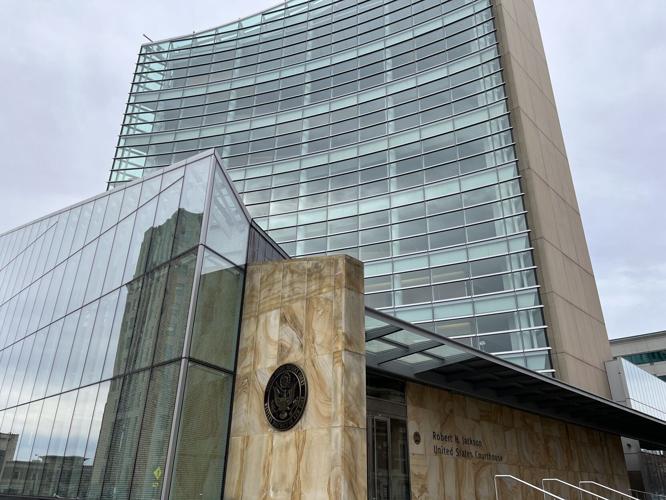
Only the jurors themselves know the degree of acrimony that flared in the jury room. They did not talk to reporters Friday as they left the Robert H. Jackson Federal Courthouse in Buffalo after being discharged from jury service after spending eight weeks on the case.
The jury foreperson announced the verdicts on the three counts the jury agreed on, and also said the jury could not reach a verdict on the other charges as they were read aloud in the courtroom. Afterward, Vilardo summoned each juror to come into the courtroom, one by one, and he asked each of them if they agreed to the three verdicts “free from coercion.”
Each of the 12 indicated they had done so.
Prosecution rests in Bongiovanni trial; defense puts his mother, wife on the stand
The first sign of jury discord surfaced on their third day of deliberations on April 5. A jury note on that day said there was a “general consensus” that a single juror was being “unduly” in relation to deliberations, but the wording in the message didn’t complete the phrase. Singer and fellow defense attorney Parker MacKay moved for a mistrial early last week, troubled by the reactions of several jurors when Vilardo read aloud that note in the courtroom.
Vilardo rejected their request for a mistrial after an oral argument about the “holdout” juror.
On Friday, Singer and Mackay said they inferred from that day’s juror notes that it was no longer just a sole juror standing in the way of a verdict favored by 11 other jurors.
“This was not an 11-to-1 thing,” Singer told The Buffalo News.
Singer said he believes there was “significant disagreement in that room over the substance of the main charges.”
Cash deposits seen as bribes by prosecutors called 'life raft' for accused ex-DEA agent
“This is a fantastic verdict,” Singer said.
Bongiovanni hugged his attorneys, family members and friends after the partial verdict, but did not comment to reporters when leaving the courthouse.
A federal grand jury had indicted Bongiovanni in 2019 on charges of accepting at least $250,000 in bribes from Serio, whose organization included Michael Masecchia, who, according to prosecutors, Bongiovanni thought was associated with Italian organized crime.
“After five years, all the jurors could agree on after hearing the government’s proof was that he took a DEA file home with him,” MacKay said.
Bongiovanni knew he was under investigation when he retired and did not trust his bosses or colleagues, so he took home the file because it provided information about cases he worked on, his lawyers said. If he wanted to destroy the file, he would have burned it. Bongiovanni wanted it to protect himself.
No one was looking at Bongiovanni. Then one investigator noticed Ron Serio starting to squirm
Prosecutors focused on the DEA file containing law enforcement sensitive documents that investigators found in a box in his basement. They showed the file to the jurors.
“That file didn’t magically teleport itself from the DEA office to his basement,” Tripi said. “He brought it. He took the file so nobody would know what he was really up to for those years.”
Prosecutors called the file a key piece of evidence that bolstered their case that Bongiovanni feigned investigations, misdirected colleagues and supervisors, and dissuaded other agencies from investigating Serio and Gerace.
Key witnesses against Bongiovanni include Gerace’s ex-wife, Katrina Nigro, who testified she twice gave Bongiovanni an envelope stuffed with cash at Pharaoh’s strip club, and Louis Selva, Bongiovanni’s longtime friend and best man at his wedding, who testified he persuaded Bongiovanni to accept $4,000-a-month payments in return for protecting him and others in the Serio drug trafficking operation.
The defense team countered that neither Selva or Serio testified to putting money into Bongiovanni’s hands. Masecchia, who was sentenced to prison in May 2022 on felony drug charges, did not testify in Bongiovanni’s trial. In Masecchia’s plea agreement, the former schoolteacher admitted getting law enforcement-sensitive information from Bongiovanni while trafficking more than a ton of marijuana into Buffalo and its suburbs over 20 years.
Gerace's ex-wife says she handed Bongiovanni envelopes full of cash at strip club
Nigro acknowledged she did not see what was inside the two envelopes she handed Bongiovanni. Even if the envelopes contained cash, she didn’t know the reason Gerace gave them to Bongiovanni.
Bongiovanni did not testify, but his wife and mother did.
The defense viewed the obstruction count and lying to a federal agency count the jury convicted him of as less serious than the bribery and drug charges Bongiovanni faced. Still, the obstruction of justice count for storing a working file of a DEA case at his home carries a maximum prison term of 20 years, although such a stiff sentence is considered unlikely. The count of making a false statement to an agency of the U.S. carries a maximum prison term of 8 years.
‘Prove to me he is innocent’
Friday’s first jury note came from the jury foreperson who said it had become “apparent we will not be able to reach a unanimous decision” on all the charges against Bongiovanni.
After that first note, Vilardo, over the objection of Bongiovanni’s defense lawyers, read the jury instructions known as an “Allen charge” – encouraging deadlocked jurors to make another effort to reach an unanimous decision.
He sent them back to the jury room to resume deliberations.
But not long afterward came the note from the individual juror who complained about being verbally attacked by other jurors.
The juror said comments from other jurors included, “You are thinking too much,” and “I knew he was guilty from day one.”
Another comment the juror said she heard was, “You have to prove to me he is innocent.”
Before the partial verdict was announced, Singer urged the judge to declare a mistrial on all of the charges, calling it the “only appropriate remedy.”
The Associated Press contributed to this report.

