




“Ohana” is Hawaiian for family.
As said in the popular Disney film “Lilo and Stitch,” “‘Ohana’ means family. Family means no one gets left behind or forgotten.”
Family could be blood-related or adoptive. For the Arizona Wildcats, “Ohana” is the roughly 100 players and dozens of staff members — and the strong ongoing Polynesian influence — that molds the UA football program.
The “Ohana” at Arizona has been the catalyst for the No. 21-ranked Wildcats’ expectations and Big 12 championship aspirations in the program’s first season in a new league under first-year head coach Brent Brennan.
The core of players who helped Arizona achieve its first 10-win campaign in nearly a decade and highest end-of-the-year ranking (11th) since 1998 had every chance to leave after their former leader Jedd Fisch became the head coach at Washington following three seasons in Tucson.
The magic behind Arizona’s historic season — the one that culminated in a win over Oklahoma in the Alamo Bowl — was in danger. The three-year rebuild from downtrodden team to a nationally relevant program was on the cusp of potentially collapse; the Wildcats faced two transfer portal periods, which gave a chance for supporters of other programs to wave their checkbooks and potentially poach Arizona’s star players.

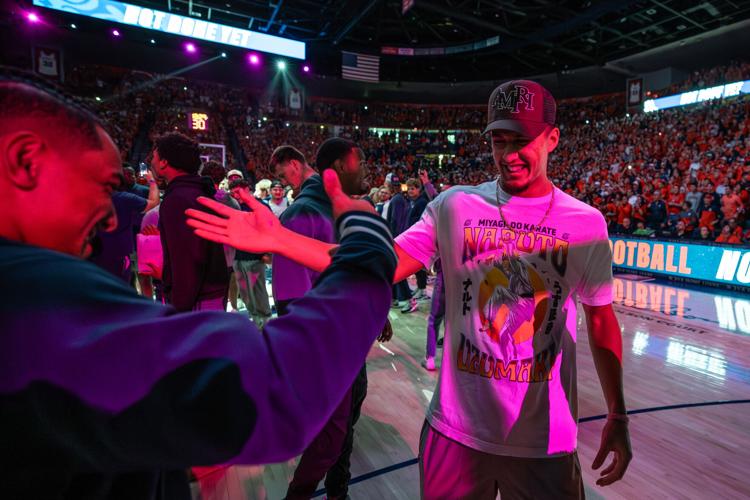
They’re staying: Arizona star quarterback Noah Fifita gestures to the crowd after a video featuring himself and teammate Tetairoa McMillan airs on the McKale Center video board during a Jan. 20 UA men’s basketball game.
Once Brennan was hired in January, he immediately spoke with the faces of the UA football program — quarterback Noah Fifita and wide receiver Tetairoa McMillan, two Polynesian players who became one of the top passing tandems in college football.
“It was a really great icebreaker for all of us to get to know each other. And I think Noah spearheading it was a huge part of that,” Brennan said.
Fifita and McMillan mulled things over and decided to stay and give Brennan and his staff a chance for the inaugural season of the program’s big 12 era. They unveiled their decision with a video on the McKale Center big screen. The video’s message: “loyalty, legacy, family, home” and “unfinished business,” during the first media timeout of a UA-UCLA men’s basketball game in front of a jam-packed McKale crowd.
Brennan, Fifita and McMillan — along with fellow Polynesian stars in linebacker Jacob Manu, offensive lineman Jonah Savaiinaea and several key returners — walked out together at the end of the video. In less than a minute on a Saturday afternoon at McKale Center, they injected hope into the veins of anxious Arizona football fans.

UA football standouts Tetairoa McMillan, right, and Noah Fifita, left, cemented their legacy as Wildcat legends when they appeared on the court at McKale Center on Jan. 20 to announce they’d be staying in Tucson.
“The fans around us didn’t even know who we were,” said Fifita’s father, Les, who attended the UA-UCLA basketball game for the announcement. “They went crazy and were hitting (Noah Fifita’s younger brother, Dash,) and I on the shoulders like, ‘That’s our quarterback and our receiver! Those are our guys and they’re coming back!’ It’s special to be a parent and see how much love you have from other people because they love your kid. Tucson has always been like that, and that’s part of the reason they wanted to stay.”
The Wildcats didn’t keep everyone, as a handful of players either followed Fisch to Washington or transferred somewhere else. But several months after the decision to stay at Arizona, echoed the early-year sentiment: “we’re happy where we’re at,” he said.
“It’s about the people in the building,” Arizona’s quarterback said. “We didn’t want to leave the locker room, and coach Brennan has proved that we made the right decision, staying here. He took a chance on us, we took a chance on him, and now we can follow him to get to where we want to be.”
In today’s name, image and likeness (NIL) era, it’s easy for a player to prioritize monetary opportunities, especially marketable high-profile athletes like McMillan and Fifita.
“We all knew Noah could’ve left,” said former Arizona quarterback George Malauulu, one of the top Polynesian quarterbacks in UA history. “Him and T-Mac could’ve been a package deal — a lucrative deal. Their roots in the Polynesian community and finishing off something that they started, knowing loyalty is one of the biggest attributes, it allows us to know that we’re in good hands.”
For McMillan, who’s expected to be a first-round pick in the 2025 NFL Draft, “money speaks loud but that’s only temporary happiness,” he said.
“Our relationships we built in the locker room in the last year, you can’t break that,” He added. “Coming here, we wanted to be program-changers and bring light back into Tucson. We wanted the city of Tucson to find pride in our play.”
Arizona offensive coordinator Dino Babers said the decision to stay highlights the “Ohana” at Arizona.
“People underestimate how important it is for them to not only come together, but lead together,” Babers said in the spring. “I understand there are distractions and temptations and stuff like that. But from everything that I’ve seen, it really looks like these guys enjoy playing with one another. ... The biggest thing that has jumped out to me is the camaraderie of the players on this football team and how they try to include and bring everyone into the family.”
Over the years as a player and coach, Babers experienced first-hand the Polynesian influence in football. Babers, who hails from a military background, was born in Honolulu and played running back and defensive back under former UA head coach Dick Tomey at Hawaii.
“They traditionally play with great spirit, they’re extremely loyal, they believe in family and believe in ‘Ohana,’ and they believe in doing things the right way,” Babers said. “And they’re tough and physical, which normally means if you’re a football player or rugby player, you have a chance if you have some of those qualities.”

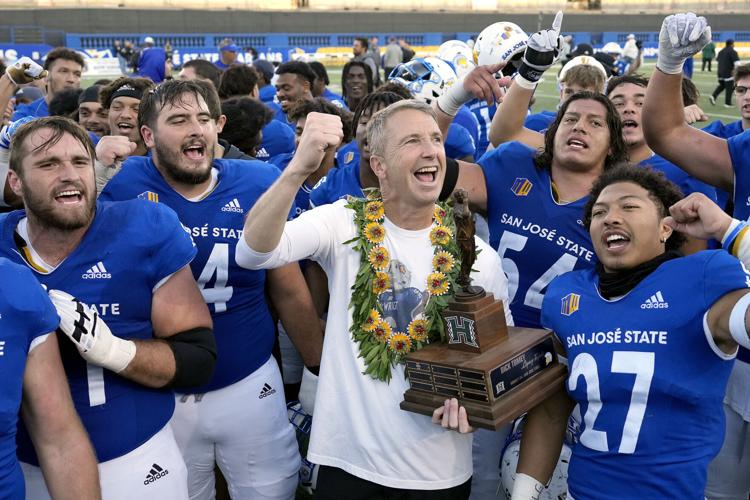
Then-San Jose State head coach Brent Brennan, center, holds the Dick Tomey Legacy trophy after defeating Hawaii 27-14 in 2022. Brennan was 26-19 over the last four years with the Spartans, with three bowl bids. Hawaii and SJSU are two of the three NCAA FBS programs once piloted by Tomey, who still remains Arizona’s all-time coaching wins leader.
Once Tomey was hired to replace Larry Smith, the last coach before Fisch to leave Arizona on their own terms, at the UA, making a concerted effort to bring Polynesian players to Tucson is something “Coach Tomey brought to Arizona from Hawaii.”
“He was one of the first guys to recruit American Samoa, Fiji, Tonga, all of those places, because of where they were at the University of Hawaii,” Brennan said. “When he came to Arizona, that obviously became a part of the team. It’s been awesome to see that culture’s impact on the game of football. It was a good fit for me, because we were building something similar at San Jose (State). That part was easy to lean into. ... That community has been such a huge part of my life. It’s also helpful for those players to be able to call someone they know play for us and have someone from that community say they trust me or our staff. In that community, that is incredibly powerful.”
It’s one thing to preach it. It’s another thing to practice it. And Tomey respected Polynesian traditions and family values, which was evident when he traveled for in-home visits with recruits. First order of business upon arrival: take off shoes and sit on the floor in the living room for small talk.
“In our customs, that is the utmost respect,” said Malauulu. “When you come into the house, you take off your shoes and show respect to the elders. Coach Tomey knew that coming in from Hawaii, and that’s why I think everyone gravitated towards him.”
Babers “saw (Tomey) bring the Hawaiian culture here to Tucson at the University of Arizona,” when he was an offensive assistant for the late UA coaching legend during the winningest stretch for the program. In the early 1990s, “that was the guts of the ‘Desert Swarm’ (defense),” said Arizona defensive coordinator Duane Akina, a Honolulu native and Tomey’s former right-hand man.
“It wasn’t some fancy-dancy defense,” Akina said. “It was a group of guys that were blue-collared, they loved each other and they played hard on all sides of the ball.”
Babers called the Polynesian movement in the late 1980s and 1990s “a huge feather in Tomey’s cap.”
“Now to see under Coach Brent that tradition of Polynesians having great success and enjoying their time in the Tucson community, I think it’s flattering. I think it’s impressive,” Babers said.
Since Tomey was fired over two decades ago, Arizona has attracted a plethora of players with Polynesian backgrounds, but it recently picked up under Fisch, especially in the last three recruiting cycles with recruits from Polynesian islands or Southern California. Brennan, who started his coaching journey as a graduate assistant under Tomey at Arizona in 2000, is maintaining the Polynesian pipeline.
“History repeats itself,” said Arizona left tackle Rhino Tapa’atoutai.
Arizona recently had seven players (including Fifita, McMillan, Manu and Savaiinaea) named to the Polynesian College Football Player of the Year preseason watch list, the most ever for the UA.
The Polynesian culture at Arizona “was a big reason why I chose here,” said senior defensive tackle Chubba Ma’ae, who transferred from UC Davis.
“That presence here helps build a family atmosphere. The Polynesian culture itself is very home-y and comforting. We love people and we love hard,” Ma’ae said. “Having Noah as one of our leaders, Jacob Manu, T-Mac, those guys showing that love is being reciprocated back.”
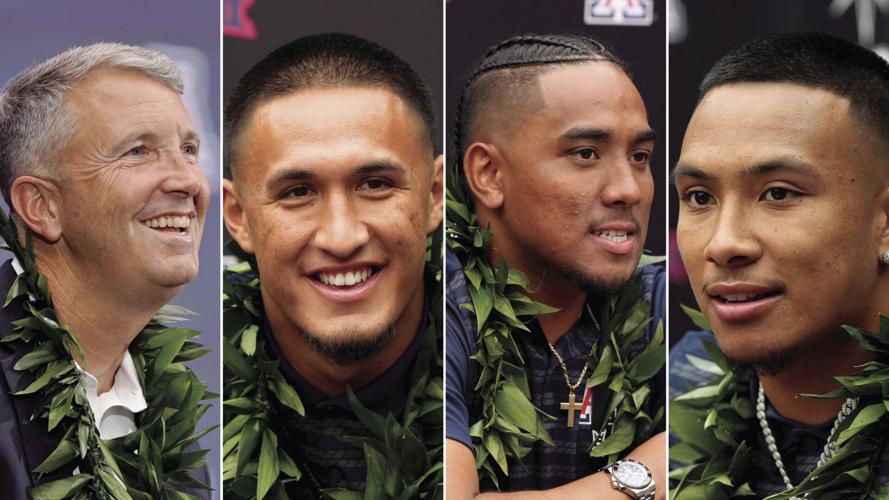
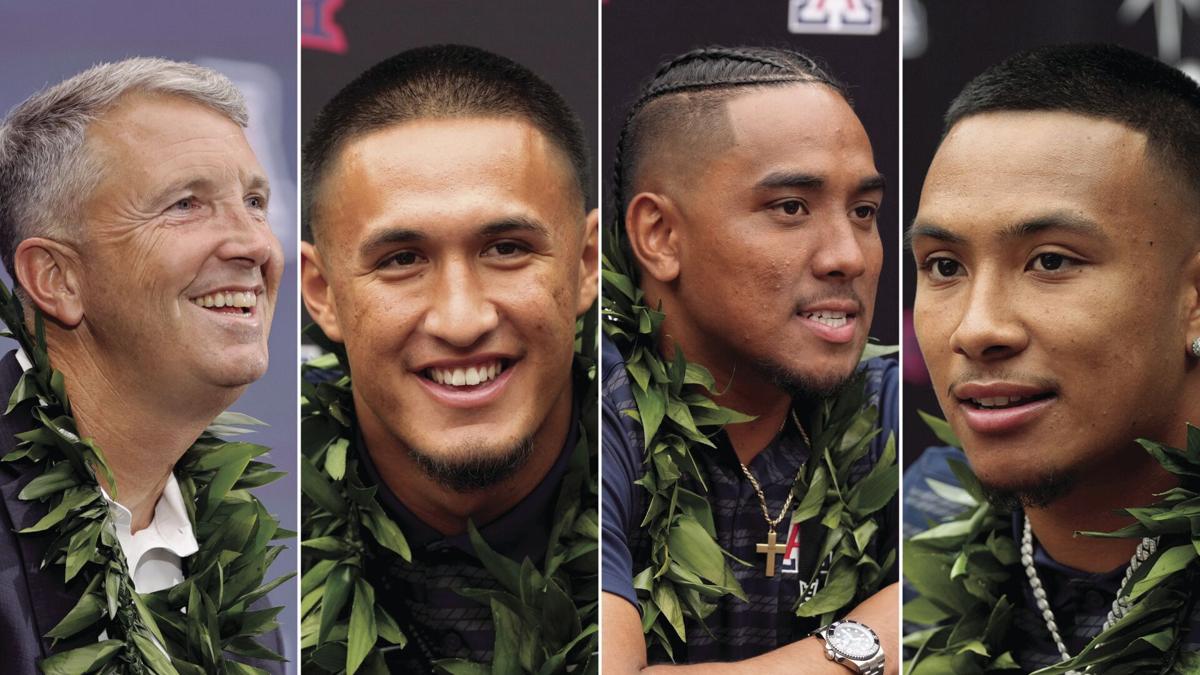
The Wildcats aren’t the only Big 12 program with a large contingent of Polynesian players. It’s been the backbone for Utah and BYU for several years. However, Arizona was the only team at Big 12 Media Days in Las Vegas with Polynesian accessories. Brennan, Fifita, McMillan, Manu and safety Gunner Maldonado each donned a double-stranded “maile-style” ti leaf lei “to bring a new spirit in the conference,” said McMillan’s mother, Shawny, who brought the lei necklaces in a cooler from Los Angeles to Las Vegas.
“It’s always an incredible honor when the mother of a Polynesian player gives you one of these. ... Everyone was excited to wear them,” Brennan said, adding that embracing Polynesian traditions and customs “will always be a part of (Arizona)” and “something I view as really, really important.
“I love how much they respect their parents, how much they respect each other, how much they respect their coaches,” the UA head coach added. “I think they add an incredible family component to the football program.”
The Polynesian impact is arguably more profound than it’s ever been at Arizona. The current rendition of UA football reminds Akina of “where we were,” when the Wildcats were considered one of the top football programs nationally.

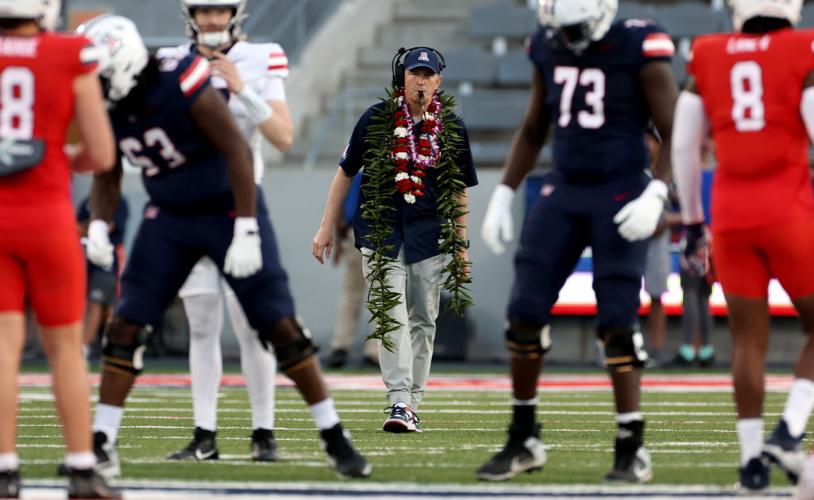
Arizona football coach Brent Brennan watches his team line up for a play during the Wildcats’ 2024 spring game on April 27 at Arizona Stadium.
“It’s really about family,” Akina said. “I know everyone says that, but what you’re going to know about the Polynesian culture is loyalty, togetherness, family and toughness. There’s no doubt that’s part of many cultures, but that’s what we are and it rubs off on everybody. ... It’s beautiful and I think that’s what really helped us this offseason in keeping many of our players here. In some circles, we couldn’t have matched the money out there. But what we can match is the true sense of family. Everyone always says that, ‘We’re a family.’ Really? Are you? Is the coach saying it or are the players feeling it? That’s the key.
“You’ll feel that with our guys, and they play like that. ... Beautiful to be a part of it, and the players are the ones who established it.”

